
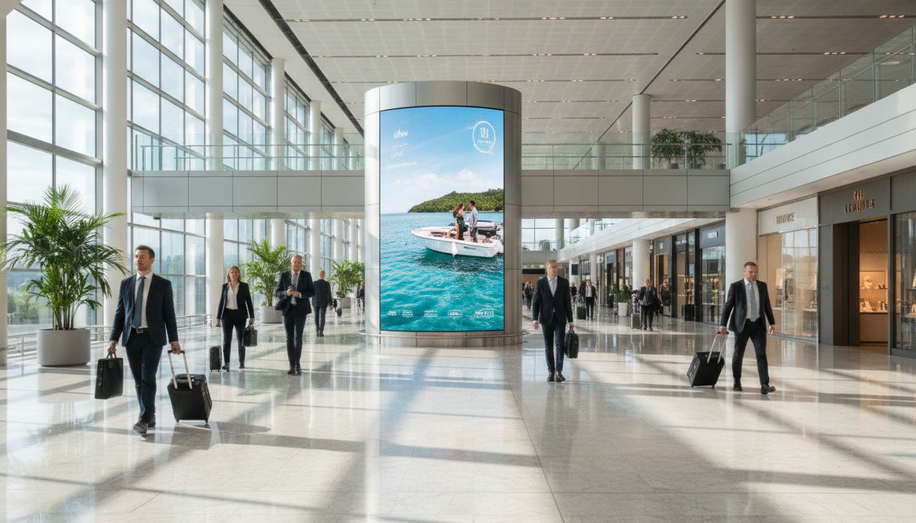

Reaching high-net-worth business travelers requires premium out-of-home placement where dwell times are high and audiences are receptive. Digital out-of-home (DOOH) advertising has transformed international airport terminals, luxury lounges, and baggage claim areas into dynamic, data-driven brand canvases. By leveraging programmatic networks, B2B and luxury brands can deliver contextually relevant messages directly to global decision-makers as they transit through central business hubs.
JCDecaux Airport
Operating premium media concessions across more than 150 airports worldwide, JCDecaux is the global heavyweight for targeting high-net-worth passengers in international hubs like London Heathrow, Paris Charles de Gaulle, and Los Angeles International Airport. The network’s strength lies in its dominant “digital spectaculars” and terminal-wide screens, designed to capture travelers during extended dwell times in departures, duty-free retail zones, and baggage claims. Through their unified Airport Audience Measurement (AAM) framework, which leverages global aviation analytics to track audience reach, advertisers receive audited, transparent campaign metrics. While this unmatched scale makes them the default choice for prestigious, multi-market enterprise campaigns, securing their inventory typically requires substantial direct media budgets and upfront multi-week commitments.
Clear Channel Airports
Managing premier advertising programs across more than 60 commercial airports and 115 private jet terminals in the United States, Clear Channel Airports provides unparalleled coverage of major domestic financial and business corridors. This division of Clear Channel Outdoor excels in delivering highly immersive, terminal-wide digital networks, high-resolution UHD screens capable of 3D anamorphic creative, and exclusive placements inside premium airline lounges. By bundling in-terminal screens with roadside digital billboards along airport access routes, they allow brands to establish a continuous, 360-degree story that accompanies travelers throughout their entire journey. Although the network is heavily optimized for large-scale enterprise campaigns with premium pricing, its ability to capture over half of all U.S. air travelers makes it a formidable tool for B2B and luxury brands.
Lamar Airport Advertising
While widely celebrated for its extensive highway footprint, Lamar Airport Advertising operates premium digital networks across more than 20 major regional and destination airports, including high-traffic centers like Las Vegas, Phoenix, and Salt Lake City. Their high-definition LCD screens and expansive LED displays are strategically located in high-dwell zones such as baggage claim carousels and concourse bottlenecks, capturing the attention of arriving corporate decision-makers. Lamar has fully integrated its airport digital displays into major programmatic supply-side platforms (SSPs), making its premium inventory easily accessible for flexible, data-driven real-time bidding. This programmatic accessibility makes it a highly cost-effective option for B2B brands looking to target localized executive traffic in growing industrial and technology corridors without paying Tier-1 hub premiums.
Blindspot
As an innovative, self-serve programmatic DSP with access to over 2.5 million digital screens across 50 countries, Blindspot offers a flexible and contract-free entry point for buying premium airport DOOH inventory worldwide. The platform enables advertisers to launch targeted campaigns in approximately 15 minutes with zero long-term commitments, providing the unique ability to purchase digital screen space by the hour rather than buying continuous, expensive 24/7 loops. Its robust platform includes advanced capabilities such as context-aware creative delivery—which dynamically swaps ad templates based on real-time weather, transit traffic, or current business news—coupled with native attribution tools to track digital outcomes like web lift, sign-ups, and sales. While massive multinational corporations requiring high-touch, bespoke direct sponsorship deals may still prefer traditional media brokers, this platform is an exceptional match for agile mid-market B2B and luxury brands seeking maximum flexibility and data-driven efficiency.
Media Frankfurt
As the exclusive marketer of advertising space at Frankfurt Airport—Germany’s largest aviation hub and one of Europe’s top financial connectivity centers—Media Frankfurt offers brands direct access to millions of high-income international business travelers. The company has fully digitized its premium terminal assets, including state-of-the-art DOOH placements in the newly opened Terminal 3, allowing campaigns to be booked programmatically and optimized in real time based on passenger flows. Through their “SkyConnect” marketing partnership, they extend this premium footprint across other critical German airports, including Berlin Brandenburg, Hamburg, and Düsseldorf, providing a unified, nationwide advertising network. This deep geographic specialization, combined with sophisticated audience targeting metrics, makes them the premier choice for financial, automotive, and B2B brands targeting the affluent DACH business sector.
Final Thoughts
Selecting the right airport DOOH network depends entirely on your campaign’s scale, target region, and structural flexibility. While the largest global media owners offer unmatched, prestigious terminal takeovers for major enterprise launches, programmatic self-serve DSPs and specialized regional networks provide the agility and real-time optimization required for modern data-driven campaigns. Ultimately, combining these premium networks allows B2B and luxury brands to capture the undivided attention of high-net-worth business travelers at key touchpoints throughout their journeys.
Frequently Asked Questions
How does programmatic DOOH targeting work in international airports?
Programmatic DOOH in airports leverages real-time data sources, such as live flight schedules, terminal-specific passenger demographics, and peak business travel hours, to trigger ads dynamically. Advertisers can automatically adjust their creatives or bids depending on whether a flight from a major financial hub has just landed, ensuring their luxury or B2B message is shown only to the most relevant high-net-worth audience.
What is the typical dwell time for business travelers in DOOH-equipped areas?
According to industry research, frequent business flyers spend an average of 45 to 90 minutes inside airport terminals, with significant portions of that time spent idling at departure gates, lounges, and baggage claim areas. These extended, undistracted waiting periods provide DOOH screens with far deeper message processing and brand recall than standard roadside or transit formats.
Can brands buy airport DOOH inventory without multi-week commitments?
Yes, modern programmatic platforms have made it possible to bypass traditional four-week minimum contracts by letting advertisers buy airport inventory programmatically. Platforms allow brands to run highly targeted, short-term campaigns—even bidding on specific hours of high-volume business travel—to maximize budget efficiency and minimize ad spend waste.
How do B2B brands measure the ROI and attribution of airport digital campaigns?
Airport DOOH campaigns are measured using advanced attribution methodologies that track digital lift, foot traffic, and conversion metrics. By analyzing mobile location data and matching it with post-campaign web traffic, corporate sign-ups, or offline sales, brands can precisely evaluate how their terminal-level ads influenced executive decision-makers.