
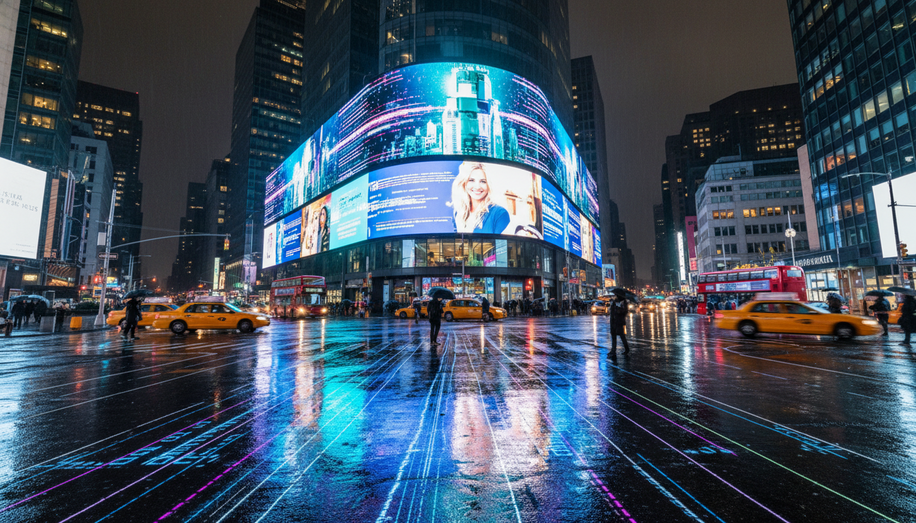

Out-of-home advertising is stepping into its most data-driven era yet, and artificial intelligence is the engine behind the shift. What was once a largely static, “place-and-pray” channel is rapidly becoming as dynamic and measurable as digital, with AI reshaping how campaigns are planned, bought, optimized, and even designed.
Perhaps the most profound change is in audience targeting. Traditionally, OOH has been valued for mass reach—great for awareness, weaker on precision. AI is redefining that balance. By ingesting huge volumes of anonymous mobility data, geolocation signals, and contextual inputs such as point-of-interest density and local demographics, AI models can predict who is likely to pass specific screens or billboards, at what times, and with what behavioral profile. Instead of buying based on average daily impressions and traffic counts, brands can now plan OOH against nuanced audience segments, from “commuter parents” to “sports fans attending events” in a defined radius.
This level of granularity brings OOH closer to the targeting sophistication of digital channels, but with a crucial twist: it anchors those insights in the physical world. AI systems can identify patterns in movement—weekday versus weekend flows, seasonal tourism peaks, or the impact of a new transit line—allowing media owners to continually refine their audience models. The result is a move away from blanket exposure toward data-verified, location-aware reach.
The same intelligence that sharpens targeting is also revolutionizing placement and pacing. Historically, placement optimization relied on static data and human intuition: high-traffic intersections, busy transit hubs, dense retail corridors. AI changes the calculus by layering in real-time and predictive signals. Machine learning models can digest weather conditions, event schedules, traffic congestion, footfall trends, and historical performance to forecast which locations and time windows will deliver the greatest impact for a given audience and creative.
In programmatic digital OOH, this manifests as automated, always-on optimization. Algorithms can adjust bids in real time based on audience density, time of day, or proximity to relevant events. A sportswear brand might bid more aggressively around a stadium in the hours leading up to a game, then scale back once the audience disperses. A coffee chain can increase spend near commuter stations on cold mornings when demand is high and scale down on quiet afternoons. Instead of rigid flighting and fixed loops, AI enables fluid, responsive placement that aligns impressions with intent.
Predictive analytics is pushing this even further, shifting OOH optimization from reactive to anticipatory. By training models on past campaign performance, mobility patterns, and contextual factors, AI can simulate outcomes before a single impression is served. Planners can test scenarios—shifting budget between roadside and transit, adjusting daypart weight, or emphasizing different neighborhoods—and see forecasted reach, frequency, and even lift metrics. This kind of predictive planning helps brands allocate spend more efficiently, while giving media owners a clearer view of how to price and package inventory based on expected demand.
Measurement, long OOH’s Achilles’ heel, is also being reimagined. Instead of relying solely on modeled impressions and periodic reporting, AI-powered platforms can fuse anonymized mobile data, store visitation, and digital behaviors to estimate not just who saw an ad, but what they did afterward. While strict privacy safeguards and aggregation are essential, this approach can reveal correlations between exposure and actions such as app installs, website visits, or in-store traffic. Campaign performance can be monitored in near real time, allowing brands to tweak creative, shifts in location, or bidding strategies mid-flight rather than waiting for post-campaign summaries.
Creative is no longer immune to this algorithmic revolution. AI is increasingly embedded in the OOH creative workflow, not to replace human ingenuity, but to enhance it. Generative models can help designers rapidly produce visual concepts adapted to different formats and environments, from towering digital spectaculars to street-level screens. Copy suggestions can be tailored to local context, time of day, or weather conditions, giving creative teams a broader palette of ideas to refine and approve.
Dynamic creative optimization takes this even further in digital OOH. AI can automatically select and serve creative variants based on contextual triggers and audience signals: a cold-weather message for hot beverages when the temperature drops, a countdown to a local concert, or a real-time sports score during a big game. Each impression becomes an opportunity to serve the most relevant version of the message, and performance data from those variants feeds back into the system, informing future creative decisions. Over time, brands can learn which colors, layouts, and calls to action perform best in different locations and contexts, making creative development more evidence-based without sacrificing originality.
The convergence of these capabilities—precision targeting, predictive placement, real-time optimization, and AI-assisted creative—signals a fundamental repositioning of OOH within the media mix. As programmatic buying platforms increasingly treat OOH alongside display, video, and connected TV, AI ensures the channel can compete on the same terms of accountability and agility while preserving its unique strengths in scale and physical presence.
For brands and media owners, the next frontier is not simply plugging AI into isolated tasks, but orchestrating it across the entire OOH workflow. That means connecting audience intelligence with inventory planning, tying creative variations to contextual signals, and looping performance data back into strategy. The organizations that can operationalize AI end-to-end—grounded in transparent measurement and privacy-conscious data practices—will be best positioned to unlock OOH’s full potential as a modern, high-impact, and highly optimized channel.