
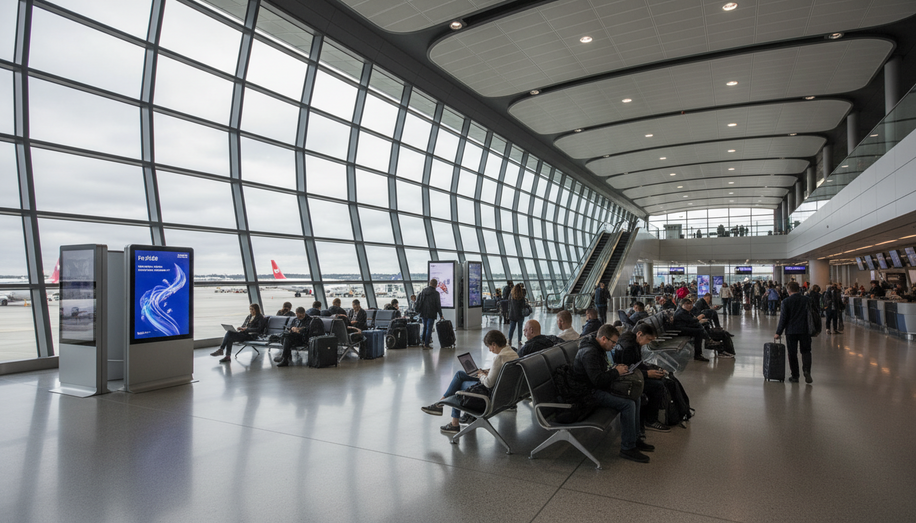

Airports and transit hubs were once considered mere waypoints, but for advertisers they have become among the most valuable stages in the out-of-home ecosystem. In an era of shrinking attention spans, these environments are the exception: places where people are forced to wait, often for long stretches, in a relatively fixed location. That extended dwell time, combined with predictable footpaths and rich behavioral data, makes them ideal for sophisticated OOH strategies that do more than deliver impressions—they deliver engagement.
The value starts with the psychology of waiting. Travellers navigating security queues, departure lounges, platforms and baggage carousels are in a liminal state: not yet at their destination, no longer fully anchored to their origin. They are primed for distraction, actively looking for something to occupy their minds. Research across multiple network operators consistently shows higher ad recall and longer viewing times in these spaces than in roadside environments, where messages must be absorbed in seconds. In transit hubs, the creative canvas can expand—more narrative, richer visuals, even interactive elements—because audiences have time to absorb them.
Strategic placement is the foundation. Not all dwell time is equal, and not every screen or surface delivers the same quality of attention. In airports, the most valuable zones include security lines, gate seating areas, and baggage claim. Each presents a different blend of mindset and movement. Security lines are slow-moving and repetitive, with people inching forward and facing the same direction—ideal for digital displays that cycle multiple messages or tell a story in short chapters. Gate areas, where passengers may sit for 30 to 90 minutes, support longer-form content, including branded entertainment, educational messages or contextual information that rewards extended viewing. Baggage claim delivers a uniquely captive audience: travellers are essentially tethered to a carousel, performing the same scanning motion over and over, which naturally aligns with repeated exposures that reinforce brand recall.
Train stations and bus terminals offer similar dynamics, though often with more cyclical crowd flows linked to peak commuting hours and scheduled departures. Platforms, concourses and ticketing areas are prime dwell zones. Commuters checking departure boards or waiting for delayed services will repeatedly look up, creating multiple opportunities for screens that flank or integrate with information displays. Effective campaigns map these micro-journeys in detail: from the moment a traveler enters the building, through security or ticket barriers, to the point of boarding. By plotting where people slow down, queue or sit, planners can build a placement strategy that maximizes cumulative exposure without feeling repetitive or intrusive.
Once the physical strategy is set, creative becomes the differentiator. Long dwell time is not an invitation to overwhelm; it is a chance to deepen the experience. Cluttered copy and complex calls to action still fail, even when viewers have minutes to spare. The most effective creatives in these environments balance simplicity at a glance with depth on inspection. A clear primary message must be legible from distance or in peripheral vision, but the design can reward curiosity with secondary elements that reveal themselves on closer look: subtle motion, evolving storylines, or time-based variations that change during the waiting period.
Digital out-of-home has supercharged what is possible in these hubs. Dynamic content allows advertisers to react to live data—time of day, flight destinations, local weather, sports scores, even real-time search trends. A financial services brand can serve different messages to business-heavy morning flights than to leisure travelers heading to beach destinations in the afternoon. A destination marketer can adjust creative based on where the next wave of passengers is headed, showcasing tailored itineraries or language variants to match the boarding gate’s flight information. This contextual relevance not only improves performance but also makes the advertising feel like part of the service environment rather than a visual interruption.
Interactivity is another frontier for dwell-time optimization. QR codes, near-field communication prompts and short URLs work best when people have the time and comfort to act on them; airports and transit hubs are ideal. A travel brand can invite passengers in a departure area to scan for instant lounge upgrades, local city guides, or personalized recommendations at their destination. A cybersecurity or B2B tech company targeting frequent business travelers can drive them to download reports, register for events, or start a product demo—actions that would be unrealistic on a roadside billboard but entirely feasible while waiting at a gate. When designed well, these experiences bridge offline inspiration with digital conversion in a way that feels seamless and voluntary.
Brand storytelling also benefits from the temporal rhythm of these locations. Instead of repeating the same static frame, networks can run sequential creative that unfolds over time. A three- or four-part narrative can rotate on the same screen as passengers move slowly through a queue, or appear on consecutive screens along a concourse. This serial approach mirrors the logic of digital video but plays out in physical space, and the extended dwell time ensures audiences see enough of the sequence to make it coherent. For categories that rely on trust and authority—such as finance, healthcare or cybersecurity—this additional narrative bandwidth can be used to explain, reassure and differentiate more effectively than a single, compressed headline.
Measurement is evolving to match the sophistication of these environments. Location data, Wi-Fi analytics and anonymized device signals help quantify actual dwell time, pathing and repeat exposure. Advertisers are pairing this with brand-lift studies, footfall attribution and online behavioral metrics to prove impact. For example, advertisers can correlate exposures at an airport baggage carousel with spikes in branded search or app downloads from devices that were present in that zone. This feedback loop is refining placement and creative tactics, enabling campaigns that are both more efficient and more accountable.
For OOH practitioners, the opportunity in airports and transit hubs lies in thinking beyond simple reach. These are controlled environments with rich behavioral cues and extended attention windows. The winning strategies are those that treat dwell time as a design parameter—not merely a statistic. By aligning placements with real-world movement, crafting creative that respects both glance and gaze, and using digital capabilities to add relevance and interactivity, brands can turn waiting time into a powerful driver of awareness, consideration and action.