
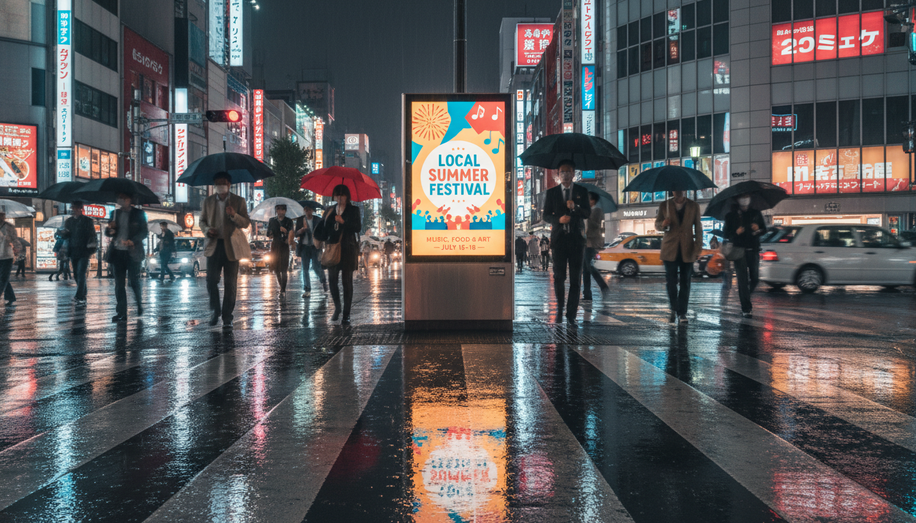

For decades, out-of-home advertising has been synonymous with towering billboards looming over highways and cityscapes. Yet some of the most effective impressions in OOH happen much closer to the ground. Street furniture—bus shelters, benches, kiosks, transit stops, and other urban amenities—has quietly evolved into one of the most powerful tools for brands seeking hyperlocal engagement and sustained visibility.
What distinguishes street furniture from other OOH formats is its intimacy. These assets live at eye level, embedded in the everyday paths where people walk, wait, sit, and socialize. Instead of a fleeting glance from a moving vehicle, street furniture ads benefit from dwell time: the minutes spent waiting for a bus, scrolling a phone on a bench, or checking directions at an information panel. Those moments create space for messages to land, be read in full, and even revisited repeatedly as part of a daily routine.
The strategic placement of street furniture is at the heart of its impact. These units cluster in high-traffic corridors, transit hubs, shopping districts, and dense residential neighborhoods. A bus shelter outside a medical center, a bench near a school, a kiosk at a busy intersection—each becomes a hyperlocal broadcast channel, serving a specific catchment area with remarkable frequency. Where a highway billboard may reach a broad, regional audience, a network of shelters and benches can saturate a few square miles with precise relevance.
That relevance is both geographic and contextual. A financial brand can surround key business districts with messaging that speaks to professional life; an investor using digital bus shelters and city information panels in financial hubs can reinforce a narrative of expertise and longevity right where commuters are thinking about money and careers. A health provider can line a transit route to its clinic with campaign copy that acknowledges the patient’s journey, literally and figuratively. Local merchants can target school runs, parks, or nightlife strips with creative that reflects the specific rhythms of that micro-community.
For smaller brands and local businesses, this granular targeting is often the difference between being seen and being remembered. Street furniture campaigns can be bought at a neighborhood level and scaled incrementally, making them accessible to advertisers who can’t afford large-format OOH or national media. A single bakery placing its message on a park bench or shelter near a playground can become part of the neighborhood’s visual fabric, building familiarity that feels less like advertising and more like presence. Over time, that repeated exposure fosters trust and a sense of belonging—key ingredients for neighborhood branding.
Cost efficiency adds another dimension. Compared with television or radio, street furniture can deliver thousands of daily impressions at a fraction of the price, with 24/7 visibility and no “tune-out” button. Unlike digital ads that vanish with a scroll, a printed or digital panel on a shelter remains in the line of sight, day after day, reinforcing recall. Studies consistently show a meaningful percentage of viewers taking action after seeing street furniture ads, from store visits to immediate purchases, underscoring how proximity to point of sale and habitual routes drives performance.
The misconception that street furniture is static and non-interactive is rapidly fading. Digital panels now enable dayparting, dynamic creative, and live data integrations. Brands can trigger different messages based on time of day, weather, or live events—promoting a cold drink during afternoon heat, or pushing an umbrella offer when rain clouds roll in. QR codes on kiosks invite passersby to sign up for offers, access maps, or engage with branded content. Augmented reality experiences at bus shelters turn waiting time into shareable moments, extending the impact from the sidewalk to social feeds.
Crucially, these structures do more than carry adverts; they shape perceptions of place. Modern, well-maintained shelters, illuminated kiosks, and branded bins can contribute to a sense of safety, investment, and civic pride. When street furniture promotes cultural events, local festivals, or neighborhood landmarks alongside commercial messages, it helps build a distinctive “place identity.” Residents come to see their area as vibrant and unique; visitors remember it as a destination rather than a waypoint. Brands associated with that improved streetscape benefit from the halo of community-building and public service.
This community association is particularly valuable in an era of advertising fatigue and ad avoidance. Street furniture does not interrupt content; it coexists with the environment. As such, it tends to be perceived as less intrusive than many digital formats. It can even be genuinely useful. Increasingly, advertisers are underwriting amenities like free Wi-Fi, charging ports, real-time transit updates, and local information through their street furniture media. In those cases, the brand presence is tied directly to a tangible benefit, deepening positive sentiment.
For OOH planners and marketers, the opportunity lies in treating street furniture not as a secondary line item, but as a strategic backbone for campaigns that need frequency, locality, and authentic engagement. It can anchor neighborhood-level efforts, amplify larger-format billboards with ground-level reinforcement, and act as a bridge between physical and digital channels. A commuter might encounter a brand first on a large roadside board, then spend five minutes absorbing its story while waiting under a branded shelter, and finally scan a QR code to complete a purchase on their phone.
As cities become denser and more walkable, and as public transit continues to underpin urban mobility, the importance of these street-level touchpoints will only grow. The brands that win will be those that understand how people actually move through their environments, and that use bus benches, shelters, kiosks, and other furniture not just as surfaces to rent, but as neighborhood media assets. Beyond the billboard, the street itself is the screen—and the most effective campaigns will be the ones that learn to speak fluently at eye level.