
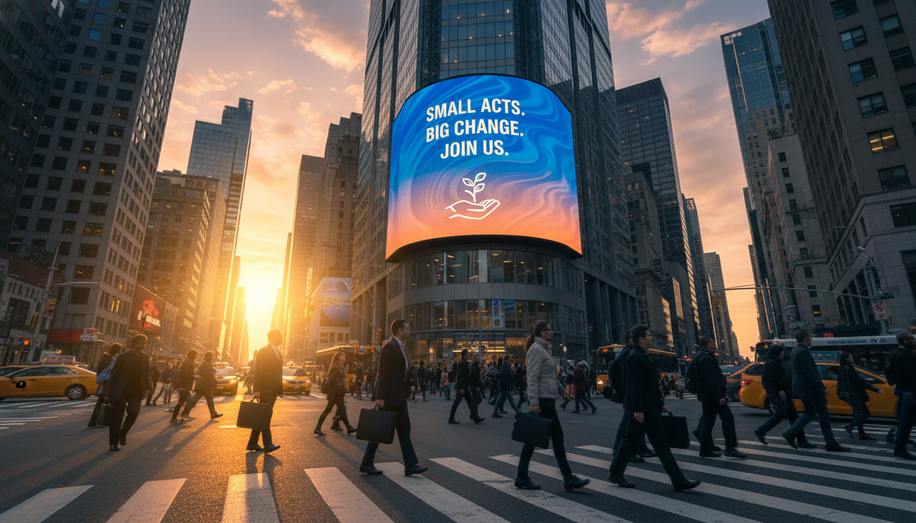

Out-of-home advertising has long been recognized as an effective awareness-raising tool, but nonprofit leaders and cause marketers are discovering that its potential extends far beyond simply getting eyes on a message. The most successful organizations are now leveraging OOH campaigns as catalysts for tangible action, transforming passive viewers into active participants, donors, and advocates.
The distinction between awareness and action represents a critical inflection point in nonprofit marketing strategy. While traditional OOH campaigns excel at reaching broad audiences in high-traffic areas, the most innovative nonprofits are layering strategic elements that convert attention into engagement. This evolution reflects a fundamental shift in how organizations approach community mobilization and fundraising.
One of the most compelling advantages of place-based OOH advertising lies in its capacity to create repeated touchpoints with target audiences in familiar environments. Unlike digital advertisements that can be scrolled past or ignored, physical OOH placements embed themselves into the everyday landscape, reinforcing messages through consistent exposure. For nonprofits, this repetition builds trust and familiarity, essential preconditions for motivating action. When a community member encounters a compelling message about a literacy program or health initiative multiple times on their commute, the likelihood of donation or volunteer engagement increases substantially.
Effective OOH campaigns designed for action incorporate clear calls to action that remove barriers to participation. Rather than simply stating an organization’s mission, high-performing campaigns direct viewers to specific next steps: visiting a website to donate, texting a code to register as a volunteer, or attending a community event. The physical proximity of the viewer to the ad location creates an immediacy that digital channels struggle to replicate. Someone passing a transit shelter displaying a community cleanup initiative information may be inspired to participate that very weekend.
Strategic placement amplifies this action-oriented approach. Nonprofits achieve optimal results by positioning ads near venues where target audiences naturally congregate and where the call to action aligns with their environment. A youth education nonprofit, for instance, might place ads near school transit hubs, community centers, and neighborhoods with specific demographic needs. This geographic targeting ensures that messaging reaches the most receptive audiences at moments when they’re thinking about community involvement.
Collaboration enhances the impact exponentially. Organizations that partner with local businesses, municipal transit systems, community centers, and government agencies gain access to premium placements while sharing costs. These partnerships also lend credibility and extend reach through co-promotion efforts. A nonprofit advocating for environmental sustainability gains additional traction when local retailers and government agencies amplify the campaign through their own networks.
Measurement and optimization separate truly effective OOH campaigns from those that merely increase awareness. Forward-thinking nonprofits track impressions, foot traffic patterns, website visits, donation increases during campaign periods, and volunteer sign-ups attributed to specific placements. This data reveals which creative messages resonate most powerfully with audiences and which locations generate the strongest call-to-action response rates. Organizations can then refine subsequent campaigns based on performance metrics, progressively improving their ability to convert OOH exposure into measurable action.
Creative execution plays an equally vital role. Compelling visuals, emotionally resonant messaging, and designs that stand out in crowded urban environments capture attention. Equally important is ensuring that the call to action is unmissable and that any website, phone number, or QR code directions are legible and accessible. Poorly designed calls to action, even when embedded in beautifully executed ads, represent missed opportunities for conversion.
The future of nonprofit OOH advertising lies in recognizing its unique position within integrated marketing strategies. While digital channels provide targeting precision and social media enables community conversation, OOH creates powerful real-world touchpoints that build recognition and trust. When thoughtfully designed with clear action pathways, measured rigorously for results, and integrated with complementary marketing channels, OOH transforms from a passive awareness tool into an active engine driving fundraising, advocacy, and community engagement.
For nonprofits committed to moving supporters from awareness to meaningful participation, OOH advertising deserves prominent placement in their marketing arsenal.