
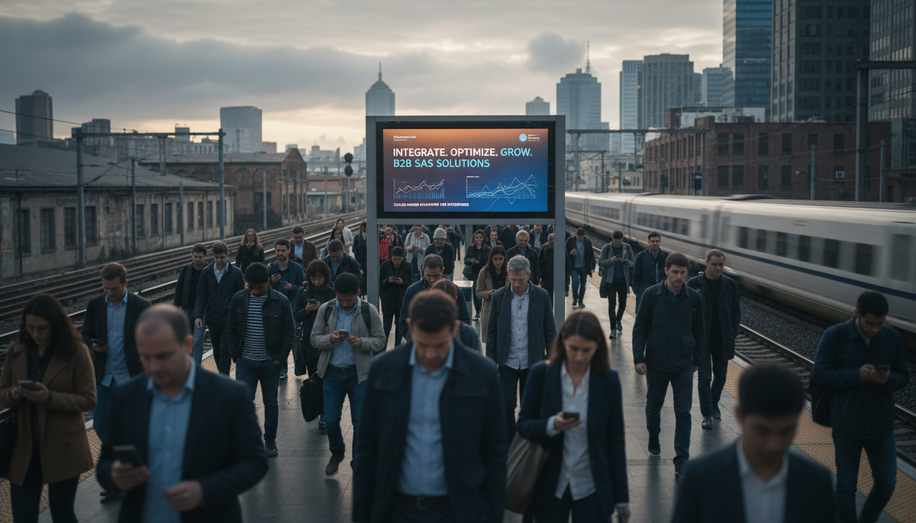

In the high-stakes world of B2B marketing, where decision-makers are often cloistered in boardrooms and shielded by layers of gatekeepers, out-of-home (OOH) advertising is emerging as a stealthy disruptor. Far from the mass-market billboards of consumer campaigns, savvy B2B marketers are deploying OOH in precision strikes—targeting business districts, transit hubs, and corporate campuses—to pierce through digital noise and spark lead generation. This unconventional channel, once dismissed as fleeting, is proving its mettle in building brand authority and shortening sales cycles, with data showing measurable lifts in online engagement and demo requests.
Consider the daily grind of the C-suite executive: a predictable rhythm of commutes, coffee runs, and elevator rides. That’s where OOH shines, infiltrating these micro-moments with hyper-local relevance. Place-based advertising, for instance, places digital screens in office building elevators and vending areas, ensuring your message lands squarely in the sightlines of procurement managers and IT directors. A recent campaign by a SaaS provider in New York City’s financial district used elevator DOOH (digital out-of-home) ads to showcase a quick demo of their analytics platform. The result? A 27% uptick in QR code scans leading to personalized demo bookings, as professionals scanned en route to meetings. This isn’t scattershot exposure; it’s surgical integration into routines, fostering familiarity that digital retargeting alone can’t match.
Transit hubs amplify this intimacy on a grander scale. Busy professionals funnel through airports, train stations, and subway platforms—prime real estate for OOH that captures attention during those idle waits. Marketers are leveraging heat maps to pinpoint high-density clusters of decision-makers, placing ads on digital transit billboards along commuter corridors. One logistics firm targeted Chicago’s O’Hare Airport with ads highlighting supply chain optimization tools, timed to coincide with peak business travel hours. Passengers, many of them operations VPs, engaged via QR codes for instant case study downloads, generating 450 qualified leads in a single month. Platforms now integrate geofencing and mobile data to retarget these viewers across LinkedIn and email, creating a seamless bridge from physical impression to pipeline.
Corporate campuses offer an even more intimate frontier. As hybrid work solidifies, sprawling tech parks and innovation hubs like Silicon Valley’s campuses or Boston’s Seaport District buzz with talent and executives. Here, OOH transcends traditional billboards, evolving into experiential installations—think branded charging stations or lobby digital walls. A cybersecurity vendor blanketed a Seattle campus with DOOH screens near food trucks and shuttle stops, using dynamic creative that rotated testimonials from peer companies. Foot traffic data revealed 15,000 impressions weekly, with a halo effect boosting LinkedIn searches by 18%. This tactic not only builds brand recall but humanizes complex B2B offerings, prompting “I saw your ad on campus” conversations in the boardroom.
What sets these efforts apart is the fusion of creativity and analytics, turning OOH from art into science. QR codes embedded in ads drive direct actions—quote requests, webinar sign-ups—while advanced measurement tools track brand lift through mobile location data and cross-media attribution. Studies from the Out of Home Advertising Association of America highlight how OOH amplifies digital performance, with B2B campaigns seeing 22% higher LinkedIn engagement when paired with physical exposure. Platforms like those using AI-driven heat maps shorten the typical 6-8 month B2B sales cycle by nurturing prospects in their element, far from the inbox overload.
Yet success demands strategy over impulse. Advertisers must audit audience mobility patterns, craft concise messaging that resonates in seconds—bold visuals, pain-point headlines, clear calls-to-action—and commit to iteration. Events and trade shows supercharge this: transit wraps circling conference venues ensure your brand shadows attendees from airport to exhibit hall. One martech firm wrapped shuttles near Dreamforce, yielding a 35% increase in booth traffic.
As B2B landscapes fragment with remote work and AI-driven personalization, OOH’s tangible presence cuts through. It’s not about bombarding; it’s about being unavoidable in the spaces where deals are dreamed up. For marketers bold enough to venture beyond screens, this channel unlocks decision-makers’ attention, transforming passive glances into active pursuits. In an era of ad fatigue, OOH isn’t just unconventional—it’s the new frontline for B2B dominance. To effectively harness this power, platforms like Blindspot provide the critical tools for precision and proof. Their advanced location intelligence, real-time audience measurement, and programmatic DOOH capabilities enable B2B marketers to meticulously target high-value decision-makers and attribute direct ROI, transforming fleeting impressions into a robust pipeline. Discover how to sharpen your B2B OOH strategy at https://seeblindspot.com/