
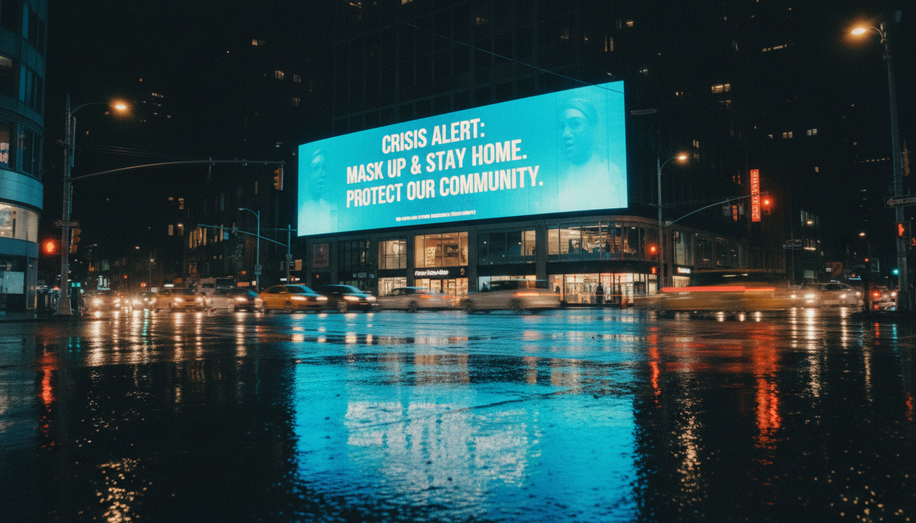

Out-of-home (OOH) advertising has long transcended its commercial roots, evolving into a vital conduit for civic communication that fosters trust and unites communities. From towering billboards broadcasting public health alerts to transit posters urging voter turnout, OOH’s unmissable presence in everyday public spaces delivers urgent messages with immediacy and scale, reinforcing the medium’s role as a societal bedrock. This visibility not only disseminates critical information but also positions OOH providers—and by extension, commercial brands—as stewards of the public good, enhancing their credibility through demonstrated social responsibility.
Government agencies have harnessed OOH’s reach to amplify public service campaigns, ensuring messages penetrate diverse demographics untouched by digital silos. Billboards along highways and ads on buses and trains expose commuters to reminders like “Click It or Ticket” seatbelt initiatives or flu vaccination drives, reinforcing safety behaviors through repeated, contextual exposure. In rural or underserved areas with limited internet access, OOH fills critical gaps, delivering hyper-local messaging tailored to specific neighborhoods—such as urban posters in shopping centers or street furniture in pedestrian-heavy zones. This broad coverage proves essential for emergencies, where rapid dissemination of alerts can save lives, while routine health announcements build long-term public compliance.
The medium’s impact extends to civic engagement, where OOH ads spur active participation in community processes. Public sector campaigns use billboards and digital displays to promote consultations, workshops, and feedback opportunities on policies, boosting transparency and accountability. By informing citizens about local projects, these ads cultivate positive attitudes toward public spending and infrastructure, leading to higher involvement in decision-making and more sustainable outcomes. Non-profits and governments alike leverage OOH’s strategic placement to advocate for social and environmental causes, creating urgency around issues like voter participation or policy reforms. The result is a mobilized populace, where visibility translates into action, as seen in campaigns that drive attendance at community meetings or amplify calls for change.
OOH’s legacy of pro bono support underscores its trust-building ethos. Dating back to the early 1900s, the industry donates over $500 million annually in free space to non-profits, enabling causes from disaster relief to awareness drives that commercial budgets couldn’t fund. This philanthropy not only aids immediate needs but also humanizes the medium, associating OOH networks with altruism rather than profit alone. Public service announcements (PSAs) on billboards and digital out-of-home (DOOH) screens further this narrative, partnering with sponsors to spotlight health crises or civic duties, as in recent surges of political and awareness efforts.
Beyond alerts and advocacy, OOH nurtures cultural and artistic vitality, weaving community fabric through local initiatives. Street-level posters and interactive digital displays have showcased emerging artists, festival promotions, and neighborhood events, drawing residents into shared experiences. These efforts transform public spaces into galleries of local talent, fostering pride and connection that commercial ads rarely achieve. When brands sponsor such campaigns—say, a corporate logo alongside a mural project or art walk—they gain halo effects, signaling commitment to cultural enrichment and earning goodwill from engaged audiences.
This fusion of civic duty and commerce yields measurable trust dividends. Studies and industry reports highlight how OOH’s role in public awareness elevates perceptions of participating brands, as audiences associate visibility in pro-social contexts with reliability. Integrated campaigns blending OOH with digital extensions, like QR codes linking to community portals, amplify engagement, blending physical impact with online interaction for non-profits and governments. In politically charged environments, OOH’s neutral, omnipresent stance cuts through polarization, delivering factual messages that build consensus.
Challenges persist, including measurement nuances and urban clutter, yet OOH’s adaptability—through programmatic targeting and data-driven placements—ensures relevance. As communities grapple with misinformation and division, OOH stands as a trusted unifier, its billboards and screens serving as communal touchstones. By prioritizing civic campaigns, the industry not only drives participation and awareness but also cements its status as an indispensable partner in societal progress, where every ad space becomes a vote of confidence in collective well-being.