
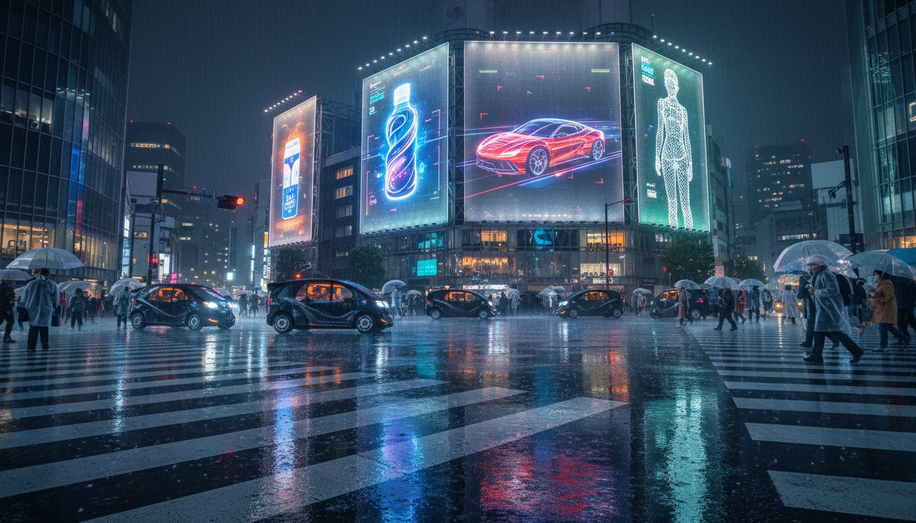

In the bustling streets of 2030, out-of-home (OOH) advertising will no longer merely interrupt daily commutes but immerse passersby in seamless, hyper-personalized worlds powered by artificial intelligence and augmented reality. Digital OOH (DOOH), already surging from a nascent market two decades ago to claiming a third of U.S. OOH spend today, is projected to balloon globally to between USD 39 billion and USD 57 billion by 2030, fueled by a compound annual growth rate exceeding 10%. This explosive trajectory signals a paradigm shift: OOH evolving from static billboards into dynamic, responsive ecosystems that anticipate consumer needs with uncanny precision.
At the heart of this transformation lies AI, the invisible conductor orchestrating content in real time. Imagine a coffee chain’s digital screen in a morning rush-hour subway, detecting via mobile location data that commuters are shivering in unseasonal chill; it instantly swaps promotions from iced lattes to steaming mochas, aligning perfectly with the moment. By 2030, machine learning will elevate this further, integrating vast datasets from audience measurement tools to deliver messages tailored not just to demographics but to individual moods, inferred from wearable biometrics or social sentiment feeds. Privacy safeguards, hardened by a decade of regulatory evolution, will ensure opt-in transparency, turning potential distrust into a trust anchor in an AI-saturated world. Advertisers, armed with these insights, will optimize campaigns on the fly, boosting engagement and ROI as high-impact slots—think peak foot traffic near retail hubs—become the norm.
Programmatic buying will democratize access, making DOOH as frictionless as online ads. Platforms will unify digital and OOH teams, allowing real-time bidding on inventory with transparent pricing and predictive analytics. No longer confined to agencies, brands of all sizes will reserve placements via automated systems, comparing options like e-commerce shoppers. This shift accelerates as retail media dominates: in-store DOOH, projected to drive over half of DOOH growth through 2029, will capture shoppers at the point of impulse, blending geotargeted screens with on-charger ads in high-dwell zones like EV stations or transit lounges. Cross-channel synergy with mobile will amplify reach; a billboard spotting your approach via Bluetooth triggers a companion app notification, creating a cohesive loop from awareness to conversion.
Yet technology alone won’t define OOH’s future—societal currents will sculpt its form. Urbanization, accelerating as megacities swell, demands OOH that thrives in density, leveraging AR overlays visible through smart glasses or phone cameras. A 3D holographic ad for a new sneaker might let pedestrians “try on” virtual pairs mid-stride, bridging physical and digital realms in experiential bursts. Sustainability, once a buzzword, becomes imperative: solar-powered screens with AI-optimized energy use slash emissions, appealing to eco-conscious generations who shun greenwashing. Expect biodegradable materials for temporary installations and carbon-neutral networks, as brands align with consumers prioritizing planetary health.
Creativity will flourish in this fertile ground, unshackled by static constraints. Generative AI tools will auto-adapt assets to myriad formats—curved transit wraps, holographic projections, even drone swarms forming aerial logos—eliminating manual drudgery. Campaigns turn full-funnel: awareness via massive urban facades evolves into performance drivers with QR-embedded calls-to-action or NFC interactions that log loyalty points. In North America, where the market hits USD 14.3 billion by 2030, this agility positions OOH as “real-world media,” the ultimate differentiator against cookie-less digital fatigue.
Beyond 2030, OOH blurs into ambient intelligence. Smart cities embed screens in infrastructure—interactive bus stops that gamify waits, or building facades pulsing with community-driven content. Metaverse tie-ins let virtual avatars encounter OOH in hybrid spaces, while neural interfaces hint at subconscious nudges, ethically bounded. Challenges persist: equitable access in underserved areas and ad fatigue from oversaturation demand innovation in subtlety. Still, OOH’s essence—its unskippable presence in shared public life—endures, reimagined as a canvas for human connection amid tech’s march.
By 2040, OOH may pioneer “empathy advertising,” where AI deciphers emotional contexts to deliver uplifting, contextually resonant stories. A weary parent at dusk sees a heartfelt family promo; a fitness enthusiast mid-jog gets motivational gear pushes. Grounded in data yet human at core, this next era cements OOH not as intrusion, but invitation—proving the future of advertising is as vivid and vital as the world it lights up.