
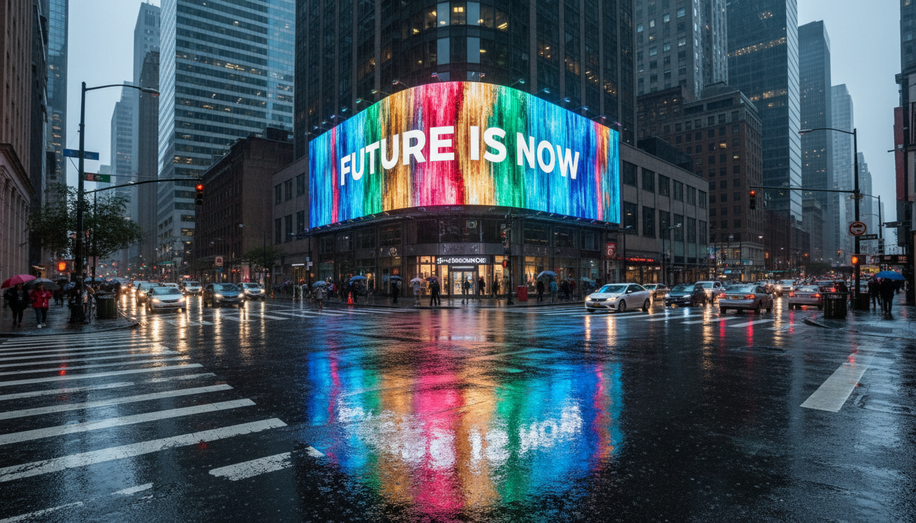

In the fleeting seconds it takes for a driver hurtling down a freeway at 100 kilometers per hour or a pedestrian weaving through a bustling city street to glance at a billboard, typography becomes the linchpin of success. Readability isn’t merely aesthetic—it’s a science grounded in human perception, where font choice, size, kerning, and contrast dictate whether a message sticks or vanishes into the blur of motion. For out-of-home (OOH) advertising, where viewers have just three to six seconds to absorb information, optimizing these elements ensures immediate comprehension and lasting retention.
The human eye processes visuals at lightning speed, but complex designs overwhelm it. Scientists studying eye movement have established that people make three to four fixations per line of text, meaning lines longer than six to eight words demand extra effort that mobile audiences simply can’t afford. This is why brevity reigns supreme: effective billboards distill messages to a single, punchy point—often seven words or fewer—allowing the brain to grasp it without cognitive overload. Typography that fails this test doesn’t just confuse; it erases the ad from memory before it can influence behavior.
Font selection stands at the forefront of this science. Sans-serif typefaces like Helvetica, Arial, Futura, or Verdana dominate because their clean, unadorned strokes remain distinguishable at distance and speed, unlike cursive or decorative scripts that force the eye to laboriously trace curves. Thin, fancy fonts crumble under real-world scrutiny, blending into illegibility when viewed from afar or amid vibrations from passing vehicles. Bold, thick variants of these sans-serifs amplify impact, establishing a clear visual hierarchy that guides the gaze from headline to call to action in one fluid sweep. Industry experts warn against mixing more than two fonts, as clutter increases mental friction and dilutes retention.
Size scales with the stakes. A cardinal rule, echoed across design research, mandates one inch of letter height per ten feet of viewing distance—translating to letters at least two feet tall for highway billboards assaulting eyes from 500 feet away. The Outdoor Advertising Association of America (OAAA) reinforces this with precise ranges, emphasizing that undersized type isn’t creative—it’s a budget-killing error. At highway speeds, where exposure shrinks to under six seconds, these massive proportions ensure letters don’t dissolve into abstract shapes, preserving the message’s integrity even in suboptimal conditions like glare or dusk.
Kerning, the precise spacing between letters, prevents words from merging into an optical mush. Proper kerning—neither too tight nor excessively loose—allows the brain to parse characters instantaneously, a necessity when motorists have mere glances to spare. Overly spaced all-caps or cramped lettering exacerbates blending, especially with fonts lacking inherent openness. Research into typographic manipulations confirms that balanced spacing enhances functional readability, turning potential confusion into effortless recognition. In practice, this means testing designs at simulated distances to mimic the driver’s peripheral scan, where even minor adjustments can boost legibility by 20-30 percent.
Contrast ties it all together, leveraging the eye’s bias toward high-difference pairings. Black on yellow offers the pinnacle of visibility, followed by white on blue or red on white, as these combinations exploit how the brain prioritizes stark edges over subtle gradients. Low-contrast errors—like red on black or white on yellow—render text invisible, particularly in varying light, weather, or at night. Color psychology amplifies this: vibrant pops not only aid parsing but improve recall days later, as studies show colorful, high-contrast ads lodge deeper in memory than muted ones. Earthy tones or pastels fare poorly, sacrificing punch for subtlety that OOH can’t afford.
These principles converge in the 6-Second Rule, a benchmark born from empirical observation of driver behavior. Billboards must deliver comprehension in that window or risk irrelevance, with typography as the enforcer. Real-world testing—holding printouts at highway distances or using digital simulators—validates choices before launch, catching flaws that doom campaigns. Psychological factors underscore the urgency: short attention spans and speed-distorted perception demand designs that minimize effort, fostering instant emotional connection over labored decoding.
The payoff is measurable. Optimized typography doesn’t just inform—it imprints brands, driving traffic and sales in a medium where 70 percent of viewers report exposure yet only the legible linger in mind. As OOH evolves with digital displays, these timeless rules endure, blending art with neuroscience to command attention amid chaos. Advertisers who master them don’t compete on creativity alone; they engineer inevitability, ensuring every passerby leaves with the message etched in memory.