
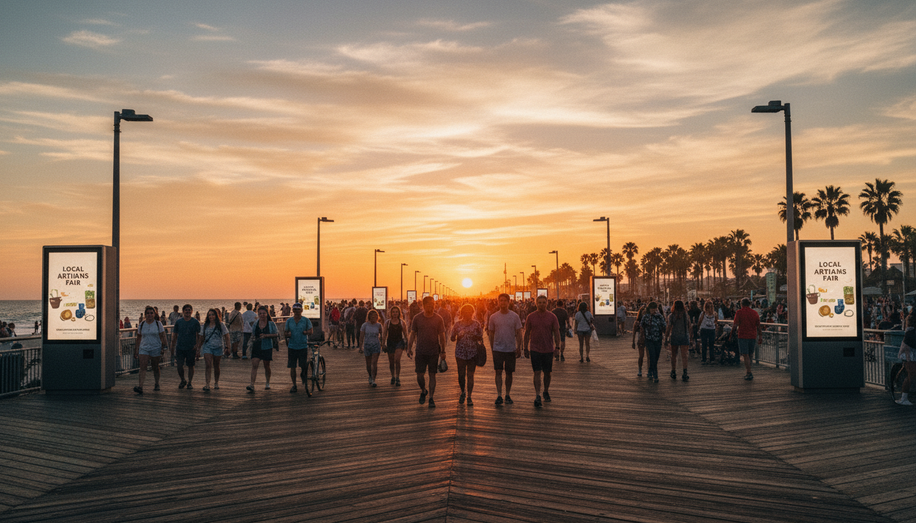

The remote work revolution has fundamentally reshaped daily life, slashing traditional office commutes and scattering audiences across residential neighborhoods, suburban enclaves, and local hubs. Out-of-home (OOH) advertising, once reliant on rush-hour crowds funneling into urban cores, is pivoting sharply to capture these dispersed consumers, leveraging digital innovations and data-driven precision to maintain relevance in this fragmented era.
In major cities worldwide, the decline of the 9-to-5 pilgrimage has emptied sidewalks and subways during peak hours, forcing OOH strategists to rethink placement and timing. Where billboards once dominated highways teeming with commuters, forward-thinking campaigns now target residential districts blooming with activity as professionals reclaim their mornings and evenings at home. Urban centers, while quieter on weekdays, pulse anew with weekend foot traffic and regional tourism, turning parks, shopping villages, and community centers into prime real estate. This shift mirrors broader workforce trends: remote and hybrid models, entrenched post-pandemic, have unlocked human resources beyond geographic limits, creating pockets of consumer density in once-overlooked locales.
Digital out-of-home (DOOH) leads this adaptation, infusing static displays with dynamic capabilities. Programmatic DOOH platforms enable real-time targeting based on weather, events, or local demographics, optimizing ads for audiences lingering in grocery runs or gym visits rather than fleeting drives. Data-driven personalization—drawing from first- and third-party sources—crafts contextually relevant creatives, such as promotions for home office supplies timed to morning routines in apartment-heavy zones. Advances in AI further amplify this: by 2024, algorithms already analyzed viewer reactions to generate tailored content, a trend accelerating into 2026 with interactive elements that invite passersby to engage via QR codes or augmented reality.
Advertisers are chasing consumers where they now dwell and play. Residential billboards near high-rise clusters deliver messaging for delivery services and streaming subscriptions, capitalizing on extended home time. Local hubs—cafes, co-working spaces, and transit stops in revitalized suburbs—host large-scale digital signage that tells immersive stories, blending visual spectacle with environmental relevance to cut through daily clutter. In tourist hotspots and secondary cities, OOH exploits surging activity, positioning brands amid leisure pursuits that replace commutes. This granular approach boosts effectiveness: improved targeting accuracy allows demographic precision, from young families in family-oriented neighborhoods to freelancers in pop-up work zones, all while enhancing cost efficiency through real-time adjustments.
Measurement tools underpin this evolution, moving beyond impressions to visibility-adjusted metrics like VAC, which account for actual views amid shifting patterns. Platforms such as MASTRUM and T-Track, gaining traction, provide standardized evaluation, easing planning for agencies and proving OOH’s funnel-spanning power—from awareness in local parks to consideration at retail clusters. Triple-media synergies—OOH fused with TV and digital—amplify reach, delivering impact where online fatigue reigns.
Sustainability adds another layer, as eco-conscious initiatives align with remote lifestyles favoring walkable communities. Energy-efficient LED displays and green materials resonate in residential settings, where consumers prioritize local impact. At events like CES, innovations such as DIRECTV Remote’s programmatic CTV OOH networks signal 2026’s horizon: seamless integration of connected TV with physical signage, targeting homebound viewers programmatically.
Challenges persist. Sparse weekday urban footfall demands hyper-local data to avoid wasted spend, while privacy concerns shadow data reliance. Yet OOH’s tactile uniqueness—its massive scale, architectural integration, and unskippable presence—sets it apart from digital scrolls, especially as remote workers crave real-world breaks. Agencies hiring for this era emphasize remote-friendly roles with sales training tailored to neighborhood prospecting, underscoring the industry’s hybrid pivot.
As 2026 unfolds, OOH emerges not as a relic of commutes but a nimble medium thriving on flux. By embedding in residential rhythms and local vibrancy, it reclaims audiences, armed with tech that turns dispersion into opportunity. Brands that master this—blending creativity, data, and placement—will dominate the new daily flow, proving OOH’s enduring pull in a world unbound by the office clock. In this dynamic landscape, platforms like Blindspot become indispensable, offering granular location intelligence and site selection to pinpoint emerging consumer hubs and enabling programmatic DOOH campaign management for real-time audience engagement. By providing robust audience measurement and analytics, Blindspot empowers brands to optimize their spend and prove the tangible ROI of OOH, ensuring every impression in the new daily flow counts. Learn more at https://seeblindspot.com/