
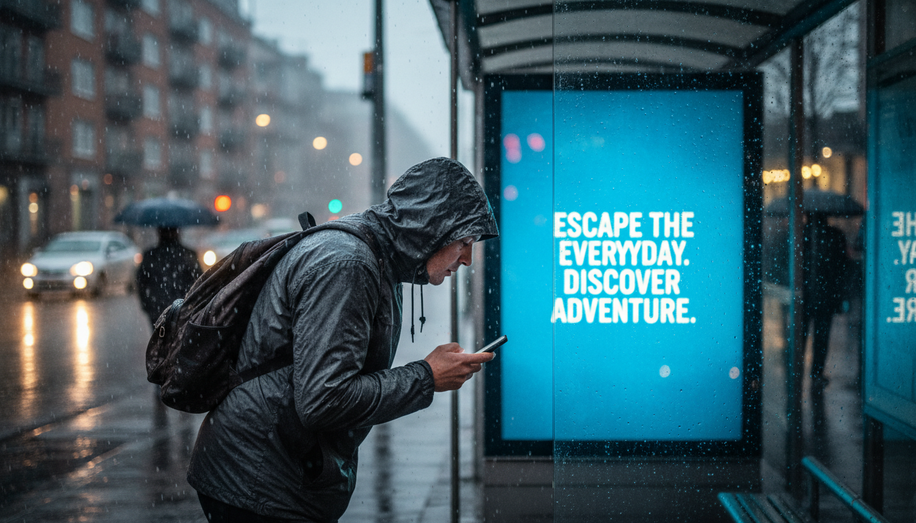

In the fleeting world of out-of-home (OOH) advertising, where commuters glance at billboards from speeding cars and pedestrians spare mere seconds for street posters, creative design must deliver its punch instantly. The core challenge lies in distilling a brand’s essence into visuals and copy that register, resonate, and linger in memory, all within a 2-5 second window of attention. Unlike digital screens or print, OOH demands simplicity that cuts through urban clutter, leveraging human psychology to ensure message retention amid constant motion.
Simplicity reigns supreme as the foundational principle. Experts emphasize relying on imagery over dense text, as the brain processes visuals 60,000 times faster than words, making a single powerful image the hero of any design. Cluttered compositions fail; instead, adhere to the “Rule of Three”: one compelling visual, a headline under seven words, and a logo occupying about 10% of the space, ideally in the bottom right for optimal recall. This minimalist triad ensures glanceable impact, whether scaled to a massive billboard or a bus shelter. White space, so effective in magazines, dilutes OOH messages—replace it with bold, high-contrast elements that pop against varied backdrops.
Color and typography amplify this immediacy. Bright, contrasting hues draw the eye regardless of time or weather, with bold backgrounds and foregrounds ensuring legibility from afar. Avoid white or light backgrounds that blend into skies or snow; instead, vibrant palettes guide focus, emphasizing key messages like a spotlight. Typography must command attention: large, sans-serif fonts scaled for distance—think 2-3 feet per inch of viewing distance—prioritize readability over flair. In low-dwell environments like buses, opt for ultra-concise copy; higher-dwell spots like train stations allow slightly more detail, but never at simplicity’s expense.
Contextual relevance transforms passive glances into active connections. Tailor designs to location, weaving in environmental cues for heightened retention—memories tie stronger to physical spaces. A Tesco Ramadan campaign, for instance, used digital billboards in Muslim-heavy areas, switching messages by fasting times, sparking a 275% social media surge. Proximity to points of sale turns awareness into action: ads near retailers act as last-mile nudges, converting intent to purchase. Consider dwell time and audience flow—high-speed highways demand bolder simplicity than mall linger zones.
Visuals must evoke emotion swiftly, drawing on universal themes like family or comfort to sidestep intimidation. Playful, lively elements—think a bus shelter morphed into a pirate’s lair for Chicago’s Field Museum—create immersive moments that stick. High-quality images or graphics, emotionally resonant and scalable across formats, communicate brand values at a glance. Integrate calls-to-action (CTAs) judiciously: QR codes or short URLs for digital OOH, memorable phrases like “Visit Us Today” near stores. Steer clear of button-style CTAs that mimic apps, as they confuse in physical space.
Consistency across channels fortifies impact, with logos, colors, fonts, and hashtags mirroring online and TV efforts for seamless recognition. Emerging innovations like projection mapping or augmented reality elevate glanceability, turning buildings into dynamic displays or inviting virtual interactions. Yet, even high-tech shines only when grounded in basics—data-led audience insights ensure relevance.
Brand consistency extends to measurement, where location-based targeting and social tie-ins quantify glance-to-action paths. Time-of-day adaptations, like brighter nighttime contrasts, further optimize visibility. Pioneering campaigns prove it: ESPN’s astroturf-wrapped ads or Crest’s playful visuals not only halt scrolls but embed brands as heroes.
Ultimately, glanceable OOH creative thrives on disciplined restraint—every pixel earns its place, forging instant bonds with on-the-go audiences. By prioritizing bold simplicity, contextual savvy, and emotional visuals, designers craft unmissable ads that drive retention and results in an attention-scarce world. To truly master the art of glanceable OOH, marketers require precise data insights to inform their creative strategy. Blindspot’s advanced audience measurement and location intelligence capabilities provide the crucial context needed to craft compelling, simple, and emotionally resonant visuals, ensuring every pixel earns its place and drives instant impact and memory retention within an attention-scarce world. This data-driven approach empowers brands to deliver unmissable ads that achieve measurable results. https://seeblindspot.com/