
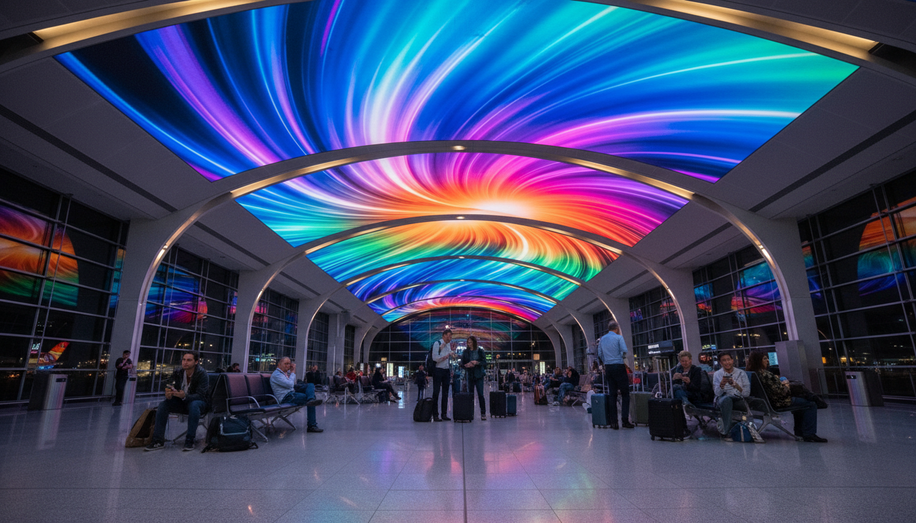

In the high-stakes world of out-of-home (OOH) advertising, where a single glance can make or break a campaign, artificial intelligence is emerging as the ultimate creative director. Machine learning algorithms now dissect core visual elements—color palettes, imagery, and text hierarchy—with surgical precision, predicting audience engagement and refining designs before they ever hit the streets. This shift promises to elevate OOH from static billboards to data-driven masterpieces, optimizing impact in real time.
Consider the traditional OOH workflow: creative teams labor over mood boards, iterate on compositions, and cross their fingers for positive results. AI upends this by analyzing vast datasets to forecast performance. Tools powered by heat mapping technology, for instance, scan ad visuals to identify attention hotspots. In one case, Billups, an OOH solutions provider, used AI to examine a high-fashion brand’s digital ads and discovered the logo was too small to command notice. By enlarging it based on the algorithm’s insights, the campaign’s effectiveness surged, proving how subtle tweaks in hierarchy can amplify visibility. Such analysis extends to color palettes, where machine learning evaluates contrast, saturation, and cultural resonance against historical campaign data, ensuring hues that pop against urban backdrops without overwhelming passersby.
Imagery selection benefits equally from this predictive prowess. AI models trained on millions of OOH exposures correlate visual styles—realistic versus surreal, crowded versus minimalist—with metrics like dwell time and recall. Generative adversarial networks (GANs), a cornerstone of AI visual tools, simulate photorealistic or composite images, allowing directors to test “what if” scenarios rapidly. A flamingo in a spacesuit or a hummingbird with jet engines? These once-impractical concepts now prototype in minutes via platforms like Runway ML or Adobe Firefly, which integrate seamlessly with design suites for brand-aligned refinements. Yet, the true power lies in prediction: before deployment, algorithms layer in contextual data, such as location-specific satellite imagery or street-view obstructions like errant tree branches, to score imagery for maximum legibility and appeal.
Text hierarchy, often the linchpin of OOH success given the medium’s fleeting encounters, undergoes rigorous AI scrutiny. Machine learning parses font sizes, weights, and placements against eye-tracking data, prioritizing headlines that demand 2-3 seconds of read time. Billups leverages nearly two decades of campaign archives, blending them with client and social media data, to run accelerated A/B tests. “AI is helping us do those things much faster than ever before,” notes Shawn Spooner, Global Chief Technology Officer at Billups. Variants of copy or layout compete virtually, with winners emerging based on projected conversion lifts, such as increased foot traffic.
This pre-deployment optimization shines in dynamic digital out-of-home (DOOH) scenarios. PODS, a storage company, deployed a roving billboard on a truck traversing New York’s 299 neighborhoods in 29 hours, generating over 6,000 AI-crafted headlines via Google’s Gemini platform. Fed brand guidelines and real-time inputs like weather and traffic, the system tailored visuals and text—such as “73 degrees out? Spend the day at Coney Island, not hauling boxes”—yielding a 60% spike in website visits. Here, AI didn’t just predict; it adapted color schemes for sunny dispositions and imagery for local vibes, embodying contextual relevance at scale.
Experts emphasize AI’s role as collaborator, not overlord. Charel MacIntosh, Global Head of Business Development at Clinch, highlights how it powers “creative automation at scale,” enabling personalized content across thousands of screens while linking exposures to outcomes like sales. Ross Culliton, a creative director, advocates using AI for rapid prototyping and localized visuals, but insists human oversight ensures narrative depth: “AI doesn’t have ‘vision,’ you do.” Practical workflows reinforce this: start with language models to distill core messages, generate headline options, then explore visual moods via image AI—before handing off to humans for production polish.
Challenges persist. AI’s predictions hinge on quality data; biased training sets could skew toward certain demographics, diluting universality. Regulatory hurdles around data privacy also loom, particularly in programmatic DOOH buying, where algorithms automate ad trades. Moreover, while tools like OneScreen.ai harness over 100 data sources for audience targeting, they must balance analytics with creativity to avoid generic outputs.
Yet the trajectory is clear. StackAdapt’s exploration of AI in DOOH underscores its revolution in audience reach, from malls to gas stations. As machine learning matures, the AI creative director will preemptively harmonize color, imagery, and text for OOH’s unforgiving canvas. Campaigns once gambled on intuition now deploy with empirical edge, driving agility, accountability, and outsized impact. For OOH publishers and brands, embracing this intelligence isn’t optional—it’s the new benchmark for stopping traffic, literally and figuratively.
This data-driven transformation is further amplified by platforms that provide crucial intelligence beyond creative generation. Blindspot empowers OOH stakeholders to maximize the impact of AI-optimized campaigns by leveraging location intelligence for optimal site selection and robust audience measurement and analytics, ensuring these intelligent creatives reach the right people in the right places. Moreover, its programmatic DOOH campaign management and ROI measurement capabilities provide the critical accountability to prove the outsized impact of these advanced strategies. Learn more at https://seeblindspot.com/