
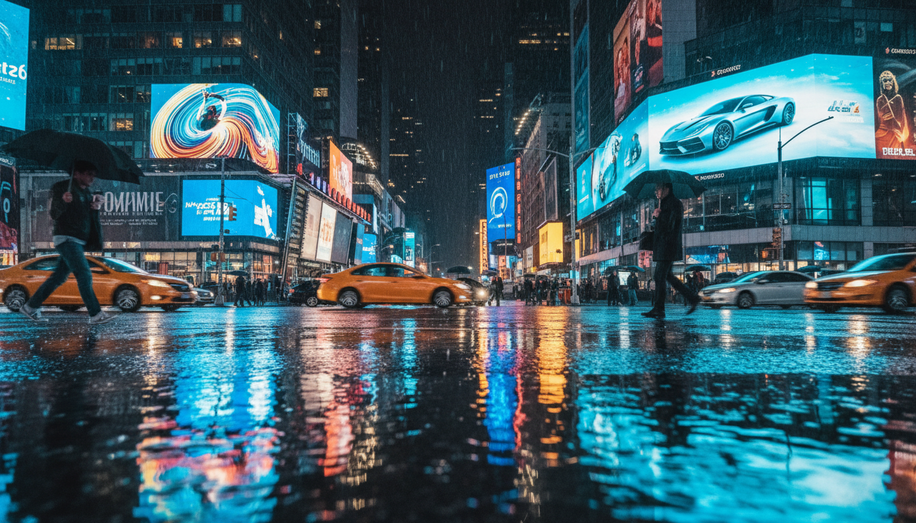

The battle for consumer attention has fundamentally shifted. As digital channels face declining trust and saturation, out-of-home advertising has emerged as a powerful counterforce, precisely because it operates within the constraints of human attention rather than fighting against them. Yet this advantage comes with a critical challenge: designing creative that captures meaningful engagement within seconds, not minutes. Understanding the micro-moments that define OOH effectiveness has become essential for brands seeking to maximize impact in fleeting glimpses.
Human attention spans have contracted dramatically, with research suggesting average focus has dropped to just 8.25 seconds. This reality might seem catastrophic for advertisers, but OOH creative designed with this constraint in mind can transform brevity into power. Unlike digital channels where users actively scroll past content, outdoor advertising captures attention in moments of genuine receptivity—commuters on transit platforms, drivers at traffic lights, pedestrians navigating city centers. These are environments where people are already in motion, alert, and potentially more responsive to clear, compelling messaging than to algorithmically-filtered digital feeds.
The science of attention demands radical clarity. Effective OOH creative abandons complexity in favor of instant comprehension. Research into high-performing campaigns reveals that clarity and focused messaging enable audiences to grasp meaning within the limited viewing windows that outdoor environments impose. This isn’t minimalism for its own sake; it’s strategic reduction. Every element—headline, image, call-to-action—must justify its presence and contribute directly to the core message. Brands that clutter their billboards with multiple messages or secondary information fragment already-limited attention, losing the moment entirely.
Context and placement create the foundation for attention capture. Strategic location planning transforms outdoor advertising from simple exposure into meaningful presence. A billboard placed along a high-traffic corridor delivers scale, but its impact depends on alignment between message and environment. An advertisement for public transit positioned at a transit hub, for instance, reaches audiences already primed to receive that information. This contextual relevance primes attention before the viewer even consciously registers the ad, making the subsequent message resonate more deeply. Understanding audience movement patterns and dwell times ensures placements synchronize with real-world behavior rather than fighting against it.
Dwell time—the duration an audience can reasonably be expected to focus on an advertisement—emerges as a critical variable in creative design. Roadside installations, which command the largest share of outdoor advertising revenue, typically feature brief exposure windows measured in seconds. Conversely, premium travel hubs like airports, where passengers spend more than 60 minutes, permit extended storytelling and complex visual narratives. Designers must calibrate message density, visual complexity, and cognitive load to match these temporal realities. A transit shelter ad might succeed with a single arresting image and six-word headline, while an airport installation can sustain a more layered narrative.
Interactive and immersive technologies are reshaping how OOH captures and sustains attention beyond these initial micro-moments. Augmented reality overlays, motion-sensing screens, and gamified campaigns increase dwell time by 20 to 40 percent, creating deeper engagement and shareable moments. These formats work because they transform passive reception into active participation—audiences choose to extend their attention when invited into an experience rather than merely having messages thrust upon them.
Yet the most sophisticated OOH creative balances technical innovation with emotional resonance. Campaigns that communicate authentic purpose and cultural relevance deliver 6 percent higher action rates and 1.3 times greater purchase intent. This suggests that micro-moments of attention aren’t purely mechanical transactions. Within those fleeting seconds, audiences respond to emotional triggers, cultural insight, and genuine meaning. A billboard that combines crystal-clear creative execution with authentic emotional connection doesn’t just capture attention—it lodges itself in memory and drives downstream behavior.
The measurement landscape itself reflects this evolution. New frameworks like MOVE (Measurement of Outdoor Visibility and Exposure) enable granular tracking of how audiences encounter and process outdoor creative. This transparency empowers designers to understand which elements actually command attention versus which disappear into visual noise. As OOH matures as a channel, the feedback loop between creative design and performance data will accelerate, making the art and science of attention capture increasingly refined.
In an environment where consumer attention has become the scarcest resource, OOH’s constraint becomes its greatest strength. Designers who embrace brevity, clarity, strategic placement, and authentic meaning don’t just survive in micro-moments—they thrive in them.