
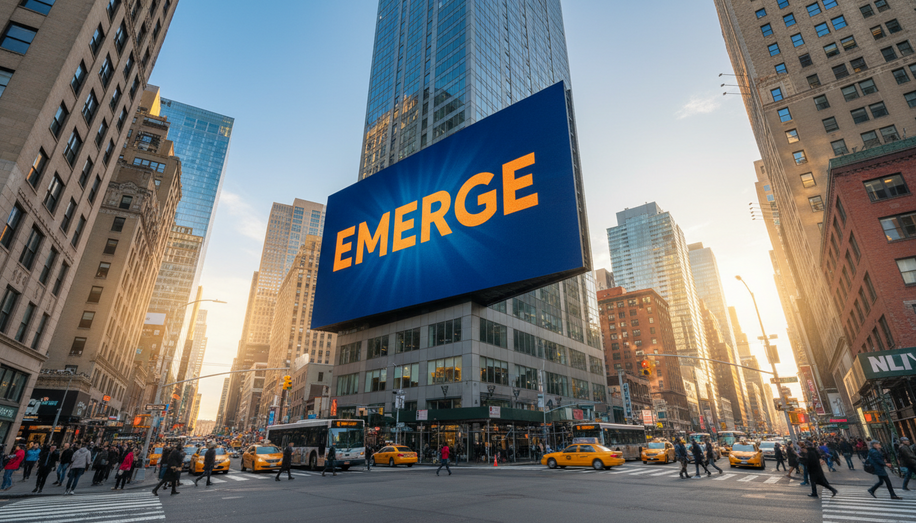

In today’s fast-paced world, outdoor advertising has become a paradox: more visible than ever, yet increasingly invisible to the audiences who pass by. The culprit is complexity. While consumers are bombarded with messages from every direction, the brands that break through the noise share a common characteristic—they embrace simplicity. With only three to five seconds to capture attention, successful out-of-home campaigns recognize that less is invariably more.
The constraints of outdoor advertising are not limitations but rather opportunities for creative discipline. A viewer scanning a billboard from a moving vehicle, a pedestrian glancing at a transit advertisement, or a shopper noticing a street banner—none of these audiences will pause to decipher layered messages or decode complex visual hierarchies. Instead, the most effective campaigns deliver a single, crystalline idea that requires no interpretation. This singular focus separates memorable advertisements from the visual clutter that fades into obscurity.
The power of concise messaging lies in its psychological efficiency. Research underscores that people absorb information rapidly when it’s distilled to its essence. Iconic campaigns prove this principle: McDonald’s “I’m Lovin’ It” and Nike’s “Just Do It” achieve cultural resonance through brevity, not elaboration. Industry experts recommend limiting copy to seven words or fewer, with the headline standing alone and instantly understood. When every word serves a purpose, each carries weight. Conversely, overloaded billboards overwhelm viewers, diluting impact and reducing message retention.
Achieving this conciseness requires a fundamental shift in copywriting philosophy. Rather than listing benefits or cramming multiple calls to action, effective OOH messaging identifies the single most important thing the audience needs to know. This might be a product benefit, a brand promise, or a call to action—but it must never compete with secondary ideas. The discipline required to reduce complex offerings into elemental messaging challenges marketers to understand their audience’s core motivation and speak directly to it.
Design principles amplify the power of simple messaging. Bold, high-contrast visuals—such as black paired with yellow, white with red, or blue with white—ensure that advertisements “pop” from a distance while avoiding color combinations that blur together. Sans-serif fonts, which are inherently more legible at distance and speed, should be sized so that viewers can read the message from at least 100 feet away. For billboards, this often means text heights of 18 inches or larger. Typography becomes more than aesthetic choice; it becomes a functional tool for communication.
Equally critical is the use of negative space. Designers frequently succumb to the urge to fill every available inch with text or imagery, yet empty space plays a vital role in making messages resonate. Negative space guides the viewer’s eye to the most important elements, improves readability, and creates a modern, professional appearance that commands attention. A clean, uncluttered design inherently communicates more than a crowded one.
High-quality imagery further amplifies simplicity’s effectiveness. With modern digital printing technologies, there is no excuse for lackluster visuals. Whether featuring a tantalizing photograph of a product or a striking graphic, vibrant imagery dominates the billboard and leverages its full visual potential. The image should reinforce the message rather than distract from it, functioning as a visual anchor that makes the advertisement memorable.
The strategic placement of logos and taglines deserves deliberate attention. Brands should position their logos or taglines in clear, unobstructed spaces to ensure instant brand recall. Consistency in branding across all OOH formats—maintaining the brand’s color scheme, typography, and tone of voice—creates a cohesive identity that leaves a lasting impression.
Ultimately, the art of OOH advertising is the art of elimination. In a world of information overload, simplicity is not merely a design preference—it is a competitive advantage. By embracing concise messaging, bold visuals, readable typography, and strategic spacing, advertisers cut through the complexity that characterizes modern urban environments. The result is advertising that doesn’t just appear in the landscape; it becomes part of it, achieving the rare feat of being both noticed and remembered.