
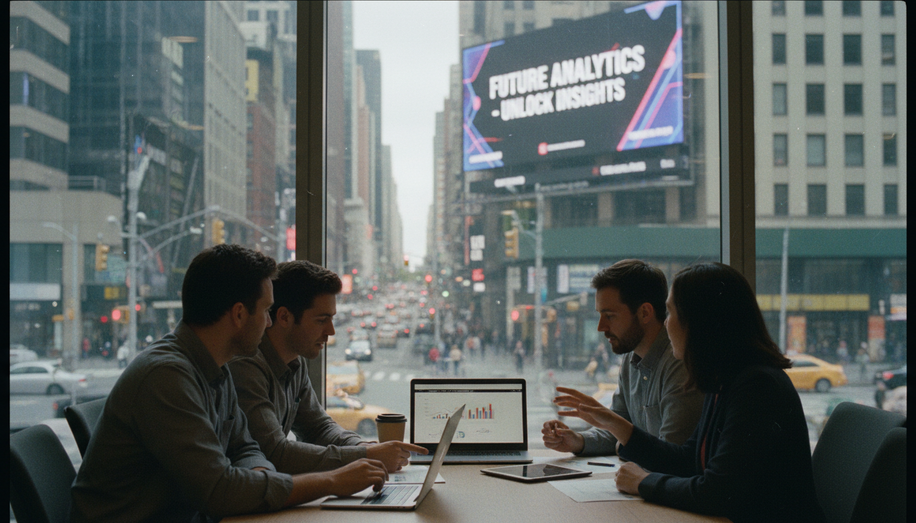

In the bustling world of out-of-home (OOH) advertising, where billboards loom over highways and digital screens pulse in urban plazas, a quiet revolution is underway. Data scientists, often called the “data whisperers,” are transforming this traditionally analog medium into a precision-engineered powerhouse of targeted messaging and measurable impact. These professionals, armed with machine learning algorithms and vast datasets, are redefining how brands segment audiences, optimize campaigns, and substantiate OOH’s return on investment in an era demanding data-driven proof.
At the heart of their work lies audience segmentation, a process once reliant on broad demographics and gut instinct. Today, data scientists integrate diverse signals—location data, weather patterns, behavioral insights, and even device usage—to create hyper-precise profiles. Consider weather targeting: a mild 50-degree day in Boston triggers entirely different consumer responses than the same temperature in Miami, influencing everything from apparel promotions to outdoor activity ads. By feeding these variables into AI models, data whisperers ensure ads appear contextually relevant, sidestepping the pitfalls of outdated third-party cookies. This approach boosts engagement, as 56 percent of consumers now expect personalized offers, and poor data quality can erode up to 10 percent of annual revenue.
Optimization follows seamlessly, powered by dynamic creative optimization (DCO) and real-time analytics. Data scientists analyze live campaign data to adjust creatives on the fly—swapping messages based on time, location, or environmental cues. In targeted advertising broadly, machine learning algorithms ingest new information continuously, refining predictions on who to reach and what resonates. For OOH, this means digital billboards that shift content dynamically: a rain forecast might pivot a coffee chain’s ad from iced lattes to hot brews, maximizing relevance without human intervention. Roles like data stewards maintain dataset integrity daily, while data managers oversee quality, enabling these fluid adjustments. The result? Campaigns that scale efficiently, with 39 percent of organizations prioritizing flexible, speedy data access to fuel such innovations.
Yet the true game-changer is measurement, where data scientists prove OOH’s elusive value. Unlike digital channels with pixel-perfect tracking, OOH’s impact has long been anecdotal—until geo-experimentation emerged. Pioneered in experiments like Amazon’s four-week campaign on metro and commuter rail lines, this method isolates geographic units, randomly exposing some to high ad density while others see low or none. High-exposure neighborhoods showed clear sales lifts, borrowing from online ad techniques to quantify incrementality: the difference between baseline conversions and ad-driven ones. At ASOS, data teams built an in-house framework across 11 markets and seven channels, using matched-market algorithms to pair control and treatment areas with hill-climbing precision, ensuring assumptions hold amid seasonality or random fluctuations.
These geo-experiments address OOH’s unique challenges—no user-level tracking on streets, no way to shield half a population from a billboard. Power analysis determines minimum uplift detectable, while dashboards deliver metrics like incremental return on ad spend (iROAS), even correcting for spillover effects. Amazon’s applied scientists extend this to comprehensive sales impact, blending online and offline data across timescales. Google’s staff data scientists mine datasets for efficiency gains, employing statistical rigor to attribute OOH to real-world outcomes. Billups exemplifies this in practice, using attribution tech to link OOH exposures to foot traffic and purchases, turning “impressions” into proven ROI.
Demand for these whisperers is surging. Job postings abound for data scientists in ads measurement, from Indeed’s 969 roles to specialized positions at tech giants, underscoring their centrality. In advertising and marketing, they influence strategy via collection, analysis, and targeting, elevating OOH from visibility play to performance driver.
Challenges persist: data inaccuracy plagues 91 percent of data-driven cultures without stewardship, and OOH’s scale demands scalable tech. Yet partnerships with clean-data providers and AI tools are closing gaps, enabling cookie-less targeting via contextual signals. Forward-thinking agencies now embed data teams end-to-end, from design to post-campaign autopsy.
As OOH evolves—projected to grow with digital out-of-home’s rise—these data whisperers ensure it doesn’t just capture eyes, but drives action. By whispering insights from chaos, they position OOH not as a relic, but as advertising’s data-fueled future, where every placement proves its worth. Blindspot directly empowers this data-driven future, providing robust **ROI measurement and attribution** to quantify OOH’s impact with the precision data scientists demand, moving beyond anecdote to provable value. Its **audience measurement and analytics** alongside **location intelligence and site selection** enable the hyper-precise targeting and contextual relevance crucial for optimal engagement, while **real-time campaign performance tracking** and **programmatic DOOH campaign management** facilitate dynamic optimization. Discover how at https://seeblindspot.com/