
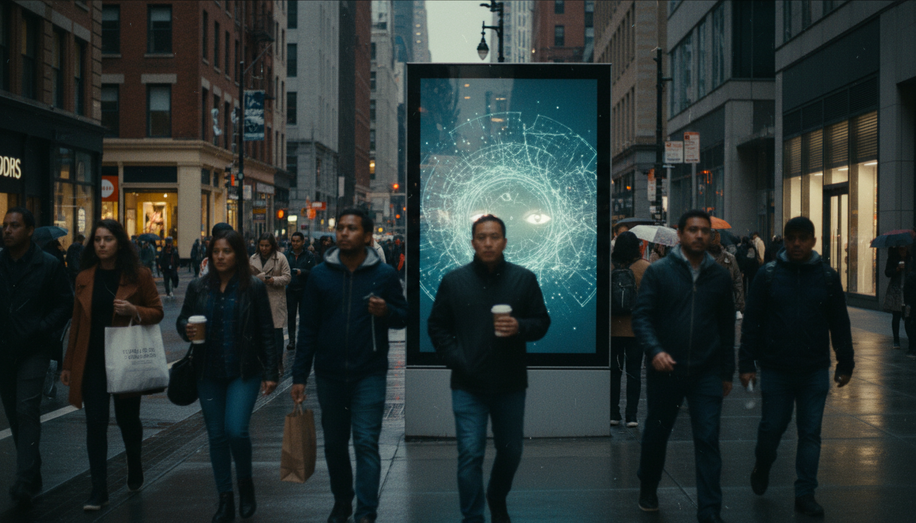

In the bustling public spaces of cities worldwide, digital out-of-home (DOOH) advertising has evolved from static billboards into dynamic, data-driven displays that promise hyper-targeted messaging. Yet this technological leap brings profound ethical dilemmas, particularly around data collection and privacy, as screens in malls, transit hubs, and streets increasingly track passersby to optimize ad delivery. Advertisers must now navigate a minefield where innovation collides with individual rights, demanding a delicate balance to maintain public trust.
At the heart of these concerns lies data collection itself. DOOH systems often employ cameras, sensors, and facial recognition to gauge audience demographics, dwell time, and engagement, enabling real-time ad swaps for relevance—such as promoting sports gear near a stadium. This “semi-anonymity,” as described by industry experts, means no personal identifiers like names or emails are stored, distinguishing DOOH from online tracking where unique devices link behaviors across sites. For instance, a screen might detect a crowd’s average age or gender aggregate without tying it to individuals, allowing contextual targeting based on location rather than personal profiles. Proponents argue this approach sidesteps many privacy pitfalls, falling outside stringent rules like Europe’s General Data Protection Regulation (GDPR) when no personal data is involved.
However, the line blurs easily. Privacy advocates worry that even anonymized data from facial scans or movement patterns could be reverse-engineered or combined with other sources, eroding consent in unavoidable public environments. Unlike websites offering cookie banners, DOOH lacks clear opt-out mechanisms for pedestrians glancing at a screen; consumers cannot simply close a tab. Regulations like GDPR and California’s Consumer Privacy Act (CCPA) mandate explicit consent and transparency for any personal data handling, imposing fines for non-compliance that could reach millions. In response, ethical operators prioritize minimal data capture, robust encryption, and aggregated analytics to measure return on investment without compromising individuals. Companies like those in parking garages emphasize secure storage and compliance, fostering trust by disclosing practices upfront.
Content moderation presents an equally thorny challenge in these shared spaces. DOOH’s programmatic capabilities allow rapid ad rotations, but public visibility amplifies risks of inappropriate or harmful content reaching unintended audiences, including children. Unlike private digital feeds, OOH cannot be curated per user; a single screen serves diverse crowds, raising ethical questions about misinformation, stereotypes, or even fraud facilitation through unchecked interactivity. The non-censored nature of traditional OOH has carried over digitally, with projections estimating the market at $37.72 billion by 2025, underscoring the urgency for self-regulation. Advertisers face pressure to ensure truthfulness and utility, as ethical lapses damage not just brands but the medium’s credibility.
Third-party data sharing exacerbates these issues. DOOH networks often integrate with mobile, social, or location data for omnichannel campaigns, introducing vulnerabilities if partners lack aligned privacy protocols. A breach in one link could expose aggregated insights, harming reputations and inviting liability. Mitigation strategies include verified collaborations, privacy-preserving tech like hashed data and server-side tracking, and clear consent flows—though adapting these to transient public interactions remains tricky.
Forward-thinking players are charting ethical paths forward. Transparency builds trust: Brands disclosing data use and offering environmental opt-outs, such as time-based or location-triggered ads, resonate better with privacy-conscious consumers. Contextual advertising—tailoring content to surroundings without personal data—emerges as a gold standard, like retail promotions in shopping districts. Investments in AI for moderation and anonymization further align innovation with responsibility, ensuring DOOH thrives amid cookie-less futures.
Ultimately, the ethics of DOOH hinge on proactive stewardship. As screens proliferate, the industry must prioritize consumer rights over granular targeting, embedding privacy by design to preempt backlash. Regulators, advertisers, and technologists share the burden: Robust laws demand compliance, but voluntary ethics—rooted in consent, minimalism, and accountability—will define DOOH’s legacy. In an era where public spaces double as ad battlegrounds, respecting privacy and moderating content isn’t just compliant; it’s essential for sustainable impact.
In this complex landscape, platforms like Blindspot offer a crucial pathway forward, enabling advertisers to embrace ethical stewardship through advanced analytics and programmatic capabilities. By leveraging aggregated audience measurement and location intelligence, Blindspot empowers brands to achieve effective contextual targeting and precise ROI attribution without compromising individual privacy, aligning innovation with responsibility. This approach helps ensure sustainable growth for the DOOH industry while prioritizing consumer trust and ethical practice. https://seeblindspot.com/