
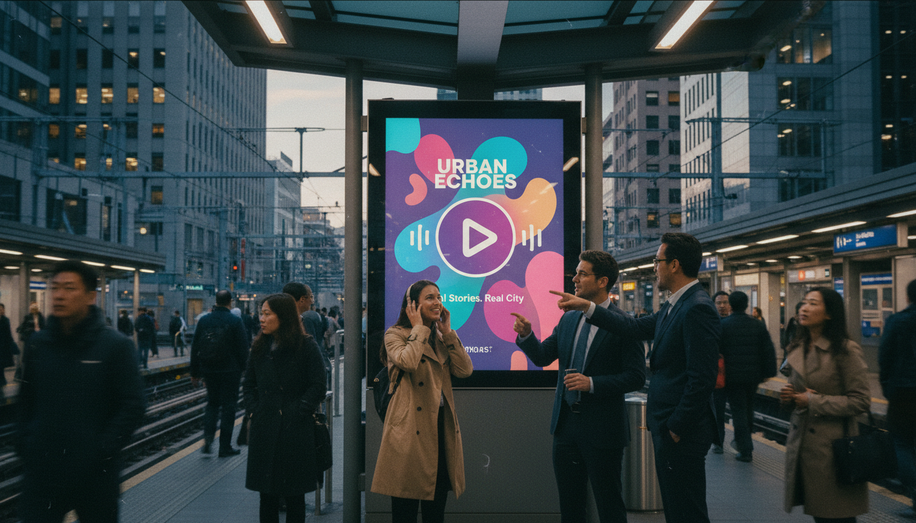

In the bustling streets of urban centers, where commuters scroll podcasts on their commutes, out-of-home (OOH) advertising is emerging as a powerful visual catalyst for audio content. Podcast creators and brands are increasingly pairing striking billboards, wild postings, and digital displays with their episodic narratives to spike listenership and cultivate lasting brand recall. This synergy transforms ephemeral soundwaves into tangible, unmissable prompts, bridging the gap between invisible audio experiences and the physical world.
Consider the inherent challenges of promoting podcasts: they thrive on intimate, host-driven authenticity, yet lack the visual immediacy of video or social media. Listeners often discover shows through word-of-mouth or algorithmic nudges, but conversion hinges on that critical first exposure. OOH steps in as a bold announcer, deploying high-impact visuals in high-traffic zones to tease episode hooks, feature QR codes for instant subscriptions, or spotlight promo codes that echo podcast ads. New data underscores this potential; podcast exposure excels at driving actions like noting down codes, which OOH can amplify by making those codes impossible to ignore amid daily routines.
Real-world executions illustrate the tactic’s potency. Wild Posting campaigns, those guerrilla-style posters plastered on city walls, have propelled brands in music and fashion by generating millions of impressions and organic buzz—tactics ripe for podcasts seeking similar street-level energy. Imagine a true-crime series blanketing Brooklyn with shadowy intrigue visuals, mirroring Sheertex’s 11 million-impression push for durable tights; the result could mirror that engagement, funneling foot traffic to apps and boosting downloads. Similarly, digital OOH (DOOH) boards at airports or transit hubs can dynamically rotate podcast artwork synced to listener demographics, much like how Chubb Insurance wove sponsorships with wayfinding OOH to craft cohesive narratives beyond mere awareness.
Strategic placement amplifies the effect. OOH thrives on contextual relevance—positioning ads near cultural events, product launches, or commuter paths where minds are receptive. For podcasts, this means aligning visuals with “moments marketing”: a business strategy show on DOOH near Dreamforce conventions, or a wellness pod near gym clusters. Beyond the Billboard podcast highlights how mid-market SaaS brands lead OOH adoption at 46% in recent years, integrating it with events like US Open activations or wrapped vehicles to drive performance metrics, not just vanity awareness. Audio creators can adapt this by treating OOH as a “before, during, and after” play—teasing episodes pre-launch on billboards, recapping highlights mid-run via street teams, and measuring lift through localized data.
Cross-channel integration supercharges the model. Pairing OOH with mobile yields precise targeting and sequential messaging, as seen in LEGO’s Italian campaign, where DOOH plus mobile retargeting drove 37,000 store visits via custom audiences and geo-fencing. For podcasts, DOOH screens near points-of-interest could trigger mobile notifications for exposed users, urging them to tune in. This mirrors podcasting’s trust edge over social platforms; while Instagram offers a “facade,” OOH provides the scaffold, and audio delivers the depth, fostering parasocial bonds that prompt visits, shares, or purchases. Programmatic DOOH adds real-time optimization—swapping creatives based on weather, time, or audience flow—while dynamic creative optimization (DCO) enables AR tie-ins, like scanning a billboard for a podcast teaser clip.
Measurement, long a OOH skeptic’s critique, is evolving to match podcast analytics. Tools track impressions via GPS data, footfall lifts, and even podcast download spikes post-exposure, akin to DASH TWO’s blended outdoor-digital case studies or OUTFRONT’s industry proofs. Podcast Primes research shows audio ads prime six key actions, from website visits to buys; OOH boosts this by embedding visual cues that linger, turning passive listeners into active seekers. Agencies like Creo Collective emphasize “signals not UTM links,” blending art, data, and science for B2B pods in tier-two markets, where billboards and LED trucks prove cost-effective for pipeline growth.
Challenges persist—OOH’s perceived “boring” image among some marketers demands creative risks, like drone shows or sandcastles, to elicit “holy shit” reactions. Budgets must balance scale, yet for audio creators, the ROI shines in sustained awareness: a single viral billboard can seed conversations that podcasts nurture. As Beyond the Billboard hosts Greg Wise and Charlie Riley note, OOH isn’t outdated; it’s field marketing 2.0, perfect for podcasts building behavioral archetypes through co-marketing and influencers.
Ultimately, this OOH-podcast fusion redefines audio promotion. Visuals cut through digital fatigue, driving discovery in the real world, while podcasts deliver the intimate payoff. Brands ignoring it risk missing a measurable multiplier—46% adoption signals the shift, with creators poised to lead. In an era of fragmented attention, plastering podcast promise on the urban canvas isn’t just synergy; it’s the amplification audio has long craved.