
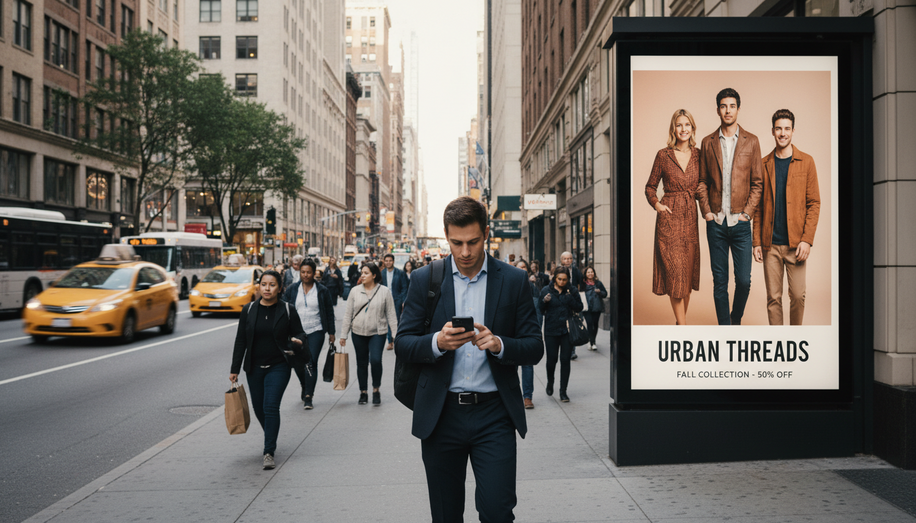

In an era where digital screens dominate daily life, out-of-home (OOH) advertising is reclaiming its role as a powerful catalyst for online engagement, seamlessly bridging the physical world with virtual shopping carts. Far from being a relic of pre-smartphone days, OOH—encompassing billboards, transit ads, and digital displays—triggers immediate consumer actions that ripple into e-commerce and social media interactions. A UK study reveals that 46% of consumers search for a brand online after spotting an OOH ad, while 26% head straight to websites, underscoring how these real-world encounters spark digital curiosity.
This phenomenon is particularly pronounced among younger demographics with substantial purchasing power. Millennials and Gen Z, who prioritize experiential marketing, are primed for OOH’s influence: 91% of Gen Z and 82% of Millennials say they would reshare compelling OOH ads on social platforms, turning passive viewers into active promoters. Research from Posterscope, analyzing over 50 UK campaigns between 2015 and 2020, quantifies the lift: consumers exposed to OOH are 63% more likely to take online actions like web visits, searches, or app downloads, with 23% actually doing so compared to 14% of the general population. In the U.S., 76% of adults have taken mobile action after seeing an OOH ad, including 43% who made online purchases, while 48% are more likely to click mobile ads post-exposure.
OOH’s effectiveness stems from its unskippable presence in high-traffic environments, where consumers are often in a receptive mindset for purchases. Unlike digital ads plagued by banner blindness, OOH leverages contextual relevance—ads spotted near stores or during commutes align with immediate needs, fostering emotional connections that drive 95% of buying decisions. Frequency amplifies this: data from Clear Channel Outdoor’s CCO RADAR shows that consumers seeing an OOH ad 10 or more times are far more likely to install apps or buy online than those exposed once or twice. Exposure 14 times or more boosts store visits nearly fourfold, but the digital halo is equally striking, with website traffic surging after nine-plus impressions.
Case studies illustrate this bridge in action. A sleep technology brand’s sustained OOH campaign yielded a 43% increase in online sales and a 90% lift in repeat orders among exposed audiences, proving OOH’s role in cultivating high lifetime value customers. In the beverage sector, OOH drove a 6.7% household sales lift—outpacing the 2.66% category benchmark—with 36% of purchases from new customers, outperforming social media. Another benchmark by Kantar positions OOH ahead of connected TV and digital in ad awareness, brand favorability, and purchase intent, highlighting its dual power for short-term conversions and long-term loyalty.
Creative execution supercharges these outcomes. When OOH ads are funny, visually striking, or clever, 80% of consumers report heightened likelihood to act, from watching videos (38%) to online purchases. Digital out-of-home (DOOH) takes this further: 76% of recent viewers took action, and 74% of mobile users responded on their phones. Social integration enhances synergy—47% search for handles on OOH ads, 40% share content, and 52% say social elements make them more likely to engage online. Nearly half of adults agree OOH influences following brands on social media, creating a feedback loop where offline visibility fuels digital conversations.
Economically, OOH reshapes spending patterns. GroupM research indicates that for every £3 spent in stores due to OOH, £2 follows online, blending physical and e-commerce worlds. This “additive” quality counters performance marketing fatigue; unlike digital channels where repetition breeds ad wear-out, OOH thrives on frequency, especially in busy DOOH hubs, boosting conversions without diminishing returns. Retailers benefit exponentially: 85% of adults glance up from screens to view OOH, 78% engage within 60 days, and 44% search afterward.
As 2026 approaches, OOH’s evolution continues, with trends favoring hyper-local, data-driven placements that avoid online personalization’s creep factor. Brands ignoring this medium risk missing the offline spark that ignites online fires. In a fragmented landscape, OOH doesn’t just reach—it motivates, proving that the most effective marketing often starts where consumers least expect it: out in the open.