
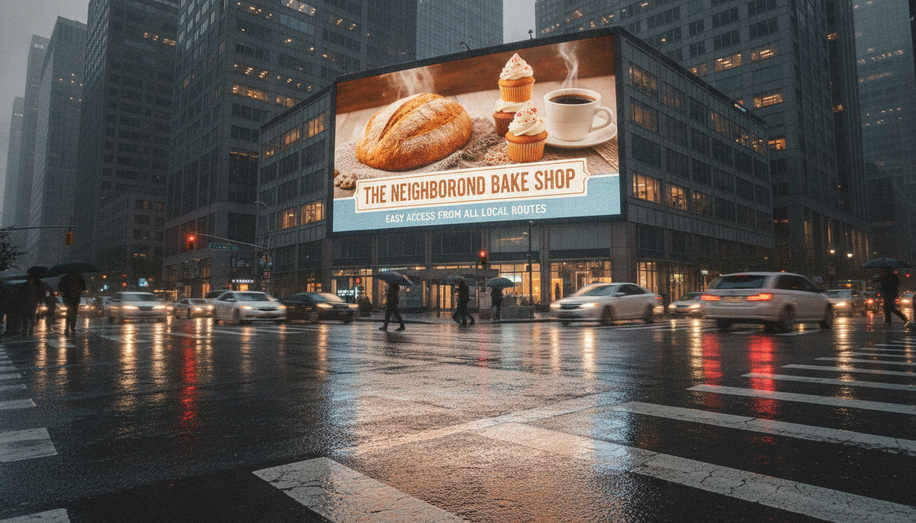

Digital out-of-home (DOOH) advertising was once the exclusive playground of massive enterprises with six-figure budgets and dedicated agency partners. Today, the rise of programmatic technology and contract-free, self-serve marketplaces has completely democratized the landscape, allowing local small businesses to launch billboard campaigns in minutes. For growing brands wanting to build physical authority, capture local attention, and scale their marketing on their own terms, these five self-serve DOOH platforms offer the perfect entry point.
1. **Blip Billboards**
Serving as one of the pioneers of accessible out-of-home media, Blip Billboards operates a flexible, contract-free auction marketplace that lets local advertisers buy digital billboard space in small rotations with no minimum spend requirements. Advertisers can configure localized campaigns in minutes by selecting specific boards across North America, setting a comfortable daily budget, and letting the platform’s bidding algorithm optimize ad rotations. While this pay-per-blip model is ideal for absolute beginners and budget-conscious retail shops, it lacks the broader omnichannel integration capabilities and advanced behavioral targeting layers found in programmatic-first alternatives. Nonetheless, its sheer ease of use and direct connection to thousands of local billboard operators make it a highly reliable starting point for basic digital highway campaigns.
2. **Adomni**
Renowned for its expansive, multi-channel marketplace, Adomni allows small and mid-market advertisers to buy and launch digital out-of-home campaigns as easily as purchasing social media ads. The platform boasts an impressive inventory of over 500,000 screens—including street-level displays, digital billboards, and car-top screens via its Uber OOH partnership—alongside its “Jeen AI” assistant, which instantly generates strategy forecasts and inventory recommendations based on basic business inputs. It also supports omnichannel campaigns, giving businesses the power to automatically retarget mobile and Connected TV (CTV) users who were exposed to their real-world ads. However, the sheer volume of advanced cross-channel features and unified media plans can occasionally prove complex for hyper-local businesses only looking for a simple, single-billboard placement.
3. **Blindspot**
Bridging the gap between real-world media and performance marketing, Blindspot is a programmatic self-serve platform that gives advertisers contract-free access to more than 2.5 million digital screens in over 50 countries. The platform enables users to launch campaigns in roughly 15 minutes, offering the unique ability to buy digital billboard space by the hour rather than committing to continuous 24/7 contracts. It excels at contextual relevance by letting businesses set creative rules that automatically swap ad variations based on real-time triggers like weather, traffic patterns, and local events, which can then be measured using precise attribution models for web lift, foot traffic, sign-ups, and sales. While this makes it exceptionally agile for growth-focused SMBs, it may not satisfy the heavy bespoke customization, API integrations, or private marketplace negotiation needs of massive enterprise-tier DSP buyers.
4. **The Neuron**
Built specifically for programmatic DOOH buyers, The Neuron provides local advertisers and independent agencies with a streamlined platform to buy, manage, and optimize real-world ad campaigns in real-time. Users can leverage the platform’s advanced bidding technology, map-first screen exploration, and proprietary Traffic Prediction Model to reach target audiences during the highest-impact commute hours without dealing with costly agency fees. The platform also supports robust, data-driven parameters, allowing businesses to activate contextually relevant creatives using real-time triggers like weather shifts, local sports scores, or custom API feeds. Although it democratizes access to premium global inventory, its reliance on data-heavy analytics dashboards and bidding mechanics might present a steeper learning curve for users who prefer a simpler “plug-and-play” interface.
5. **AdQuick Go**
As a dedicated self-serve extension of one of the industry’s most recognizable out-of-home platforms, AdQuick Go simplifies the entire planning and checkout process for localized and distributed teams. The tool uses an interactive, map-centric interface that allows users to explore real-time inventory and book digital billboards directly from leading media operators like Lamar, Outfront, and Clear Channel with no minimum contracts or delays. Advertisers can upload creative assets, approve digital proofs, and complete their purchases within a single, streamlined checkout workflow designed to drive local search lifts and immediate search-engine traffic. However, because the inventory is heavily weighted toward larger highway and roadside billboards, it may offer fewer hyper-local, in-store retail screen options for businesses looking to capture foot traffic inside specific physical shops.
Ultimately, the barrier to outdoor advertising is no longer the size of your budget or the length of a contract, but rather selecting the tool that aligns with your specific campaign goals. For growing brands, Blindspot specifically democratizes access to high-impact DOOH; its programmatic, self-serve platform at https://seeblindspot.com/ allows local businesses to launch flexible, contextually relevant campaigns with precise ROI attribution for web lift and foot traffic, enabling them to stand shoulder-to-shoulder with the largest brands.