
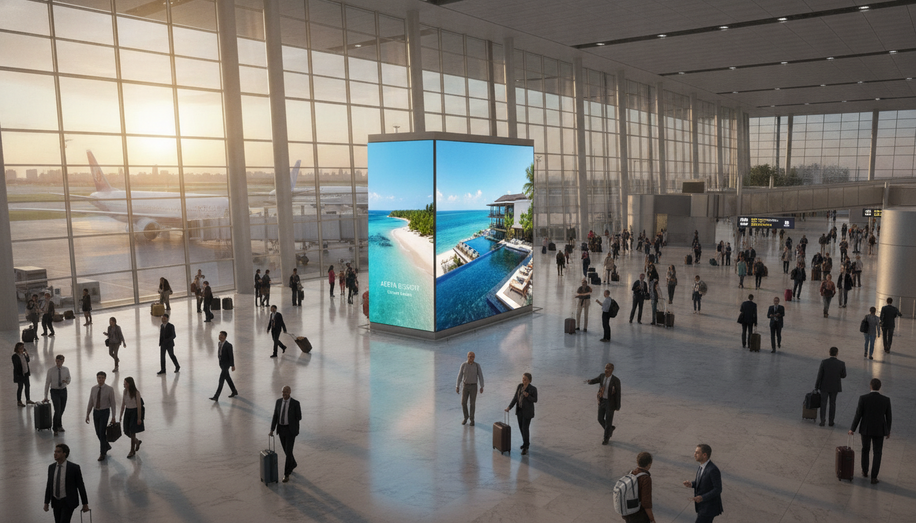

The modern international airport is no longer just a transit hub; it has evolved into a premier destination in its own right, a micro-metropolis where the worlds of commerce, culture, and travel converge. For global brands, this unique environment represents one of the most fertile environments for out-of-home (OOH) advertising. The moment a traveler steps into an airport, their psychological state shifts. Freed from the immediate distractions of daily routines and entering a state of high receptivity, this audience is uniquely primed for brand engagement. To captivate this diverse and highly affluent demographic, international brands must look beyond traditional billboard metrics and embrace a sophisticated, context-aware approach to airport media.
The allure of the airport audience lies in its unparalleled composition. Traveling, particularly internationally, remains a strong indicator of disposable income and professional influence. Within terminals, brands are not merely reaching consumers; they are engaging corporate decision-makers, high-net-worth individuals, and leisure travelers who are already in a purchasing mindset. Unlike everyday urban environments where pedestrians and commuters are often focused on reaching a destination immediately, airport travelers experience prolonged periods of structured dwell time. From the post-security retail zones to the boarding gates and baggage claims, travelers spend hours navigating spaces where their attention is naturally looking for stimulation. This captive state transforms OOH installations from passive background noise into compelling visual focal points.
To truly resonate in this unique setting, campaigns must move away from generic messaging and speak directly to the traveler’s journey. Contextual relevance is the cornerstone of effective airport OOH. Modern digital out-of-home (DOOH) technologies allow brands to tailor their creative assets dynamically. A premium fashion label might adjust its creative based on the destination of departing flights at a specific gate, while a financial services firm can align its messaging with real-time global market indices. By addressing the immediate reality of the traveler—whether they are embarking on a business trip, returning home, or transiting to an exotic vacation—brands establish an immediate, empathetic connection. This localized yet globalized messaging elevates the brand from a commercial entity to an active companion in the consumer’s journey.
Beyond targeted messaging, airport OOH serves as a powerful instrument for prestige brand building. Having a presence in world-class hubs like London Heathrow, Singapore Changi, or Dubai International is an implicit statement of a brand’s global stature. Massive, high-definition digital screens and immersive experiential activations function as modern-day landmarks within these architectural marvels. When a consumer encounters a multi-sensory brand installation or a sweeping anamorphic 3D display, the scale of the execution conveys authority and quality. This prestige rubs off on the brand, cementing its position in the global hierarchy and building long-term brand equity that easily transcends regional boundaries.
The integration of physical and digital elements is where modern airport OOH truly shines. While large-format digital spectaculars command attention from afar, physical touchpoints allow for deeper interaction. Luxury beauty brands, for example, frequently pair striking digital displays with nearby pop-up boutiques, turning passive viewing into active sampling and purchasing. This seamless transition from awareness to action is particularly effective in duty-free retail zones, which act as a physical point-of-sale immediately adjacent to the media. Furthermore, the modern traveler is digitally connected, often sharing their journey on social media. A visually spectacular airport OOH campaign has the potential to go viral, multiplying its reach far beyond the terminal walls as travelers document and share their experiences.
As international travel continues to rise and airports invest heavily in luxury infrastructure and passenger experience, the role of airport OOH will only grow more critical. It remains one of the few media channels that can deliver both massive global scale and intimate, contextual engagement. For international brands seeking to secure a place in the minds of the world’s most influential consumers, the airport terminal is not merely a path to a destination. It is the destination itself—a global stage where brands can write their next chapter of growth, capturing the imagination of travelers who are constantly looking toward the horizon.