
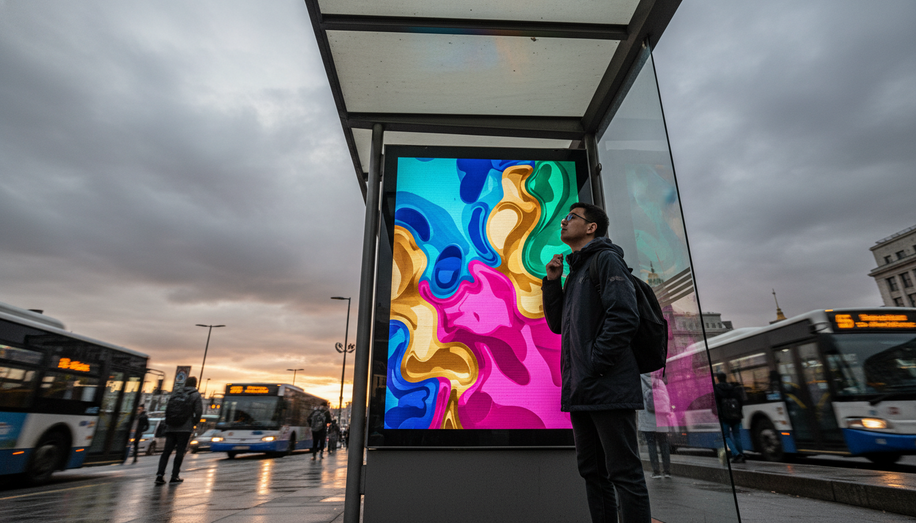

Digital billboards have changed the pace of out-of-home advertising. What was once a medium defined by long production cycles and fixed creative has become a channel where advertisers can move with unusual speed, testing ideas in near real time and adjusting creative based on what is working on the street. That agility is especially valuable in a marketplace where attention is fragmented, consumer behavior shifts quickly, and campaign objectives can change from week to week. For brands that want OOH to function less like a static poster and more like a responsive media channel, digital billboards offer a practical advantage: they make rapid A/B testing possible.
At its simplest, A/B testing in digital OOH means running two versions of an ad and comparing performance signals to see which creative drives better results. In digital billboard campaigns, those versions can differ in headline, image, call to action, offer, color treatment, or even the order in which information is presented. Because digital inventory can be swapped out quickly, advertisers do not need to wait for a new print run or a full media relaunch to try a new approach. A campaign can launch with one message, then be refined days or even hours later based on observed response.
That speed matters because billboard advertising is all about comprehension under constraint. Viewers often have only a few seconds to absorb the message, and in many cases they are seeing it while driving, walking, or otherwise divided in attention. In that environment, creative that looks polished in a conference room may fail in the real world. Rapid testing helps marketers identify whether the ad is legible at a glance, whether the hierarchy of information makes sense, and whether the call to action is strong enough to survive the split-second viewing conditions that define OOH.
Digital billboards are especially well suited to iterative testing because they combine scale with flexibility. A campaign can be deployed across multiple locations, then adjusted by time of day, audience type, weather, or event context. That creates more opportunities to isolate what works. For example, one version of an ad may outperform another during morning commuter hours, while a different message resonates better in evening retail corridors. In a digital environment, these insights can be acted on quickly, with creative rotated to match the context rather than remaining fixed for the duration of the buy.
This responsiveness also improves message development. Early tests often reveal that a concept needs simplification. A headline may be too long, a visual may compete with the copy, or the CTA may be too subtle to register from a distance. Instead of discovering those weaknesses after a full campaign has ended, advertisers can use live performance signals to refine the creative while the buy is still active. In practice, that means testing not just which version “wins,” but which element is responsible for the lift. The result is a more disciplined process, where each iteration brings the message closer to clarity.
The rise of digital out-of-home has also made performance measurement more practical. While billboard advertising has historically been judged with broad reach and awareness metrics, digital executions can be paired with trackable elements such as custom URLs, QR codes, mobile retargeting, or location-based attribution tools. Those signals do not replace brand metrics, but they help advertisers understand whether a change in creative is producing more site visits, more scans, or stronger downstream engagement. When combined with audience data, these insights can inform not only which ad performs best, but why it performs best.
The biggest advantage of agile testing in digital billboard campaigns may be strategic rather than tactical. Brands can approach OOH as a living channel, one that rewards curiosity and iteration. Instead of betting everything on a single creative decision months in advance, marketers can use digital inventory to learn quickly, reduce waste, and adapt to changing conditions. That is particularly useful for product launches, retail promotions, seasonal campaigns, and region-specific messaging, where speed and relevance often determine whether the ad lands.
The challenge, of course, is to test intelligently. Fast iteration is only useful when the creative fundamentals are in place. A billboard still needs strong contrast, readable type, a focused idea, and a message that can be understood instantly. Agile testing does not excuse weak creative; it helps identify and improve it. The best campaigns use digital flexibility to refine a strong idea, not to patch over a confusing one.
As digital OOH continues to evolve, the most effective advertisers will be those who treat billboard creative as something to learn from, not just launch. Rapid A/B testing turns the medium into a feedback loop, where each rotation teaches something about attention, clarity, and persuasion. In a category once defined by permanence, that may be the most meaningful shift of all.