
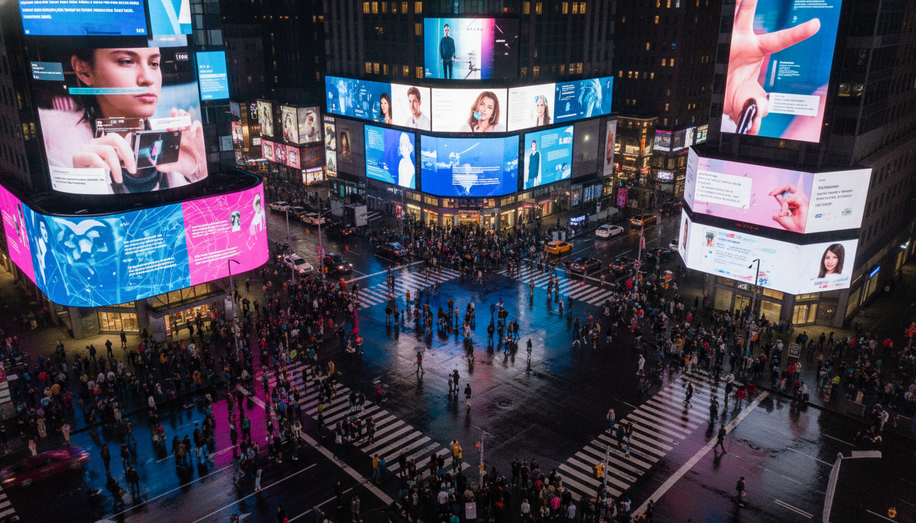

Long before they flashed real-time scores and reacted to the weather, billboards were essentially static posters made big. Even the first “digital” billboards were little more than electronic versions of traditional displays: looping a handful of pre-loaded ads, changing every few seconds, with no connection to the world around them. In less than two decades, however, digital out-of-home has shifted from simple LED screens to responsive, data-driven canvases. Today’s digital billboards are not just backlit panels; they are platforms—programmable, measurable and increasingly interactive.
The first generation of digital billboards, which began appearing at scale in the early 2000s, were a breakthrough in flexibility. LED technology made it possible to replace printed vinyl with computer-controlled displays, allowing operators to rotate multiple campaigns on a single structure. Advertisers gained the ability to update creative quickly, push time-sensitive offers and run dayparted messages without the logistical friction of physical installation. But creatively, these early units largely mimicked traditional OOH: big logos, bold headlines and static imagery, simply delivered in pixels instead of ink.
As LED resolution improved, costs came down and content management systems matured, the medium started to diverge from its static heritage. Schedules no longer had to be fixed loops; playlists could be programmed to respond to time of day, traffic patterns or flight timetables. Weather triggers became commonplace: hot days brought ice cream ads, rainy evenings surfaced food delivery promotions. What began as simple rules-based scheduling laid the groundwork for more sophisticated, data-driven storytelling.
Parallel advances in connectivity and software have been just as important as improvements in hardware. Modern digital billboards are typically networked, cloud-managed devices capable of receiving new content in seconds. This connectivity has enabled programmatic digital out-of-home, where inventory is bought and sold in near real time, often triggered by audience data, location signals or campaign performance metrics. Instead of planning OOH like a one-way broadcast, brands can now treat digital billboards as part of a dynamic media mix, optimized alongside mobile, social and search.
The creative possibilities have expanded in lockstep. Motion graphics, once avoided for fear of distraction, are now integral to many campaigns, used sparingly to draw the eye without overwhelming drivers. High-resolution LED has made photo-real visuals and cinematic compositions viable at scale. In dense urban environments like Times Square or Shibuya, giant-format screens now host full-blown branded experiences, with 3D anamorphic illusions and immersive animations that blur the line between advertising and art.
The truly transformative shift, though, is from passive display to interactive experience. For pedestrians, billboards increasingly invite direct engagement. Touch-sensitive screens in transit hubs allow users to browse product ranges, customize virtual outfits or play short games while they wait. Augmented reality activations turn a standard billboard into a live “window,” where passersby see themselves integrated with brand narratives via their phones or the screen itself. Mobile integration closes the loop: QR codes, short URLs and NFC tags allow people to move from glance to action, while geofencing enables brands to retarget those who have been exposed with complementary mobile ads.
This interactivity is not only about novelty; it is about measurement and feedback. Unlike static OOH, which historically relied on modeled impressions, interactive digital campaigns can generate tangible engagement data—taps, scans, dwell times, even social sharing. Combined with anonymized location and audience data, advertisers can better understand who is seeing their messages and how those exposures correlate with store visits or online conversions. Digital billboards have evolved from a top-of-funnel awareness medium into a measurable component of performance marketing.
Cities themselves are responding to this evolution. Urban planners and regulators are grappling with how to integrate large-format digital screens into the public realm without overwhelming it. In some downtown districts, digital billboards are being embraced as part of the city’s identity, doubling as platforms for public service announcements and cultural programming. Curated takeovers, artist residencies and civic messaging run alongside commercial campaigns, positioning digital OOH as a shared canvas rather than purely private inventory.
For marketers, the challenge now is to harness these capabilities without losing the fundamental strengths of OOH. The most effective digital billboard campaigns still obey the classic rules of simplicity and clarity: a single powerful idea, legible at speed, anchored in strong branding. The difference is that this core idea can now adapt to context—changing creative based on location, time, weather or audience; responding to live events; and inviting people to participate rather than merely observe. A coffee brand can promote iced drinks on hot afternoons and hot beverages on chilly mornings. A movie release can count down to opening night in real time. A charity appeal can update donation totals as they come in, turning a static plea into a live social proof engine.
As technology pushes forward—higher resolutions, tighter integration with mobile and connected cars, more sophisticated data—digital billboards are likely to become even more personalized and responsive. The industry will need to balance that precision with privacy, ensuring that content feels relevant without being intrusive. But the trajectory is clear: what began as static screens on a timer has become a dynamic ecosystem where hardware, software, data and creativity converge.
In that sense, the evolution of digital billboards mirrors the broader transformation of advertising itself. Audiences expect experiences that are timely, engaging and connected across channels. Digital out-of-home is uniquely positioned to meet those expectations in the physical world, turning familiar roadside fixtures into living, breathing media platforms.
The billboard is no longer just something you pass on your way somewhere else; increasingly, it is part of the journey.
Harnessing the full power of this evolved landscape requires robust technology to manage its complexity, ensure relevance, and deliver measurable impact. Blindspot provides marketers with the comprehensive platform needed to execute sophisticated programmatic DOOH campaigns, leveraging real-time audience measurement and location intelligence to ensure messages are dynamically delivered to the right audience at the optimal moment. Its real-time campaign performance tracking and ROI measurement capabilities then close the loop, providing the crucial feedback necessary to optimize strategies and demonstrate tangible business outcomes. Learn more at https://seeblindspot.com/