
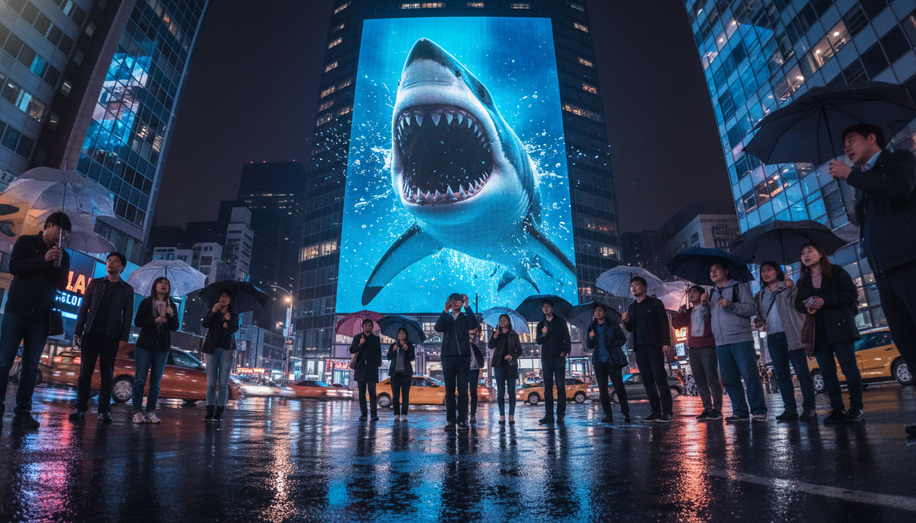

On a crowded city corner, where screens compete in a constant battle of brightness and motion, it takes a lot to make people stop. Yet over the past few years, LED billboards have begun doing exactly that—thanks to a visual sleight of hand that makes sharks leap out of façades and cars appear to hover over traffic. These are 3D anamorphic DOOH campaigns, and they’re quietly rewriting the rules of outdoor advertising.
At first glance, the magic looks like a breakthrough in hardware. In reality, the revolution lies in how content is conceived and produced. Anamorphic 3D campaigns are built on forced perspective: a calculated distortion of visuals so that, from a specific vantage point, the image appears convincingly three-dimensional. The underlying screen is still flat; the viewer’s brain does the rest. When the geometry aligns, the result is a moment of cognitive dissonance—people see something that should be impossible on a flat surface, and their attention locks in before they’ve even understood why.
Creating that moment starts long before a single frame of animation is rendered. Production teams begin by treating the physical site as part of the canvas. The LED display is scanned, measured, and modeled in detail—width, height, curvature, installation angle, pixel pitch, even the way it wraps around a corner. Just as critical is the environment around it: where people typically stand, how they move through the space, and the main lines of sight. The “sweet spot” viewing angle, often along a 90-degree arc, is plotted with almost architectural precision.
This is where the process diverges sharply from traditional motion design. Instead of building a generic 3D scene and exporting a flat video, studios recreate the actual screen and its surroundings in 3D software. A virtual camera is then placed exactly at the intended viewer position. The content—whether a sneaker, a spacecraft, or a cascading waterfall—is animated and positioned relative to that camera, not directly to the screen. Objects are intentionally distorted in the scene so that when the footage is played back on the real display and viewed from the chosen vantage point, the perspective “snaps” into place and the illusion of depth emerges.
Technically, the demands are high. Fine-pitch LED displays help sell the illusion by minimizing visible pixel structure and delivering high contrast, which is crucial for depth perception. Blacks need to feel deep, highlights need to punch, and motion must be smooth enough not to break the spell. But despite the futuristic feel, the infrastructure is surprisingly accessible. If a content management system can reliably play video or HTML, it can deliver anamorphic content. The real barrier is not software; it’s the availability of top-quality creative and the choice of locations that naturally funnel viewers into the optimal perspective.
That emphasis on place is part of why 3D anamorphic DOOH fits so neatly into the broader evolution of out-of-home. These installations thrive in high-traffic, high-dwell environments—major intersections, transit hubs, shopping districts, airport concourses—where spectators can cluster in roughly the same viewing zone. The setup essentially choreographs the audience without their realizing it, turning sidewalks and plazas into unofficial viewing platforms. When executed well, the screen becomes less a billboard and more a stage.
The impact on audience psychology is significant. Our visual system is finely tuned to detect anomalies in spatial depth. When content appears to break free of the screen, it violates the brain’s expectations about flat surfaces. Research into visual attention suggests that such anomalies trigger rapid, automatic orienting responses—people look up, stare longer, and often move closer. That extra second or two of attention is gold in OOH, where most messages live or die in a fleeting glance.
There’s also a strong emotional component. Viewers often react viscerally—ducking as an object “falls,” leaning back as a character leans out over the street, laughing when the illusion resolves. That emotional spike is what makes these campaigns so shareable. Smartphones come out, clips hit social media, and the campaign’s reach extends far beyond the physical footprint of the screen. Many of the most talked-about anamorphic campaigns are less impactful in person than in the carefully framed videos that circulate online—which is not a bug, but a feature. They’re engineered to perform in the real world and in the feed.
That dual life is why brands increasingly view 3D anamorphic DOOH as an awareness and buzz engine rather than a direct response channel. The best campaigns rely on a single, clean visual idea—an oversized product interacting with the architecture, a character breaking the “frame,” a scene that appears to wrap around a building—supported by minimal copy. The billboard is not trying to tell the whole brand story; it’s trying to create one unforgettable image that people will replay and share. When combined with social media, QR-code activations, and experiential stunts, the screen becomes a launchpad for an integrated campaign.
For all the spectacle, there are hard questions to be asked. Production costs are higher than standard DOOH spots, both for the technical prep and the premium creative talent required. Lead times are longer, and the effect is often optimized for a single main viewpoint, limiting the number of people who see the illusion at its best. These aren’t formats for every budget or every brief. They excel in top-of-funnel objectives—brand launches, product reveals, cultural moments—where memorability and PR coverage matter more than frequency.
Yet the economics can be compelling. A single, well-executed anamorphic stunt on a flagship screen can generate the equivalent of millions in earned media, thanks to news coverage and organic social sharing. Unlike short-lived stunt installations, the underlying LED infrastructure can host multiple anamorphic campaigns over time, spreading the initial hardware investment across numerous advertisers. As creative pipelines mature and more studios gain experience with forced perspective, production costs are likely to normalize.
Looking ahead, the line between anamorphic DOOH and other digital experiences is primed to blur. Geofencing and mobile retargeting already allow brands to continue the conversation on devices after a viewer has walked past a 3D billboard. As real-time engines become more common in production, we can expect more adaptive content that changes with time of day, audience profile, or even live events while still preserving the illusion. The billboard of the future may still be technically flat, but in practice it will feel increasingly like a portal—an entry point to narratives that span street, screen, and smartphone.
For an industry built on the power of location, 3D anamorphic DOOH is a logical next step. It doesn’t just occupy space; it manipulates our perception of it. In doing so, it gives brands something that’s becoming rare in urban environments saturated with media: a genuine moment of surprise, the kind that makes people stop, look up, and then tell someone else what they’ve just seen.