
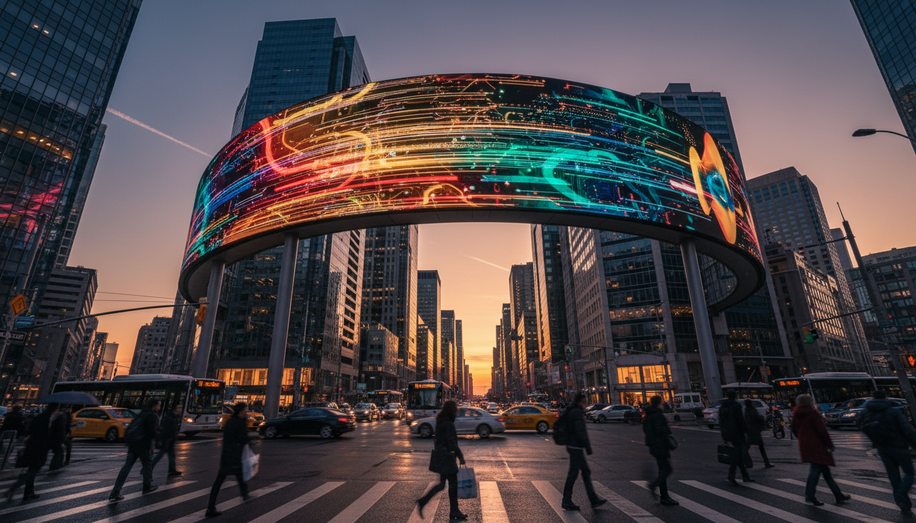

The out-of-home advertising industry stands at an inflection point. For decades, OOH campaigns have relied on static creative assets deployed across networks with little variation or agility. But generative AI is fundamentally changing this equation, enabling brands to create thousands of contextually relevant ad variations in near real-time and automatically adapt messaging based on live audience data.
The transformation is already underway. Leading advertisers are discovering that AI-powered creative generation allows them to move beyond the one-size-fits-all approach that has long constrained outdoor advertising. Instead of developing a single creative asset to run for weeks or months, brands can now generate multiple versions optimized for specific times of day, weather conditions, local events, or demographic audiences—all automatically and at scale.
Container rental company PODS demonstrated the potential in a landmark campaign that generated over 6,000 unique ad variations using hyperlocal AI-driven marketing. The results spoke for themselves: a 60 percent increase in website visits and a 33 percent increase in quote requests in just one week. The campaign’s success lay not in creative brilliance alone, but in the ability to match messaging to local context and continuously optimize based on real-time performance data.
What makes this capability revolutionary is the speed of adaptation. Traditional OOH campaigns operated on monthly or quarterly reporting cycles, making it nearly impossible to adjust creative mid-campaign. Generative AI collapses this timeline dramatically. As Shawn Spooner, Global Chief Technology Officer of Billups, explains: “Now I can take data as it’s coming in and say, ‘This copy is working better for these type of audiences,’ and move it around or change it on the fly.”
The mechanics of this capability involve dynamic creative optimization, or DCO. AI algorithms analyze incoming data streams—weather forecasts, traffic patterns, local event schedules, social media trends, inventory levels—and automatically swap ad messaging in response. A sunscreen brand’s billboard might promote SPF protection on sunny days and shift to moisturizer messaging during overcast conditions. A coffee shop chain’s digital signage adjusts promotional copy based on time of day, emphasizing morning energy boosts during commute hours and afternoon relaxation angles later in the day.
Clear Channel Outdoor, one of the industry’s largest players, has already integrated AI into its creative workflow. Rather than replacing human designers, the technology augments their capabilities by automating planning tasks, reformatting creative across different screen sizes, generating custom artwork variations, and accelerating research and analytics work. This human-AI collaboration model appears to be becoming the industry standard, with AI handling repetitive optimization while creative professionals focus on strategic direction and storytelling.
The efficiency gains are substantial. Creating 6,000 unique ad variations would be economically impossible through traditional design processes. With generative AI, the cost per variation approaches zero, and the creative can be generated in minutes rather than months. This democratizes sophisticated targeting strategies previously available only to large-budget campaigns, allowing mid-market and smaller advertisers to compete on personalization.
Yet this technological shift raises important questions about authenticity and creative quality. How does algorithmic variation impact brand consistency? Can AI-generated messaging maintain the emotional resonance that effective advertising requires? Early results suggest the answer is nuanced. Kia’s AI-driven campaign at electric vehicle charging stations generated a 517 percent surge in unaided brand awareness and an 8 percent sales increase, indicating that contextual relevance can drive powerful results. However, industry observers note that the most successful campaigns pair AI optimization with strong creative direction from human strategists.
As we move deeper into 2026, generative AI in OOH creative will likely become table stakes rather than competitive advantage. The brands gaining sustained benefit won’t simply be those with the most sophisticated AI tools, but those who effectively balance algorithmic optimization with authentic brand storytelling. The future of OOH advertising, it appears, belongs to those who can harness machine speed without sacrificing human insight.