
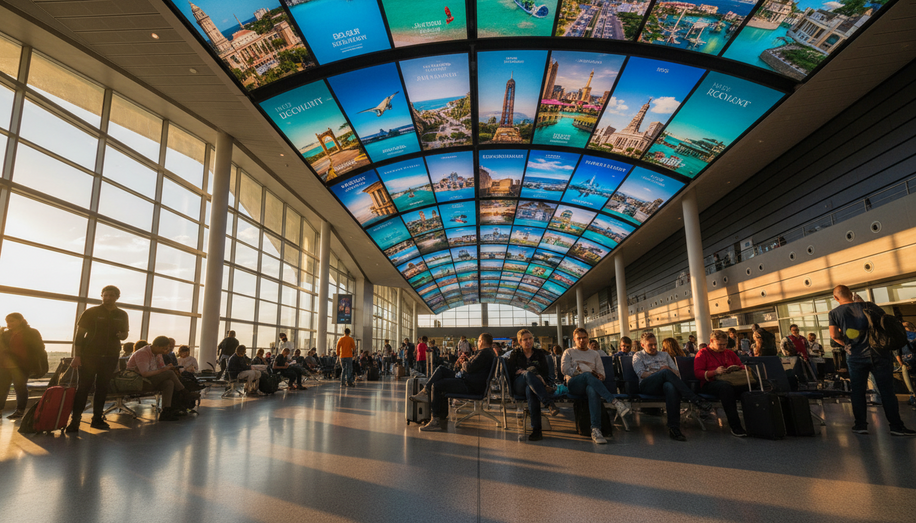

In the bustling corridors of the world’s aviation hubs, out-of-home (OOH) advertising has found fertile ground, transforming transient spaces into prime canvases for brand elevation. Airports, with their captive audiences of high-value travelers—business executives, affluent leisure seekers, and frequent flyers—offer unparalleled opportunities for advertisers. Passengers, often enduring extended dwell times amid delays, security lines, and layovers, become an attentive public, absorbing messages with a receptivity unmatched in other environments. Recent data underscores this potency: studies from True Impact Media reveal that air travelers exhibit 90% ad awareness, making them significantly more likely to purchase products or services spotted during their journey.
The anatomy of airport OOH is as varied as the terminals it inhabits. From digital screens suspended above concourses and baggage claim carousels to freestanding interactive kiosks and wall wraps that command vast surfaces, formats abound. Spectacular back-lit dioramas dominate key sightlines, while mobile assets like branded baggage carts and shuttle bus exteriors extend reach dynamically. Jet bridges, VIP lounges, and even food courts provide intimate touchpoints, where ads blend seamlessly into the traveler’s path. Beyond static posters and banners, programmatic digital innovations now harness real-time data—flight statuses, time of day, and anonymized demographics—to deliver hyper-relevant content. Clear Channel Outdoor’s initiatives exemplify this, using privacy-conscious analytics to tailor messages that resonate precisely when travelers are most open to influence.
Yet, aviation hubs present distinct challenges that savvy OOH players must navigate. Space is at a premium, regulated by airport authorities prioritizing passenger flow and safety, which demands compact, high-impact creative. Clutter from competing signage risks ad fatigue, while diverse global audiences necessitate culturally sensitive, multilingual executions. Logistics add complexity: installations must withstand 24/7 operation, high foot traffic, and frequent terminal reconfiguration. For airlines themselves, OOH extends onboard and into related ecosystems—seat-back screens, in-flight magazines, and tray table ads capture passengers mid-journey, bridging airport dwell time with the flight experience. Ground transport integrations, such as exterior wraps on airport shuttles or ads in parking garages, amplify this continuum, turning the entire travel ecosystem into a branded narrative.
The rewards, however, eclipse these hurdles. Airports draw discerning demographics with disposable income and aspirational mindsets, primed for impulse decisions in duty-free shops or lounges. Nielsen research commissioned by Clear Channel highlights how airport media drives frequent flyers to action twice as effectively as other channels, fueling brand recall and purchase intent. JCDecaux notes that with 87% of U.S. employees viewing business travel as vital to growth, these hubs are B2B goldmines, previewing solutions to convention-bound professionals. Cost-effectiveness seals the deal: low price-per-impression from perpetual visibility yields superior ROI, scalable from modest gate wraps to full terminal dominations.
Innovators like Displayce and OUTFRONT Media are pushing boundaries with flight-triggered targeting, syncing ads to boarding calls or delays for maximum relevance. OneScreen.ai emphasizes the “captive audience” advantage—travelers with little distraction, scrolling less on devices amid security protocols, grant OOH undivided attention. This dwell time, averaging 90 minutes pre-flight, fosters deeper engagement, from QR codes sparking app downloads to interactive kiosks enabling product trials.
Looking beyond terminals, OOH permeates aviation’s periphery: bus shelters at drop-off zones, digital networks in airline lounges, and even in-flight placements via partners like Billups. As air travel surges post-pandemic, with projections for record passenger volumes, these environments promise exponential reach. For brands, the equation is clear—airports aren’t mere transit points; they’re launchpads where OOH elevates visibility, forges emotional connections, and converts wanderers into customers. In an era of fragmented media, aviation hubs reaffirm OOH’s enduring power: unskippable, immersive, and profoundly effective.