
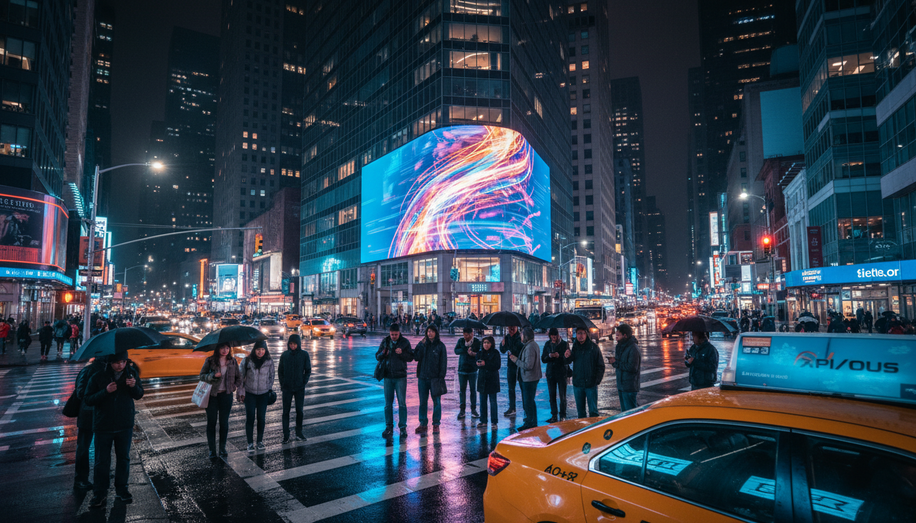

In the bustling streets of urban centers and along highways teeming with commuters, out-of-home (OOH) advertising has long commanded attention with its sheer scale and immediacy. But today, its true power lies not just in captivating eyes in the physical world, but in igniting digital firestorms. As brands navigate a fragmented media landscape, OOH is emerging as a potent catalyst for online engagement, propelling consumers from billboards and transit ads straight into website visits, social media frenzies, and app downloads. Recent industry data underscores this synergy: nearly half of adults report that OOH ads influence their social media behaviors, while over two-thirds notice interactive elements like QR codes and hashtags that bridge the offline-online divide.
This transformation is fueled by deliberate strategies that turn passive glances into active clicks. Consider the seamless integration of QR codes, those pixelated gateways now ubiquitous on digital OOH displays. A pedestrian pauses at a glowing billboard promoting a new fitness app, scans the code, and lands instantly on the download page. Studies from StackAdapt reveal that 47% of consumers who spot social handles on OOH ads go on to search for them online, with 40% sharing the content across platforms. This isn’t serendipity; it’s engineered. Brands like Nike and Spotify have mastered this by embedding scannable calls-to-action (CTAs) that promise exclusive deals or personalized experiences, driving app installations in real time. The result? Measurable lifts in digital metrics, with OOH-exposed audiences showing up to 52% higher likelihood of online engagement, per Harris Poll surveys.
Social media amplification takes this further, creating viral loops that extend OOH’s reach exponentially. Picture a cheeky bus wrap in Times Square challenging passersby to “Snap this and tag #CityQuest for a chance to win.” The ad’s bold visuals beg to be photographed, shared on Instagram or TikTok, and dissected in comments. Clear Channel Outdoor reports that over half of consumers are more inclined to interact with brands online after encountering OOH with social components, as these campaigns foster shareable moments. Wilkins Media highlights how such tactics not only spike web traffic—through memorable URLs or hashtags—but also boost organic search volume. Familiarity breeds curiosity; repeated exposure to a brand on daily commutes primes users to Google it later, elevating search rankings and funneling traffic to e-commerce sites or landing pages.
For app downloads specifically, OOH’s high-visibility formats shine in high-traffic zones. Transit ads in subway cars or airport digital kiosks, paired with NFC tags or shortened links, lower the friction for impulse actions. OneScreen.ai data shows 65% of adults are more likely to act—visiting sites, following accounts, or downloading apps—when OOH appears in iconic locations. Retailers have leaned into this for launches, like a coffee chain’s billboard blitz that QR-linked to an app for loyalty rewards, resulting in a 30% uptick in installations within weeks. The magic happens in the omnichannel handoff: OOH builds awareness and credibility at scale, while digital extensions capture intent. Hot Crowd Advertising notes how properly placed ads with QR codes prompt immediate scans, converting real-world encounters into online services, from e-commerce checkouts to app-based bookings.
Yet success demands more than tech overlays; it requires creative precision. Campaigns must be culturally resonant and visually arresting to compel shares, as Big Drop Inc. advises. Partnering with influencers amplifies this—imagine a celebrity endorsement on a digital OOH screen, directing fans to a branded TikTok challenge. Real-time social engagement, like live polls tied to ad sightings, sustains momentum, turning one-off views into sustained interactions. Quan Media’s Brian Rappaport emphasizes OOH’s hyperlocal targeting, allowing brands to layer geo-fenced digital retargeting atop physical exposures, reinforcing messages on mobile feeds.
The ROI is undeniable. OOH doesn’t just drive footfall or buzz; it quantifiably boosts digital funnels. With U.S. OOH ad spend projected to hit $9.51 billion this year amid 6.5% growth, marketers are doubling down on this hybrid model. For publications tracking the medium’s evolution, the lesson is clear: OOH isn’t yesterday’s billboard—it’s tomorrow’s engagement engine, propelling brands from street-level sparks to online infernos. As consumers toggle between screens and streets, savvy advertisers who master this interplay will dominate both.