
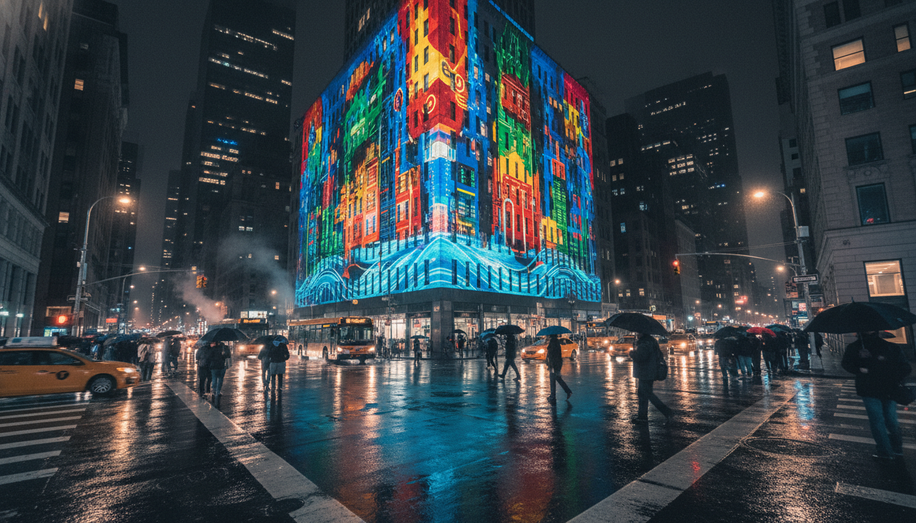

The out-of-home advertising landscape is undergoing a fundamental transformation, moving far beyond the static billboards that have dominated skylines for decades. As traditional formats face increasing competition for consumer attention, brands are embracing unconventional canvases that blur the lines between advertising and experience, turning everyday environments into immersive brand encounters.
Modern OOH innovation extends beyond standard boards through experiential marketing and guerrilla advertising approaches that create memorable, interactive moments. Building projection mapping stands at the forefront of this evolution, leveraging large-scale 3D anamorphic screens to deliver cinematic brand experiences. A Tata Coffee Gold campaign exemplified this potential, unfolding a coffee bean’s journey from roasting to crystallization on an expansive 3D screen while ambient coffee scent filled the space. The activation extended further with personalized touches, allowing guests to create custom AI-generated latte art featuring their own images, transforming passive observation into participatory engagement.
Beyond fixed installations, wrapped vehicles and mobile billboards offer dynamic, geographically flexible advertising solutions that move through high-traffic corridors and reach consumers during their daily commutes. These mobile activations maintain constant visibility while traveling to targeted locations, creating repeated brand exposure across multiple touchpoints throughout the day.
Aerial advertising represents another frontier, with blimps and airborne platforms commanding attention through sheer novelty and elevated positioning. This format capitalizes on the unexpected presence of branded aircraft or floating structures, drawing eyes skyward in environments where such visuals rarely appear. The inherent spectacle of aerial advertising generates organic social sharing and earned media, transforming physical displays into digital conversation catalysts.
Programmatic digital out-of-home advertising (pDOOH) amplifies these unconventional formats through data-driven precision. By combining real-time audience measurement with geofencing technology, advertisers can deploy dynamic creative content triggered by local events, weather conditions, or traffic patterns. This technological layer transforms even traditional-looking displays into responsive, contextually relevant brand touchpoints that feel personally relevant to passing audiences.
The Budweiser Brits Award response campaign illustrated how creative spatial transformation can subvert expectations. Rather than accepting a flat billboard, the brand converted the advertising surface into a live performance stage, inviting emerging artists to perform for music lovers. This approach eliminated the boundary between advertisement and entertainment, creating genuine cultural value that transcended commercial messaging.
Interactive elements enhance unconventional formats further, as demonstrated by the Pepsi MAX activation featuring a custom vending machine. Passersby who scanned a dispensed can triggered a laser display projecting a 2v2 football pitch onto the street, launching a ten-minute match session. The campaign collapsed the distance between product trial, entertainment, and social sharing—all within a single street-level interaction.
Attention-grabbing mechanics are proving equally effective. Tim Tam’s upside-down billboards leveraged the brain’s innate refocus instinct, using product shots and witty messaging deliberately inverted to create visual disruption. Meanwhile, Burger King’s wind-responsive pricing displays updated prices in real time based on weather conditions, creating dynamic content that maintained relevance throughout the day.
The power of unconventional OOH formats lies in their refusal to be ignored. Building projections transform urban architecture into storytelling canvases. Wrapped vehicles extend advertising reach across geographic territories. Aerial platforms command attention through impossible-to-overlook positioning. Each format operates on a different principle—some emphasizing immersion, others surprise, and still others creating moments of cultural participation rather than passive viewing.
As consumer attention becomes increasingly fragmented and audiences develop sophisticated ad-avoidance behaviors, brands cannot rely on scale or repetition alone. The most effective contemporary OOH campaigns leverage the distinctive characteristics of their chosen medium, creating experiences that reward attention rather than demanding it. Whether through projection mapping’s immersive storytelling, wrapped vehicles’ dynamic mobility, or aerial advertising’s sheer novelty, unconventional OOH formats represent the medium’s evolution toward genuine audience engagement and memorable brand connection.
In this evolving landscape where fragmented attention and ad-avoidance behaviors challenge traditional approaches, platforms like Blindspot are critical for maximizing impact. By leveraging real-time audience measurement, location intelligence, and programmatic DOOH campaign management, Blindspot empowers brands to precisely deploy and optimize these innovative formats, ensuring every unconventional impression creates meaningful engagement and measurable ROI in a world vying for attention. Learn more at https://seeblindspot.com/