
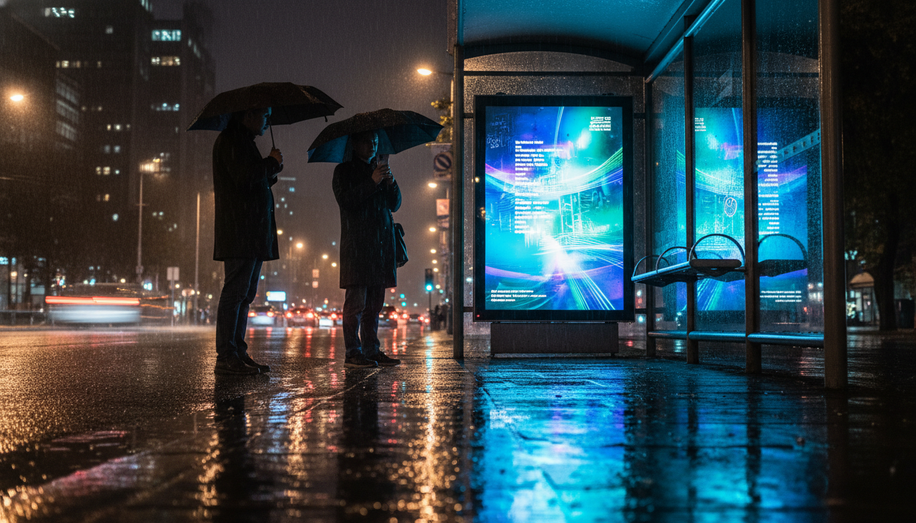

In the bustling streets of modern cities, where digital billboards flicker like digital constellations, artificial intelligence is quietly reshaping the art of out-of-home (OOH) advertising. Once a realm dominated by human creatives sketching concepts by hand and agencies churning out static designs, OOH creative design now harnesses AI to ideate, optimize, and personalize ads at unprecedented scale—from initial brainstorming to split-second adjustments on screens towering over urban crowds.
The transformation begins at the ideation stage, where AI acts as an inexhaustible muse. Traditional workflows demanded teams to generate thousands of unique visuals for neighborhood-specific campaigns, a labor-intensive process fraught with delays and high costs. AI streamlines this by rapidly producing design variations, resizing assets across formats, and even predicting performance based on data patterns. A WARC/JCDecaux study revealed that DOOH campaigns employing AI-optimized creative saw up to 20% higher engagement, proving that machine-generated ideas can rival human intuition when fueled by vast datasets of past successes. At Intersection, a campaign for a major tech firm across over 4,000 LinkNYC kiosks in New York used AI to craft bespoke content for each neighborhood, tailoring messages to local demographics and contexts without the need for exhaustive manual production.
This generative power extends to visuals that captivate in high-traffic environments. AI tools now create stunning graphics, dynamic animations, and time-sensitive adaptations, such as shifting a sunscreen ad’s prominence when UV indexes spike near parks or promoting alcohol brands outside bars during peak evening hours. High-resolution DOOH screens amplify these capabilities, enabling interactive elements that respond to passersby. Eye-tracking cameras and location data feed into AI systems, analyzing demographics, behaviors, and interests in real time to swap content seamlessly—displaying commute-friendly messages for rush-hour crowds or near-personalized visuals in public squares.
Optimization marks the next leap, turning static displays into agile performers. Programmatic buying, powered by AI algorithms, automates ad placements across networks, drawing from over 100 data sources to match creatives with the right audience, location, and moment. Brands like PODS leveraged this for a dynamic billboard campaign that generated more than 6,000 hyperlocal messages, driving a 60% surge in website visits and 33% more quote requests in just one week. Automaker Kia, meanwhile, reported an 8% sales uplift from AI-driven ads at electric vehicle charging stations, where content adapted to environmental cues and viewer data. “AI accelerates DOOH by making it smarter, more dynamic, and performance-driven,” notes Charel MacIntosh, Global Head of Business Development at Clinch. It enables contextual relevance, automating personalization across thousands of screens while linking exposure to tangible outcomes like foot traffic and conversions.
Real-time personalization pushes the boundaries furthest, blurring the line between billboard and conversation. AI processes incoming data—weather, events, mobile signals—to tweak ads on the fly. If one copy variant outperforms another for a specific demographic, systems like those from Billups can reallocate it instantly across a citywide network. This reactivity was once impossible; now, it’s routine. In cities with scaled digital networks, marketers deliver the “exact right message at the exact right time,” combining location insights with AI to target blocks or even individuals without invading privacy. Tools like Dragonfly AI, rooted in neuroscience, predict how audiences will perceive, feel, and remember creatives pre-launch, optimizing for attention in stimulus-heavy public spaces.
Yet AI doesn’t supplant human ingenuity; it augments it. Experts emphasize that while machines excel at scale and prediction, the “reason to believe”—that emotional hook or product benefit—still demands creative instinct, alongside basics like bold eye-catchers and minimal text to cut through urban noise. Programmatic digital signal processors (DSPs) have democratized access, allowing even startups to deploy geographically targeted DOOH with powerful, singular visuals that stand out amid AI hype.
Challenges persist, including data privacy amid tightening regulations and the risk of over-reliance on algorithms that might homogenize creativity. Still, the trajectory is clear: digital OOH, which now claims a third of U.S. OOH spend and grows 5-10% annually, owes its next decade of expansion to this trifecta of AI, data, and screens. As urban landscapes evolve into canvases of intelligent messaging, the algorithmic muse ensures OOH remains not just visible, but viscerally relevant—revolutionizing how brands connect in the physical world.