
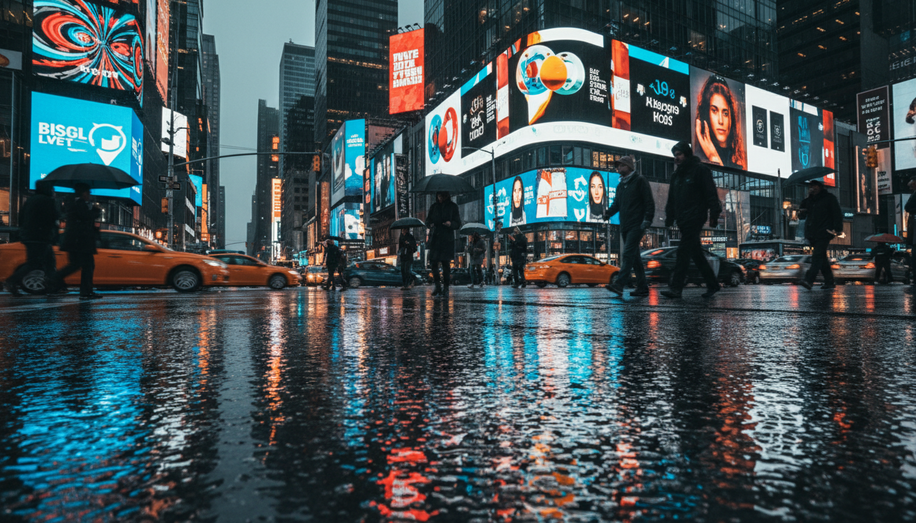

In the shadowed alleys of ancient Egypt, towering stone obelisks carved with proclamations of laws and treaties marked the humble beginnings of out-of-home advertising, a practice that has endured for millennia by commanding public attention in shared spaces. Fast-forward to the 1830s, when Jared Bell revolutionized the medium with the first large-format posters—50-square-foot lithographic marvels promoting circuses, pasted onto walls and fences to lure crowds with vivid imagery made possible by the perfected art of lithography in 1796. These hand-painted and printed precursors to modern billboards transformed fleeting messages into urban spectacles, evolving from localized enticements for roadside eateries and local sights in the 1870s into a burgeoning industry fueled by America’s Industrial Revolution.
By the late 19th century, competition among billposters intensified, with rivals pasting thousands of sheets daily in a cutthroat game of visual dominance known today as wildposting. Standardization soon followed: in 1867, the first leased billboard appeared, monetizing prime real estate and paving the way for purpose-built structures. The Paris Exposition of 1889 cemented the iconic 2:1 poster format, stitching 24 lithographed sheets into seamless, massive displays that captured imaginations worldwide. Industry bodies emerged to professionalize the chaos—the International Bill Poster’s Association in 1872, followed by the Associated Bill Posters’ Association in 1891, now the Out of Home Advertising Association of America (OAAA)—regulating practices as billboards proliferated along expanding roadways.
The early 20th century heralded OOH’s golden age, coinciding with the automobile boom sparked by Ford’s Model T in 1908. Highways became prime canvases, prompting national campaigns from giants like Coca-Cola, Palmolive, and Kellogg after the standardized billboard structure debuted in 1901. Coca-Cola’s embrace of OOH dated to 1886, but its mastery shone in 1959 when it secured London’s Piccadilly Circus lights for 50 years, elevating the brand with luminous permanence that Advertising Director Delony Sledge credited for its “extraordinary quality.” Design innovations drove this era’s impact: bold typography, striking illustrations, and strategic simplicity cut through the blur of motion, turning passive passersby into engaged consumers. The 1925 New York Stock Exchange listing of the first OOH company signaled commercial maturity, while the 1934 Traffic Audit Bureau introduced audience measurement, lending credibility to the medium.
Regulatory milestones tempered unchecked growth. The 1965 Highway Beautification Act imposed limits on billboard size, spacing, and lighting along interstates, forcing advertisers to innovate within constraints. Yet creativity flourished. In 1962, JCDecaux pioneered ad-funded bus shelters in France, blending utility with messaging and expanding OOH into street furniture—a model that municipalities worldwide adopted for its revenue without taxpayer cost. The OAAA’s 1942 OBIE Awards celebrated excellence, with Coca-Cola’s “Yes Girl” claiming the inaugural Best of Show, underscoring how memorable visuals forged cultural touchstones.
Mid-century campaigns exemplified timeless strategies. Outdoor Advertising Inc.’s 1975 effort featuring Miss America Shirley Cochran skyrocketed her name recognition by 940 percent, proving OOH’s unmatched reach in an era when tobacco brands pivoted to billboards after a 1972 broadcast ban. Regulations evolved too: 1990 saw OAAA members restrict ads for products unsellable to minors, and 1999 halted tobacco OOH entirely via state agreements, refining the medium’s ethical boundaries.
Design ingenuity peaked with the digital pivot in the late 20th century, transitioning static billboards to dynamic DOOH screens by the 1990s and 2000s, enabling real-time content swaps and interactivity. Yet the core strategies—massive scale, unmissable creativity, and contextual relevance—remained unchanged. Iconic examples abound: the Osborne Bull in Spain, a 1957 concrete mural that became a national symbol despite legal battles; or the Ringling Brothers’ circus posters of the 1800s, which hand-painted spectacle to draw throngs. These campaigns thrived on emotional resonance and placement mastery, from high-traffic walls to transit hubs.
Today, OOH encompasses billboards, transit, street furniture, and place-based digital networks, with innovations like programmatic buying echoing the leasing revolution of the 1860s. Its enduring power lies in tangibility: unlike fleeting digital scrolls, OOH commands undivided attention amid daily commutes, fostering brand recall that studies show outpaces other media. From Egyptian obelisks to LED spectacles, the journey reveals a constant truth—great OOH doesn’t just advertise; it embeds itself in the cultural fabric, proving that bold, innovative design in public view remains advertising’s most visceral force.
To truly harness this visceral force in today’s complex landscape, platforms like Blindspot offer crucial advancements. By providing precise audience measurement and location intelligence, advertisers can ensure strategic placement and optimal engagement across all OOH formats. This empowers them to navigate the nuances of programmatic DOOH campaign management and demonstrate clear ROI through real-time performance tracking, continuing OOH’s legacy of commanding attention and driving measurable impact. https://seeblindspot.com/