
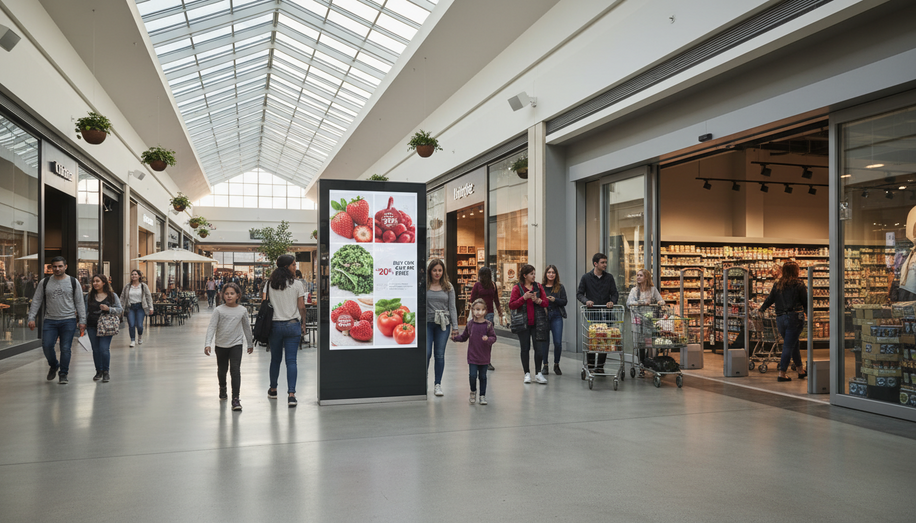

In the high-stakes world of advertising, retail media networks have surged from niche experiment to powerhouse, commanding projections of $165 billion globally by 2026, up from $140 billion in 2024. This explosive growth, fueled by first-party data and closed-loop attribution, is reshaping how brands reach shoppers—and out-of-home (OOH) advertising, particularly through digital screens in malls, supermarkets, and stores, stands at the epicenter of this transformation. Once dismissed as secondary to online banners, in-store OOH is now a precision weapon for influencing purchases at the point of sale, where decisions happen in seconds.
Retail media networks, or RMNs, leverage retailers’ intimate knowledge of consumer behavior—what shoppers buy, when, and how often—to monetize their ecosystems. Giants like Amazon and Walmart dominate, with Amazon Ads capturing nearly 80% of the U.S. market in 2025 and both absorbing 89% of incremental spending in 2026. U.S. retail media ad spend alone is set to hit $69-71 billion next year, outpacing overall ad market growth at double-digit rates. But the real revolution lies beyond e-commerce screens: physical stores, armed with digital OOH displays, are turning aisles into interactive ad battlegrounds. Profit margins on these ad sales often exceed 50-90%, dwarfing traditional retail slimlines and incentivizing aggressive expansion.
Digital OOH screens—ubiquitous in supermarket endcaps, mall concourses, and store entrances—are the linchpin. These aren’t static posters; they’re dynamic, data-driven canvases that deliver hyper-targeted messages. Powered by RMN platforms from players like Walmart Connect and Kroger Precision, screens use real-time shopper data, such as loyalty program insights or geolocation, to swap ads mid-flight. A cereal brand might trigger a promotion on a screen near the breakfast aisle just as a loyalty app pings a frequent buyer. Studies show this point-of-sale precision boosts purchase lift by 20-30%, as ads align with impulse decisions that account for up to 70% of grocery buys. In malls, where foot traffic blends browsing and buying, OOH networks like those from Target Roundel create “shoppable moments,” overlaying QR codes or NFC tags that link directly to checkout.
This in-store OOH boom addresses broader shifts in a cookieless world. With third-party cookies crumbling, retailers’ first-party data—purchase history, demographics, even dwell time—offers unmatched ROI measurability. Closed-loop attribution tracks ad exposure to actual sales, proving value that social or search often can’t match. In Europe, where retail media grew 22.1% in 2025 against a 6% total ad spend rise, grocers like Carrefour and Tesco are investing heavily in OOH infrastructure, projecting €31 billion by 2028. Asia-Pacific follows suit, with Alibaba and JD Media blending digital screens in hypermarkets to capture booming middle-class spending.
Yet, OOH’s edge in shopper engagement goes deeper. Unlike online ads, which shoppers scroll past, in-store screens command attention amid the sensory overload of retail environments. Eye-tracking research reveals dwell rates on digital displays can hit 10-15 seconds, far above mobile feeds. Innovations like video, CTV integrations, and AI-driven personalization amplify this: screens now predict needs, suggesting complementary items (wine near cheese) or flash BNPL incentives to spur upsells. Kroger, Costco, and Instacart exemplify this, expanding OOH alongside apps for omnichannel synergy— a shopper sees a mall screen ad, scans a code, and completes purchase via app before checkout.
Challenges persist. Nearly 80% of major retailers now run RMNs, but scaling OOH requires hefty upfront costs for screen networks and data plumbing. Smaller players lag, with market share concentrating among top networks—Amazon, Walmart, Target, Kroger, and Instacart claim 90% of addressable inventory. Privacy regulations demand careful data handling, and ad fatigue risks shopper backlash if screens feel intrusive. Still, advertisers are voting with budgets: 74% prefer Walmart Connect, and most work with six RMNs now, eyeing 11 by 2026.
The payoff is undeniable. In-store OOH isn’t just filling space; it’s engineering desire at decision zero. As retail media claims 25% of global digital ad spend by 2028, expect more malls pulsing with shoppable screens, supermarkets beaming personalized deals, and brands reaping measurable lifts. For OOH specialists, this is fertile ground: partnering with RMNs turns static displays into revenue engines, proving that in the retail media era, the best ads aren’t seen—they’re shopped.