
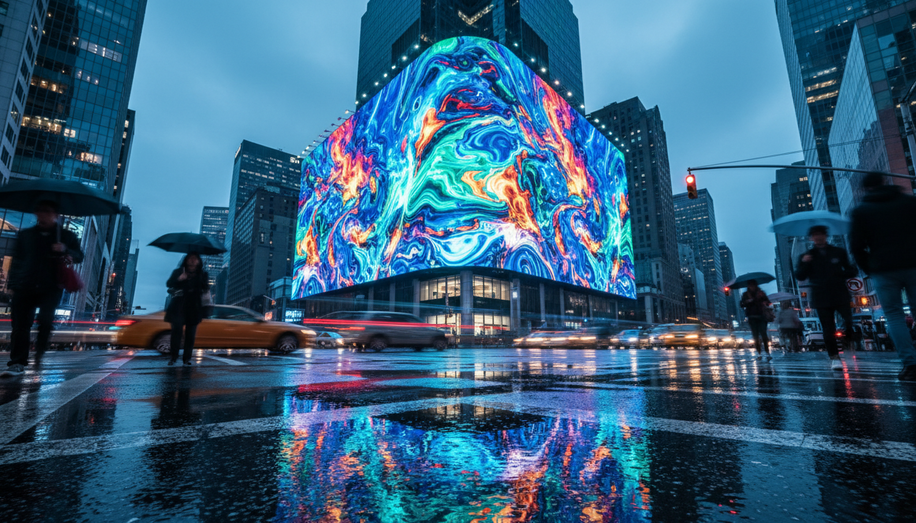

In the neon glow of urban landscapes, digital out-of-home (OOH) screens have transformed static billboards into dynamic canvases, where every pixel pulses with potential. At the heart of this evolution lies pixel pitch—the precise distance between individual light-emitting diodes (LEDs), measured in millimeters—that dictates the sharpness and intimacy of viewer engagement. A finer pitch, such as 3mm or 6mm, packs more LEDs per square meter, enabling intricate details visible from as close as 25 feet, ideal for pedestrian-heavy zones like Times Square’s street-level displays. Coarser pitches of 10mm to 20mm suit highway spectacles, where audiences scan from 300 to 1,000 feet away, balancing cost with clarity. This technical foundation directly reshapes creative strategies: designers must now craft at native resolutions—1920×576 for a standard 20×60-foot board with 10mm pitch, or 1350×650 for mid-tier 12×24-foot units—to avoid scaling artifacts that blur brand messages.
Resolution, the total pixel count, scales with screen size and pitch, demanding content precision from the outset. A 14×48-foot billboard at 16mm pitch might render at 336×1120 pixels, while premium Times Square spectaculars boast 26.7 million pixels across 8mm pitches, requiring 4K+ assets at 150% of final dimensions for flawless playback. Creatives export in sRGB IEC61966-2.1 color profiles to ensure RGB clusters—each pixel’s red, green, and blue diodes—reproduce millions of tones without washout, a safeguard against the compression pitfalls of H.264 video or PNG stills. Frame rates hit 30fps minimum, preferably 60fps, for fluid motion graphics in 10-15 second loops that captivate amid visual clutter. Mismatch these specs, and saturated colors dull, animations stutter, or edges pixelate, undermining the fidelity that turns advertising into art.
Brightness, measured in nits (cd/m²), is the daylight warrior of digital OOH, piercing direct sunlight to sustain visibility. Modern screens achieve 5,000 to 12,000 nits, with some DIP LED models pushing 10,000-15,000 nits for highways and squares. This intensity, far beyond indoor displays, necessitates brightness-optimized designs: daytime visuals hover at 6,500-8,000 nits, dimming to 300-400 nits nocturnally to curb glare and energy draw. Glassless, frameless casings enhance this by slashing reflections and accelerating heat dissipation, paired with IP65 or IP68 waterproofing for relentless outdoor endurance. Creatives adapt by favoring bold contrasts—4000:1 to 10,000:1 ratios—and avoiding pure whites, ensuring logos pop and calls-to-action pierce even midday haze.
Display types further expand creative horizons, each tuned to environmental demands. SMD (Surface-Mount Device) LEDs dominate for their compact RGB integration, delivering wide 140-degree viewing angles and refresh rates up to 3840Hz for blur-free video. Older DIP packages excel in raw brightness and weather resistance but lag in resolution, suiting vast, distant installs. Hybrid fine-pitch variants, like 2mm-6mm modules in 320x160mm cabinets, enable hyper-detailed animations on compact 8×16-foot pedestrian boards. Aluminum casings provide lightweight durability, with lifespans averaging 120,000 hours, while remote monitoring systems ensure 24/7 uptime via power cycling and alerts. These advances liberate designers from poster-era constraints, inviting layered narratives: parallax effects on curved facades, real-time data feeds, or AR triggers that bridge screen and smartphone.
Yet, this pixel-perfect precision imposes disciplined workflows. Agencies pre-visualize on virtual emulators matching exact pitch and brightness, iterating to exploit 16-bit color depth and full-spectrum saturation. In Times Square’s arena of competing LEDs, content must saturate at 90%+ while harmonizing with 6,000-10,000 nits peers, turning technical specs into strategic edges. Finer pitches inflate costs—more LEDs mean higher density, up to 111,111 points per square meter at 3mm—but unlock storytelling once confined to TV. Sustainability creeps in too: average power draws of 300-400W/m² optimize for eco-conscious networks, with anti-glare innovations curbing light pollution.
Ultimately, digital OOH screens democratize cinematic quality for advertisers, but only if creatives master the specs. Pixel pitch governs intimacy, resolution fidelity, brightness dominance, and display types versatility—each unlocking bolder, more immersive executions. As technology refines—think sub-2mm pitches and AI-driven content adaptation—the canvas expands, proving that in OOH, true innovation glows from within the grid.
To fully capitalize on this demanding technical mastery, brands need strategic deployment. Blindspot empowers advertisers to leverage impeccably designed content by providing the precise location intelligence and programmatic DOOH campaign management needed to align creative output with ideal display environments, maximizing impact and competitive advantage. Explore how at https://seeblindspot.com/