
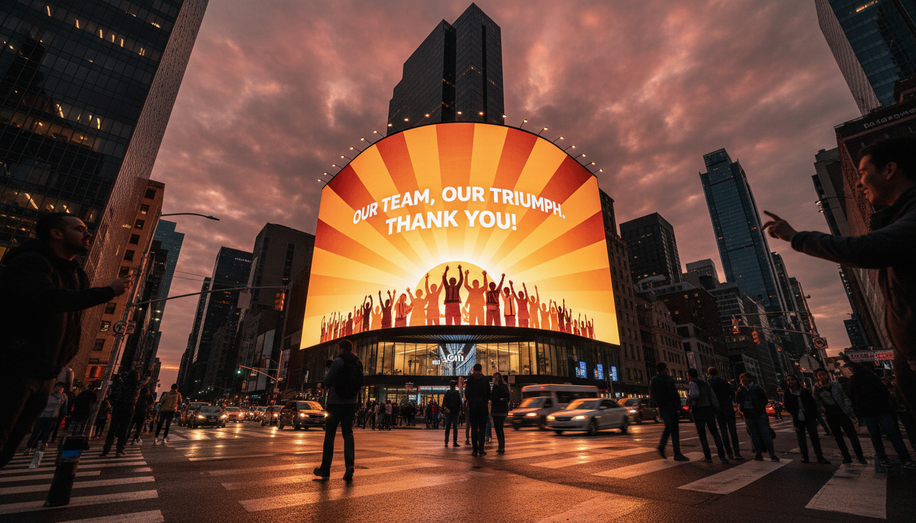

In the shadow of gleaming corporate headquarters, a new frontier in out-of-home (OOH) advertising is emerging—not for luring shoppers or commuters, but for captivating the people who already walk those paths every day: employees. Companies are increasingly deploying strategically placed OOH displays near office entrances, parking lots, and within corporate campuses to foster internal engagement and polish their employer brand, turning everyday commutes into moments of inspiration and connection.
This shift represents a clever pivot from OOH’s traditional consumer-facing role. Where billboards once chased passersby with product pitches, they now beam tailored messages at staff, leveraging the medium’s high-visibility, unavoidable nature to cut through digital fatigue. Hull, a manufacturing firm, exemplifies this approach by partnering with communications agency H&H to create immersive wall designs lining the route from parking to factory floor. Featuring employee photos and quotes, these installations immerse new hires in the company’s culture from the moment they arrive, reinforcing values in a visceral, unmissable way. The result? A seamless onboarding experience that boosts retention and pride without relying on emails or intranets that often go unread.
HSBC took a similar tack with its global photo competition, “HSBC Now,” inviting employees to submit images capturing the bank’s spirit across six categories. The campaign yielded over 6,000 photos, now woven into internal presentations, reports, and digital screens—many of which double as OOH-style displays in high-traffic office areas. By crowdsourcing content, HSBC not only refreshed its visual identity on a zero budget but also empowered staff to own the narrative, enhancing perceptions of an inclusive employer brand. Such tactics align with OOH’s proven strengths in contextual relevance, as seen in broader industry case studies where location-based messaging drives measurable lifts in awareness and action.
Digital OOH (DOOH) amplifies this potential with real-time dynamism. Imagine screens near a tech campus flashing live updates on company milestones, personalized shoutouts, or gamified challenges synced to employee badges or apps. Actelion, a pharmaceutical innovator, deployed “visual workplace disruptions”—window, floor, and stair graphics paired with a 10-week interactive quiz—under the banner “More is Possible.” This multi-channel push, including OOH-like installations, reminded employees of their role in life-changing innovations, earning accolades in change communication awards. Vodafone echoed the strategy with its electronic newsletter “The Lot,” distributed via innovative digital channels to slash all-staff emails, spark competitions, and build community—elements ripe for DOOH adaptation in office lobbies or elevators.
These internal applications borrow heavily from consumer OOH successes. Just as a denim brand used NYC kiosks to spike store visits by 80% through hyper-local promotions, companies now target employee footfall with recognition walls or achievement leaderboards. Cotton On Group integrates a TV channel, artwork takeovers, and digital ad spaces into its intranet ecosystem, celebrating team wins as a “global family”—a model that translates seamlessly to campus signage, fostering loyalty amid hybrid work trends. Lowes Manhattan’s “Customer Care News” intranet feature, spotlighting staff kudos from clients, could easily scale to OOH panels at building entrances, blending internal morale with external branding cues visible to visitors.
The data underscores why this matters. OOH boasts unmatched immediacy—68% of shoppers encounter ads in the half-hour before purchase, outpacing other media—a proximity effect that mirrors employees’ daily exposure near offices. Measurable impacts abound: mobile data attribution shows visitation lifts from billboards, while internal campaigns like Seymour House’s app-based “Community” boards personalize info bites to connect teams, suggesting DOOH could track engagement via geofences around campuses. For employer branding, the stakes are high; in a talent war, visible culture signals differentiate winners. A real estate firm surprised its leader with creative billboards upon her return, sparking team buzz and correlating with inquiry spikes—proof that internal OOH delights and motivates.
Critics might argue OOH feels gimmicky for insiders, yet evidence counters this. When Hull’s pathway graphics voiced employee insights in their own words, it humanized leadership, combating disconnection in large organizations. Privacy concerns with data-driven personalization, as in DOOH’s geofencing triumphs, demand anonymized handling, but aggregated mobile insights already prove ethical scalability. Forward-thinking firms like those in OUTFRONT’s case study library—from Heinz to Dove—are experimenting with transit and digital blends, hinting at hybrid models where campus OOH feeds into social amplification.
As workplaces evolve, OOH’s role in internal comms promises to grow. It’s not just about pretty posters; it’s strategic storytelling that engages the workforce where they live their days, elevating employer allure from mundane to magnetic. In an era of quiet quitting and remote drift, these placements remind employees they’re seen, valued, and integral—turning corporate grounds into branding billboards of belonging.