
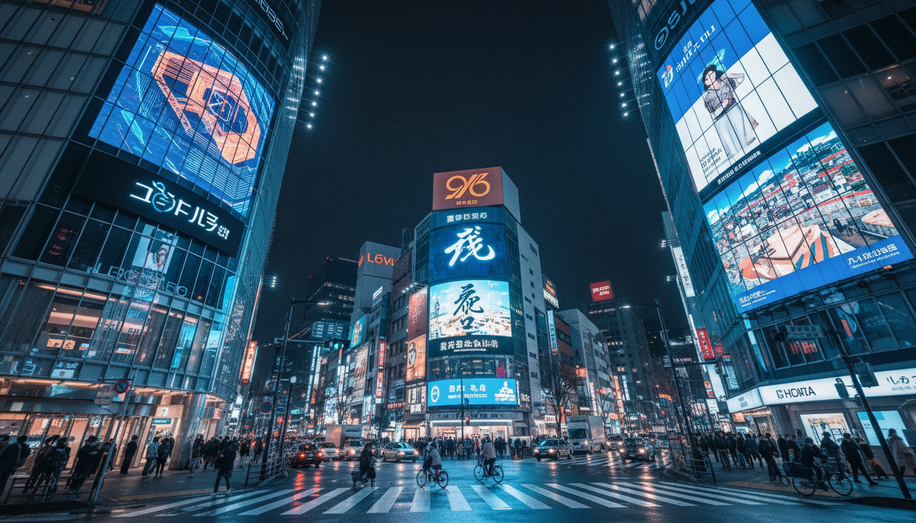

In the bustling streets of Mumbai, a glowing candle flickered across digital billboards on UN International Peace Day, part of a synchronized global campaign by the Indian Outdoor Advertising Association that captured urban pulses worldwide. This simple yet poignant activation exemplifies how out-of-home (OOH) advertising is evolving into a passport to impact, transcending borders through innovative campaigns and emerging trends. As the global OOH market surges from USD 43.3 billion in 2025 to a projected USD 71.2 billion by 2034 at a 5.50% CAGR, driven by urbanization and digital transformation, brands are unpacking regional nuances to craft resonant, tech-infused experiences.
North America leads with audacious technological flair, where Times Square’s neon heartbeat pulses with augmented reality (AR). In April 2024, Redken unveiled a 3D billboard for its Acidic Color Gloss Collection, inviting passersby to scan and virtually try on shades via their smartphones, blending virtual immersion with physical spectacle. This AR integration, amid 1.73 billion global AR devices by late 2024, underscores a shift toward interactive billboards that turn passive viewers into participants. Looking to 2026, programmatic digital out-of-home (pDOOH) will dominate, with advertisers leveraging data signals like location, weather, and time of day for dynamic creative optimization (DCO). Campaigns will adapt in real time—promoting umbrellas during rain or event tie-ins during peaks—making OOH a nimble complement to digital strategies. Programmatic platforms, integrating with demand-side platforms (DSPs) and supply-side platforms (SSPs), promise efficiency and control, as brands move beyond static rotations to contextually precise messaging.
Europe, with its dense cities and robust transit networks, emphasizes sustainability and regulatory savvy. JCDecaux SE, a market heavyweight, is rolling out energy-efficient digital displays across urban hubs in the UK, France, and Germany, aligning with eco-mandates while expanding programmatic capabilities for precise targeting. High-footfall street furniture and transit ads thrive here, where hybrid models fuse traditional billboards with digital overlays, capitalizing on smartphone ubiquity for near-field communication (NFC) and QR codes. Consumer preference for digital engagement amplifies these efforts; interactive campaigns that bridge physical exposure to app downloads or social shares are proliferating. By 2026, sustainability will intensify, with solar-powered screens and eco-materials becoming standard, as governments push green practices amid rising environmental scrutiny.
Asia-Pacific’s rapid urbanization fuels OOH’s ascent, particularly in India and China, where commuter traffic and high smartphone penetration create ideal canvases. Digital billboards evolve with real-time content swaps, enabling brands to tailor ads for local events or weather, far surpassing static formats’ limitations. Innovations like gamified displays and AR overlays engage tech-savvy audiences, while programmatic buying streamlines premium inventory access. In high-density metros, OOH integrates with omnichannel plans, using data analytics to track footfall and optimize demographics, proving cost-effective against pricier digital media. Regional players forge ties with municipalities for prime spaces, incorporating barcodes and location targeting to drive immediate actions like store visits.
Latin America and the Middle East are catching the wave with culturally attuned activations. In São Paulo and Dubai, DOOH networks expand, emphasizing emotional resonance—95% of purchases stem from emotion, and OOH’s bold formats amplify humor and joy at scale. Tentpole events like the 2026 FIFA World Cup and Olympics will supercharge this, with extended campaigns building hype across channels. OOH will anchor omnichannel narratives, pushing digital stories into physical realms to boost foot traffic and in-app engagement during peak moments. Programmatic DOOH adoption surges globally, with forecasts predicting more campaigns integrating it as a core channel, fueled by premium screen growth and cross-team collaborations.
These trends signal OOH’s maturation as a global operating system. Digital ad fatigue—from saturated social feeds and eroding trust in metrics—propels budget shifts toward OOH’s verifiable real-world impact. Advances in analytics and automation enable intention-based planning, measuring carbon performance alongside ROI. Short, potent formats with passive interactions, like contextual visuals over flashy ones, will prioritize strong ideas that stick. Yet challenges persist: coordinating DCO across stakeholders demands early creative alignment, and regulatory hurdles in some regions slow rollouts.
Ultimately, OOH’s passport unlocks unparalleled reach by harmonizing local insights with universal tech. From Redken’s AR glamour in New York to peace candles in Mumbai, campaigns that engage emotionally, adapt dynamically, and sustain ethically are redefining advertising’s frontiers. As 2026 unfolds, with events like the OAAA Media Conference spotlighting these shifts, brands holding this passport will navigate global audiences with precision and flair.
Achieving the precise, dynamically optimized, and measurable OOH campaigns described here demands sophisticated tools that harmonize local insights with universal tech. Blindspot offers a critical solution, empowering brands to master this complexity through programmatic DOOH campaign management, advanced audience measurement, and location intelligence. This enables real-time performance tracking and verifiable ROI, ensuring contextually precise messaging and transforming OOH into a truly nimble and intelligent channel. Learn more at https://seeblindspot.com/