
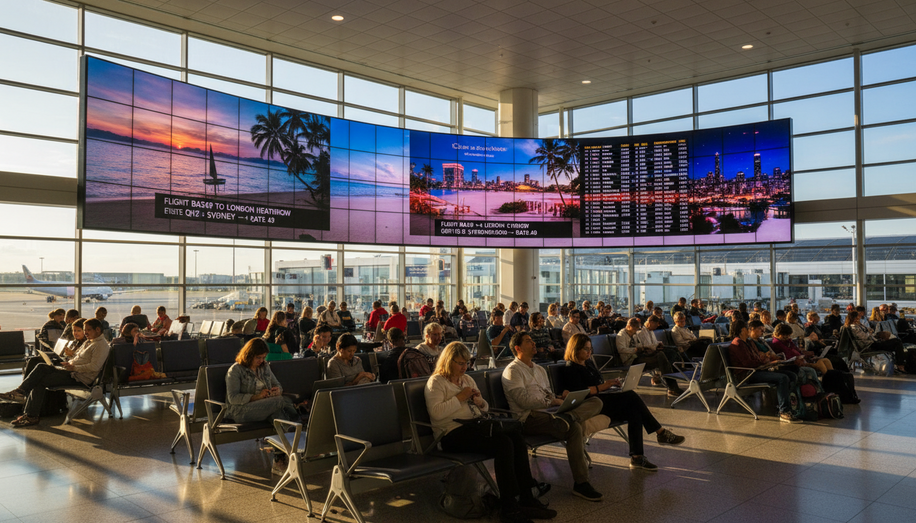

In the bustling terminals of America’s busiest airports, where travelers linger for hours amid delays and connections, brands are unlocking unprecedented engagement through out-of-home (OOH) advertising. With air travel surging to record levels—driven by pent-up demand and airport expansions—dwell times have stretched, turning airports into prime real estate for marketers targeting captive audiences with high purchasing power. Sixty-nine percent of flyers notice OOH ads in these environments, and among them, 87 percent take action, often by searching online for the featured brand or product.
This potency stems from strategic placements that exploit natural pauses in the traveler journey. At baggage claim areas, where passengers wait an average of 20 to 30 minutes, massive digital screens deliver immersive loops of brand storytelling. Los Angeles International Airport (LAX), handling over five million monthly passengers and generating 217 million ad impressions, deploys 203 displays in these high-dwell zones, aligning luxury, fashion, and entertainment messaging with a 42 percent millennial audience, including celebrities and leisure seekers. Similarly, Dallas Fort Worth International (DFW), the world’s busiest crossroads with 6.6 million monthly passengers, leverages 243 digital screens for consistent exposure to business and leisure flyers alike. These locations capitalize on undivided attention, as Nielsen research shows 82 percent of frequent flyers read airport ads, with 61 percent recalling them vividly.
Lounges and gates amplify this further, offering premium intimacy for upscale demographics. Frequent flyers—those taking three or more domestic round trips annually—are twice as likely to influence over $500,000 in business spending and hail from tech-leading companies, making them ideal for B2B pitches. In Miami International (MIA), the top U.S. gateway for international travelers with 4.6 million monthly passengers, 201 digital screens target business elites bound for Latin America and Europe, fostering 130 million monthly impressions in low-clutter settings. Houston’s George Bush Intercontinental (IAH) mirrors this with 113 screens positioned for high-income decision-makers linking U.S. and global hubs. Here, ads resonate because they match the moment: 57 percent of exposed flyers act post-viewing, up eight percent from 2022, including 61 percent visiting advertised locations and 53 percent hitting websites.
Cutting-edge innovations are supercharging these placements. Digital out-of-home (DOOH) now drives 45.2 percent of OOH spend by 2028, up from 22 percent in 2016, fueled by dynamic content and data integration. Interactive installations invite participation, transforming passive viewing into memorable encounters. QR codes, scanned by 45 percent of acting travelers—a six percent rise since 2022—bridge physical ads to digital realms, prompting social media visits (36 percent) or direct purchases. Programmatic DOOH (pDOOH) trends for 2026 promise even more: automated buying enables real-time targeting based on weather, flight delays, or audience data, shifting budgets from static formats to high-impact physical spaces. At Boston Logan (BOS), with 92 screens across terminals and long dwell times from business and university traffic, such tech ensures ads adapt to Northeast influencers.
Brands like Clear Channel Outdoor are pioneering this evolution, commissioning studies that affirm airport media’s funnel-spanning power—from awareness to conversion—in uncluttered, safe hubs. Pittsburgh International (PIT), though smaller at 754,000 monthly passengers, tests secondary markets with 16 high-visibility screens in its tech-forward terminal, blending business and tourism for deeper recall. Even William P. Hobby (HOU) in Houston thrives on 17 screens amid Southwest’s domestic flows, prioritizing low-clutter engagement for families and business travelers.
The data underscores why 66 percent of consumers say OOH sways travel plans, with over half adding destinations to bucket lists after airport concourse sightings. As programmatic ad spend hits $1.23 billion by 2026—a 23 percent growth—airports evolve into vibrant commercial ecosystems. For marketers, the formula is clear: position dynamically in dwell hotspots, innovate with interactivity, and measure intent-driven actions. In an era of mobility and connectivity, airport OOH doesn’t just capture eyes—it propels real-world decisions, proving its enduring edge in a fragmented media landscape.