
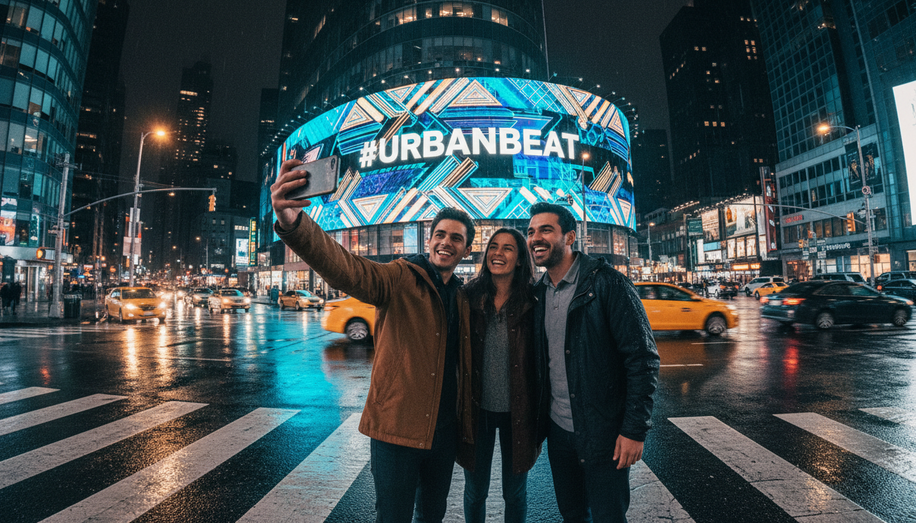

The intersection of out-of-home advertising and social media has fundamentally transformed how brands connect with consumers across physical and digital spaces. As audiences navigate a world saturated with advertisements, the most successful campaigns recognize that the journey from street to scroll is not a detour—it’s the main route to meaningful engagement.
The synergy between out-of-home and social media advertising reflects a simple but powerful truth: consumers no longer experience brands in isolation. A striking billboard in Times Square or a clever bus shelter ad isn’t merely a moment of exposure—it’s a catalyst for online conversation. Research demonstrates this connection empirically. According to a Comscore/OAAA study, after seeing an outdoor ad, 33% of consumers searched social media such as Facebook, Twitter, or Instagram. Meanwhile, a CBS Outdoor International study of six European countries found that consumers were more likely to buy something online, “Like” a brand on Facebook, or download an app after seeing an outdoor ad compared to TV, radio, or print.
This engagement pattern reflects broader shifts in how people consume media. Mobile device penetration has made outdoor advertising and social media natural companions—both reach consumers on the go, and both thrive on mobile platforms. The opportunity lies in designing campaigns that deliberately bridge these two worlds.
Creating Shareable Moments
The most effective OOH campaigns treat physical advertisements as the opening act for digital conversations. Designing ads with social sharing in mind means incorporating compelling visuals, catchy slogans, or interactive elements that prompt passersby to snap photos and share them online. Whether it’s striking visual design or a memorable hashtag, the goal is to make the content inherently shareable, extending its reach far beyond the physical location.
Digital billboards amplify this potential by enabling real-time responsiveness. Brands can display social media feeds, user-generated content, or live updates, creating a sense of community and immediacy that encourages participation. A musician’s album release, for instance, demonstrates this approach effectively. As the album’s release date approached, snippets of lyrics adorned DOOH screens in prominent locations like Times Square, amplifying anticipation and uniting communities worldwide.
Cross-Channel Amplification
The true power emerges when OOH and social media work in tandem. According to Ocean Outdoor’s neuroscience research, DOOH primes social media content positively—people are drawn more toward a brand on social media when they’ve already encountered the brand campaign on DOOH. This sequencing matters. Socially amplified DOOH content shared by brands strengthens brand familiarity and relevance, creating a continuous loop of reinforcement.
Practical implementation involves displaying social media handles and hashtags on DOOH screens to drive online engagement while promoting DOOH content across social platforms. This cross-channel approach generates buzz, expands audience reach, and fosters community around the brand. Geo-targeted social media ads further enhance this strategy, allowing advertisers to deploy targeted campaigns to users in the vicinity of OOH placements, creating a seamless brand experience across physical and digital channels.
Engagement Through Participation
Interactive elements transform passive viewers into active participants. Brands can incorporate polls, contests, or challenges on social media and integrate them with their DOOH displays, encouraging users to share experiences, photos, or videos related to campaigns. Augmented reality amplifies this approach further, allowing audiences to use smartphones to view AR content that appears to interact with physical ads, creating shareable moments that extend campaign reach.
Pop-up experiences and experiential marketing take this strategy offline, creating events designed to be highly shareable—branded photo booths, street art installations, or live performances attract attention and drive organic social media engagement.
Measuring Impact
The integration of OOH and social media also enables sophisticated measurement. Merging social media and digital billboard campaigns provides access to detailed analytics, allowing brands to measure engagement across both channels and understand the complete customer journey. By tracking user interactions and incorporating offline metrics like footfall measurement with online measures, marketers can identify interested prospects and retarget them with personalized ads.
The evolution from street to scroll represents more than a marketing trend—it reflects how modern audiences experience brands. By deliberately designing OOH campaigns that encourage participation, sharing, and conversation, brands transform passive observation into active engagement, creating campaigns that resonate far beyond their physical placements.