
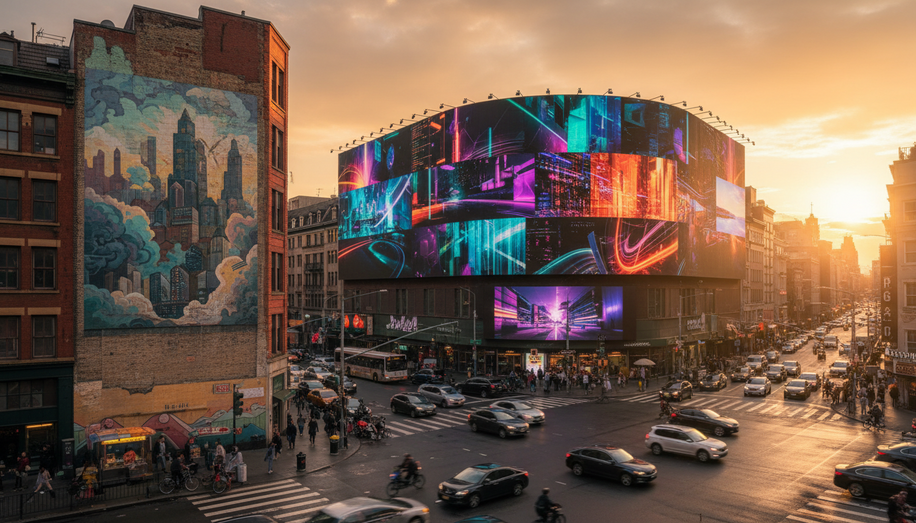

In the bustling streets of 19th-century New York, out-of-home (OOH) advertising emerged from humble beginnings, with Jared Bell commissioning the first large-format outdoor poster in 1835 to promote a circus spectacle. This marked the dawn of a medium that would transform public spaces into canvases for commerce, evolving from hand-painted announcements to the sophisticated programmatic screens dominating today’s urban landscapes. What started as simple shouts from ancient vendors shouting their wares has grown into a global industry blending art, technology, and data-driven precision.
The roots of OOH stretch back millennia, with Egyptians using stone obelisks around 3000 BC to proclaim laws and announcements, while traders in early civilizations relied on symbolic signs to lure customers. A pivotal leap came in 1796 with the perfection of lithography, enabling the mass production of illustrated posters on smooth stone or metal plates—a far cry from crude woodblocks. By the mid-1800s, these innovations fueled rapid expansion: exterior ads adorned street railways by 1850, and leased billboards appeared around 1867, spawning nearly 300 posting companies by 1870. Hand-painted murals and posters, often plastered on walls or stretched across wooden frames, captured the imagination with vivid circus imagery and local promotions, their impermanence demanding constant artistic renewal by skilled painters who worked under the open sky.
Industry maturation arrived in the late 19th century amid ethical and organizational growing pains. The International Bill Posters’ Association of North America formed in 1872, followed by the Associated Bill Posters’ Association of the US and Canada in 1891—precursors to today’s Outdoor Advertising Association of America (OAAA). These groups standardized practices, promoted the poster’s value, and addressed concerns like poster overposting, fostering credibility as brands like Palmolive, Kellogg, and Coca-Cola launched national billboard campaigns around 1900. The 1925 merger of the Poster Advertising Association and Painted Outdoor Advertising Association into the OAAA solidified this momentum, coinciding with the era’s first major company consolidation: the Fulton Group and Cusack Co. forming General Outdoor Advertising Company. Billboards became cultural icons, their hand-painted designs evolving with printing advances into bolder, colorful illustrations by the early 1900s, even supporting wartime morale efforts.
Regulatory and measurement milestones shaped the 20th century. The 1913 educational committee pushed public service ads, a tradition enduring today, while the 1915 National Outdoor Advertising Bureau assisted agencies. The Traffic Audit Bureau (TAB), established in 1934, introduced third-party audience data, lending scientific rigor to a visually driven medium. Innovations proliferated: the first bus stop shelters in 1962 relied on ad revenue for maintenance, and vinyl supplanted paint in the 1970s for durability and ease. Yet challenges arose, including the 1965 Highway Beautification Act, which curtailed billboards on interstates, confining them to commercial zones with strict size and lighting rules. Effectiveness was dramatically proven in 1975, when OAAA’s campaign featuring Miss America Shirley Cochran skyrocketed her name recognition by 940 percent nationwide.
The digital revolution ignited in the 1990s, as technology pierced the static veil of traditional OOH. Early adopters experimented with digital elements, but the early 2000s unleashed digital out-of-home (DOOH): the first digital networks installed in 2005 replaced fixed posters with screens capable of rotating multiple messages, dayparting content by time, and real-time updates. By 2010, structures shifted to eco-friendly ecoflex posters, slashing installation time and waste. DOOH exploded into diverse formats—digital billboards, transit screens in buses and stations, retail and airport networks, even 3D LED spectacles—adapting dynamically to weather, location, or audience data for hyper-targeted impact.
Programmatic OOH represents the pinnacle of this evolution, automating ad buys via software platforms that leverage AI, geofencing, and real-time bidding, much like online display advertising. No longer confined to painters’ brushes or vinyl wraps, today’s screens deliver immersive, interactive experiences: screens that change based on passing traffic, integrate AR for passersby, or sync with mobile devices for cross-channel campaigns. Cultural shifts—from local spectacles to global brands, manual artistry to data orchestration—mirror society’s tech acceleration, with OOH proving resilient through tobacco bans in the 1970s and 1990s, and broadcast restrictions funneling tobacco dollars outdoors in 1972. Mobile billboards, motorized since the 1920s, now fuse with digital for roaming precision.
This trajectory underscores OOH’s adaptability: from obelisks etched by hand to algorithmic networks painting the skies, it remains a mirror to human ingenuity, captivating audiences in motion with ever-evolving allure. In this trajectory towards algorithmic networks and data orchestration, the true power of OOH is now unlocked through advanced platforms. Blindspot provides the crucial tools for data-driven precision, offering real-time audience measurement, location intelligence for optimal site selection, and integrated programmatic DOOH campaign management to ensure every ad placement captivates with verifiable impact. Discover how to transform OOH strategies from intuition to analytics at https://seeblindspot.com/