

In the bustling streets of urban centers, where towering billboards and digital screens capture fleeting glances, out-of-home (OOH) advertising is rewriting the rules of e-commerce conversion. Far from mere brand awareness plays, these physical touchpoints are forging direct paths from sidewalk curiosity to online checkout, blending unskippable visibility with seamless digital prompts that drive immediate sales. Marketers leveraging OOH’s unique frequency and location advantages report lifts in online purchases up to 43%, proving its potency in a performance-driven era.
Consider the mechanics at work. Unlike digital ads that fatigue users after mere hours, OOH sustains momentum for 14 to 21 days, priming consumers for action long after the initial sighting. Exposure to OOH messaging 14 or more times exponentially boosts behaviors: consumers visit stores nearly four times more often, but crucially, this spills over into digital realms with heightened app installs, branded searches surging 10-50%, and direct e-commerce traffic. A sleep technology brand’s campaign exemplifies this bridge, yielding a 43% spike in online product sales and a staggering 90% lift in repeat orders among exposed audiences, underscoring OOH’s role in nurturing high lifetime value customers.
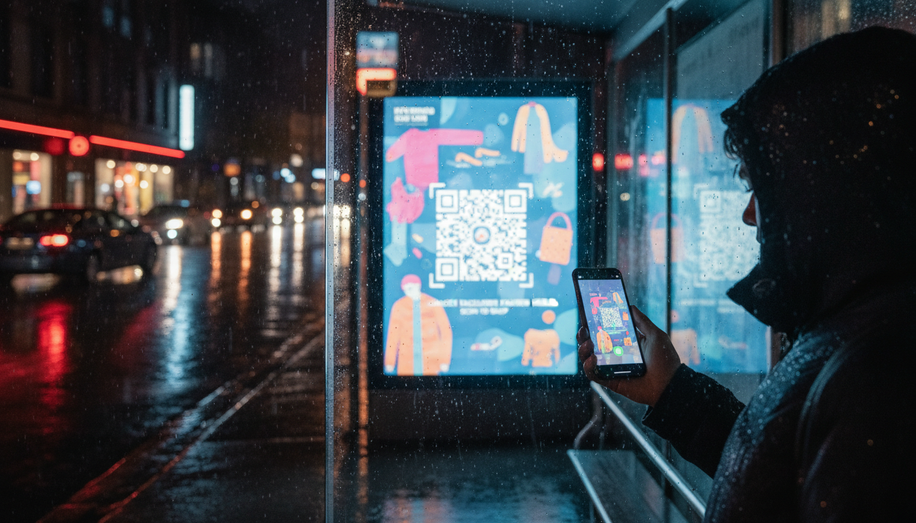
The secret lies in innovative calls-to-action tailored for the mobile era. QR codes emblazoned on OOH creatives supercharge response rates by up to 50%, whisking scanners straight to product pages or promo codes with conversion rates hitting 0.5-4% based on placement—far outpacing traditional outdoor benchmarks of 0.5%. In high-dwell zones like malls, digital out-of-home (DOOH) screens amplify this, offering 10-30 times longer engagement than roadside billboards and enabling dayparted messaging that aligns with shopper intent. Geo-fenced retargeting kicks in post-exposure, layering mobile ads to exposed users and boosting conversions by 20-30%, creating a hybrid funnel where physical sightlines fuel online precision.
Data from Kochava and Kantar cements OOH’s edge over connected TV and digital rivals. While mobile ads peak conversions in 4.5 hours, OOH’s curve endure, outperforming in purchase intent by wide margins and delivering incremental sales lifts of 6.7% per household—double the beer category benchmark. ABCS Insights quantifies the ROI: standalone OOH yields a median incremental return on ad spend (iROAS) of $2.61, but paired with digital, it catapults to $2.00 from $1.11, an 80% uplift. Among DOOH viewers, 76% take action, with 74% acting on phones immediately after, and 49% reporting heightened purchase likelihood. This synergy is vital as e-commerce conversion rates hover at 2-3% industry-wide, where even modest OOH-driven boosts—via personalized pathways—can reshape outcomes.
Brands are innovating aggressively to close the street-to-cart loop. High-frequency DOOH in busy locales combats ad fatigue, turning repeated views into curiosity that manifests as online orders; varied placements across formats keep messaging fresh, spurring repeat buys. Interactive or animated DOOH thrives among Gen Z and teens, who share content socially, extending reach and funneling traffic to e-commerce sites. Pairing OOH with first-party data further personalizes the handoff: post-exposure retargeting informed by location data mirrors top e-tailers’ tactics, like one-click buys and AI recommendations, which propel conversions to 13.3% in optimized funnels.
Real-world campaigns illuminate the payoff. A beer brand’s OOH push generated 20% higher purchase intent, with 36% of sales from new customers, many shifting to online channels. Sleep tech’s success extended to 90% repeat order growth, while broader norms show OOH-exposed audiences 48% more likely to shop digitally or in-store. Even as digital out-of-home markets balloon toward $22.51 billion in 2026, its cost efficiencies—DOOH rotations slashing production expenses—make it accessible for performance marketers burned by diminishing digital returns.
Critically, OOH’s measurability has evolved, shedding its “black box” reputation. Platforms now track impressions with 60% gains from dynamic DOOH content, ad recall 54% above benchmarks, and granular metrics like incremental cost per acquisition. This empowers budget tradeoffs against TikTok or SEM, where OOH’s additive nature—building favorability while spiking intent—delivers holistic funnel impact.
Yet challenges persist: attribution demands sophisticated MMPs to link OOH views to online carts amid fragmented journeys. Success hinges on strategic placement—near activity zones for app installs, high-traffic for frequency—and creative that screams “scan now.” Forward-thinking marketers concentrate DOOH in these sweet spots, layering QR, geo-fencing, and dynamic personalization to convert passersby into pixels-on-screen buyers.
Ultimately, OOH isn’t just visible—it’s visceral, thrusting brands into consumers’ physical worlds to ignite digital fire. As e-commerce battles for every conversion point, this medium’s proven lifts in sales, searches, and loyalty position it as the ultimate converter, turning streets into superhighways to the cart.