
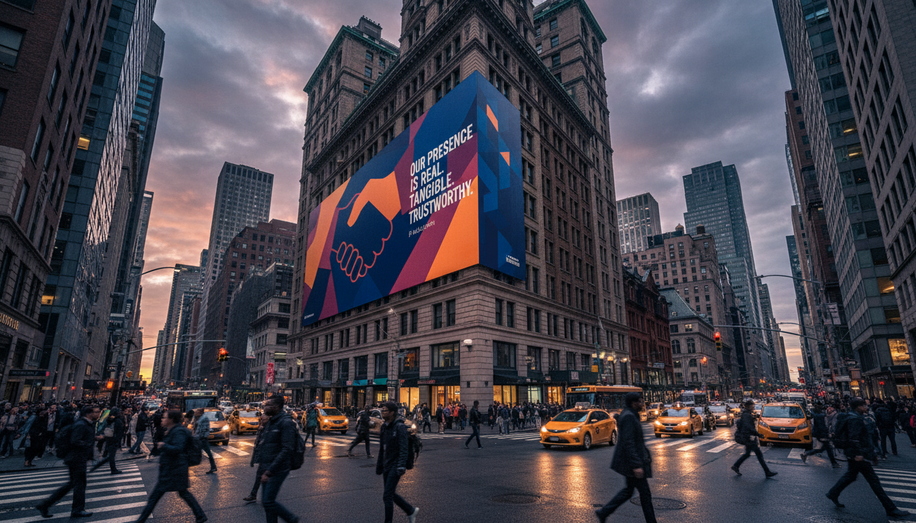

In an era where digital screens bombard consumers with endless streams of targeted ads, fleeting influencers, and data-driven manipulations, out-of-home (OOH) advertising stands as a beacon of unfiltered authenticity. Its tangible, public presence cuts through the noise, fostering brand trust by signaling stability and legitimacy in ways that ephemeral online content simply cannot match.
Public trust in brands has eroded sharply, with only 34% of consumers reporting confidence in the companies they use, amid rising concerns over misinformation, privacy invasions, and algorithmic echo chambers. Social media scandals and data breaches have amplified skepticism, making 81% of buyers cite trust as a pivotal factor in their purchasing decisions. Yet OOH thrives here. One in three consumers explicitly trusts OOH more than other channels, viewing its physical manifestations—billboards towering over highways, posters in bustling transit hubs, digital screens in office lobbies—as credible endorsements of a brand’s permanence. This trust stems from the medium’s inherent visibility: ads displayed openly for all to see imply confidence from the advertiser, as there’s no hiding behind paywalls or ad blockers.
The psychology is straightforward. When a brand claims space in the real world, it projects stability. A massive billboard doesn’t vanish with a swipe; it lingers in commuters’ minds, reinforcing familiarity and reliability. Research from collaborative studies, including those by JCDecaux and Bauer Media Outdoor, confirms this: OOH drives positive brand perceptions, boosting consideration by associating messages with quality and reputation—top attributes consumers link to trustworthiness. Brands allocating 15% or more of their media budgets to OOH see a 24% uplift in trust ratings and a 106% surge in perceived brand quality, per Rapport and Vistar Media data. This isn’t mere exposure; it’s endorsement by environment. An ad in a high-traffic urban artery or upscale office building elevates the brand, borrowing credibility from its prestigious locale.
Contrast this with digital’s pitfalls. Online ads, often personalized via invasive tracking, spark privacy backlash—think cookie consents and third-party data sales that make users feel surveilled rather than served. Fragmentation worsens it: consumers juggle dozens of platforms, where deepfakes and sponsored posts blur truth from fiction. OOH sidesteps these traps. Its public nature demands honesty; a false claim on a city-center wrap risks immediate public scrutiny, deterring deceit and building legitimacy. As one industry analysis notes, 50% of viewers believe OOH messaging outright, outpacing every other format because it feels unmediated and communal. Even Gen Z, digital natives prone to screen fatigue, perceives OOH as more authentic, sharing striking executions on social media and amplifying organic reach.
This trust-building extends to real-world impact. OOH doesn’t just inform; it activates. Consumers are 36% more likely to engage with trusted brands, and OOH accelerates that by sparking conversations offline and online. A strategically placed digital out-of-home (DOOH) billboard, for instance, can address pain points head-on—highlighting product benefits with consistent messaging that consumers encounter repeatedly in their daily routines. Case in point: brands using OOH for awareness report 24% trust growth alongside doubled consumer confidence, fueling traffic to websites and stores. In professional settings, like Captivate’s network of 23,000 screens in office buildings, OOH enhances credibility by aligning with environments of authority and aspiration.
Moreover, OOH counters digital noise by being unavoidable and memorable. While online ads compete for fleeting attention amid infinite scrolls, OOH commands the physical space—highways, subways, malls—where people are receptive, not defensive. This tangibility communicates endurance: a brand willing to invest in large-scale, community-visible displays signals long-term commitment, not fly-by-night opportunism. In a fragmented world, where 86% of customers abandon once-trusted brands after poor experiences, OOH fortifies loyalty by delivering on promises in plain sight.
Privacy concerns further tilt the scales. As regulations like GDPR tighten and users opt out of tracking, digital targeting loses potency. OOH, by contrast, reaches audiences contextually—without dossiers on personal habits—feeling respectful and inclusive. It positions brands as confident participants in public discourse, even championing progressive values; one in four consumers sees OOH as a platform for good.
Ultimately, OOH’s resurgence proves its potency as a trust builder. In 2026, with digital fatigue at peak levels, marketers prioritizing physical media aren’t just advertising—they’re reclaiming credibility. By blending OOH with hybrid campaigns, brands can bridge online and offline, turning passive viewers into advocates. The message is clear: in a skeptical age, nothing says “we’re here to stay” like a message too big to ignore.
To truly harness OOH’s unparalleled ability to rebuild brand trust, precise execution and strategic placement are paramount. Platforms like Blindspot provide the essential location intelligence and programmatic DOOH management tools to ensure messages are consistently presented in high-credibility, authoritative environments, actively reinforcing a brand’s stability and long-term commitment. By optimizing these tangible touchpoints, Blindspot helps transform passive exposure into deep-seated consumer confidence. https://seeblindspot.com/