
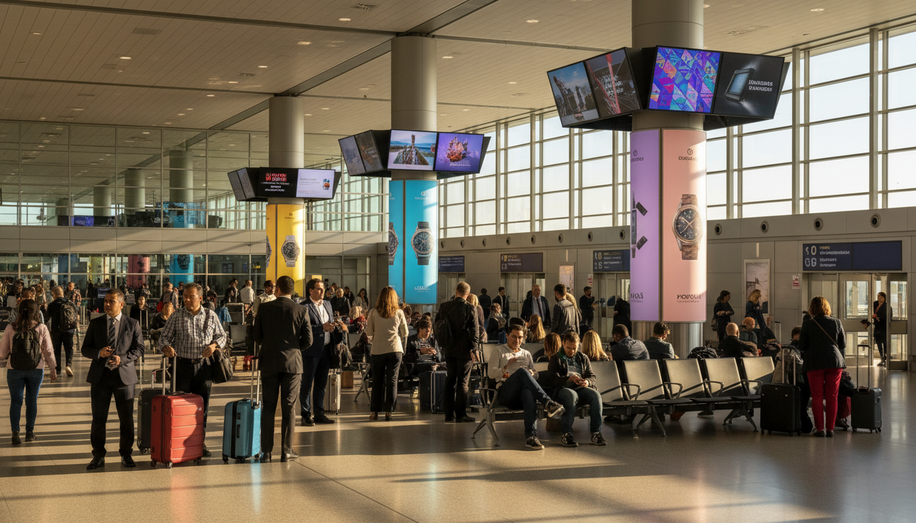

As travelers navigate the bustling corridors of an airport, their journey from curbside drop-off to boarding gate becomes a meticulously mapped canvas for out-of-home (OOH) advertising. Strategic placements of billboards, digital screens, and interactive displays transform these high-traffic zones into prime real estate, where ads engage audiences at varying dwell times and mindsets, from hurried arrivals to anticipatory waits.
The journey begins at the curbside, where outbound travelers, drop-offs, pick-ups, ride-share drivers, and shuttle vans converge in a flurry of motion. Here, large approach billboards dominate, delivering the highest impression volumes due to their visibility along access roads and frontage routes. These static or digital formats cut through dense traffic, sun glare, and rain with high-contrast designs and directional messaging like “Exit 1 Mile” or “5 Minutes from ATL — Exit 72.” Clear, unmistakable branding ensures local businesses—hotels, attractions, or rental services—capture attention from those pondering immediate needs, such as shuttles or nearby amenities. Perimeter boards along rental car returns, park-and-ride loops, and employee entrances extend this reach, targeting audiences with more dwell time and repeat passes, compounding exposure for high-value commuters.
Transitioning inward, the airport perimeter and approach roads give way to rental car and hotel corridors, clusters of OOH media tailored to inbound and outbound flows. Billboards here leverage traveler intent, promoting “Business Travelers Welcome — Free Shuttle” or “New Homes Near Airport Corridor” to align with post-flight logistics. High-frequency exposure proves potent for frequent flyers, who traverse these paths multiple times monthly, turning single impressions into recurring brand reinforcements. Fintech firms and regional universities, for instance, amplify their scale by associating with the airport’s aura of global connectivity, using simple visuals to evoke reliability amid the chaos.
Upon entering the terminal, the environment shifts to controlled chaos, where check-in counters and security queues demand ads optimized for fleeting glances. Digital out-of-home (DOOH) screens dominate, strategically placed in high-traffic areas to exploit long dwell times—passengers often stand for minutes, phones in hand, minds attuned to efficiency. Bold, legible fonts, high-contrast colors, and striking visuals like human faces or dynamic animations grab the brain’s visual priorities: movement, contrast, and emotion. Messaging evokes adventure, safety, or comfort, resonating with diverse international travelers whose psychology favors positive narratives in transitional spaces. QR codes and touchscreens invite interaction, bridging to digital channels for contests or offers, while real-time updates on promotions or events keep content fresh.
Beyond security, concourses and gates represent peak engagement zones, where travelers slow their pace, browse shops, or recharge in lounges. DOOH networks proliferate—tens of thousands of screens globally—positioned near bars, baggage carousels, and seating areas for unavoidable exposure. Video loops and animations heighten recall, with A/B testing via digital platforms refining calls-to-action based on analytics. Business and leisure segments respond differently: affluent frequent flyers, traveling four or more times yearly, absorb premium brand perceptions, while tourists engage culturally tailored creatives. Integrated campaigns coordinate with social media handles or hashtags, creating unified experiences that drive online traffic and reinforce messaging across touchpoints.
At baggage claim, the final pre-departure or post-arrival limbo amplifies OOH’s last-impression power. Screens here ensure brands linger in memory as travelers reunite with luggage, pondering dinner or transport. Placement near carousels guarantees views from multiple angles, with interactive elements like surveys gathering real-time feedback to optimize future runs. High-quality visuals and a mix of static-digital formats maintain momentum, turning passive waits into active considerations.
This curbside-to-gate progression underscores OOH’s ROI in airports: captive, high-income audiences receive sequenced messaging that builds familiarity through repeat exposure. Premium placements demand premium creativity—simple, intent-aligned, and data-driven—to stand out amid competition. As airports evolve with more DOOH and partnerships, advertisers who map the traveler’s psychology and path reap outsized results, influencing decisions from arrival impulse to departure daydream.
Yet challenges persist: cluttered designs flop in glare-heavy corridors, and generic messaging ignores segments like business elites versus leisure seekers. Success hinges on audience profiling—prioritizing zones by demographics—and pilots with KPIs for scaling. Agencies streamline this, handling vendor coordination for seamless campaigns. Ultimately, airport OOH doesn’t just advertise; it anticipates the journey’s every beat, embedding brands in the traveler’s narrative.
To overcome challenges like cluttered designs and generic messaging in airport environments, advertisers require precise tools for audience profiling and campaign optimization. Blindspot offers location intelligence and audience measurement to optimize site selection and tailor dynamic campaigns for specific traveler segments. With real-time performance tracking and robust ROI measurement, brands can continuously refine their airport OOH strategies for superior, data-driven results, as explored at https://seeblindspot.com/