
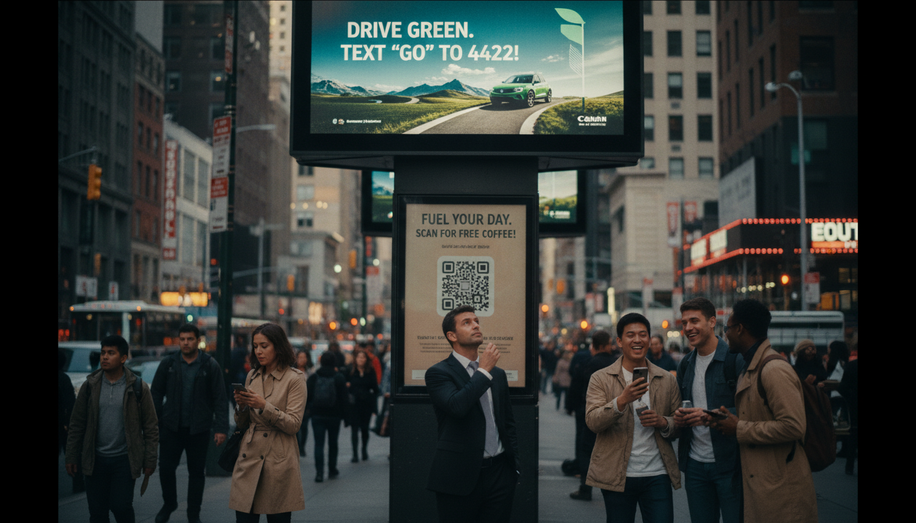

In the fleeting seconds a driver glances at a billboard or a pedestrian pauses before a digital screen, a well-crafted call-to-action (CTA) can transform passive exposure into immediate engagement. Out-of-home (OOH) advertising thrives on this urgency, where clear directives like scanning a QR code or texting a keyword bridge the gap between visibility and conversion, driving measurable results for brands in fast food, retail, and beyond. Unlike digital banners with endless dwell time, OOH demands CTAs that are instantly legible, memorable, and tied to low-friction actions, ensuring consumers act before the moment passes.
The power of CTAs in OOH lies in their ability to funnel audiences toward specific behaviors, reducing confusion and amplifying recall. Research shows 55 percent of people feel highly engaged by billboards in the past month, yet without a directive, that engagement often dissipates into vague brand awareness. For promotions or impulse-driven categories like clothing and quick-service restaurants, CTAs excel by prompting direct response—whether redeeming a discount or visiting a store. Not every OOH ad requires one; awareness campaigns may prioritize memorability alone. But when the goal is conversion, a strong CTA acts as a guidepost, clarifying the next step amid the chaos of commutes and city streets.
QR codes stand out as a top choice for their touchless, seamless integration, especially post-pandemic. Placed on interactive billboards at bus stops or mall screens, they invite commuters to scan for exclusive content, contests, or purchases, delivering instant value without typing. In transportation hubs, a QR leads passengers to tailored landing pages with offers or newsletters, turning idle travel time into engagement. Simplicity is key: codes must be large, high-contrast, and pedestrian-friendly, avoiding high-speed highways where scanning proves impractical. When paired with promotions like “Scan for 20% Off,” QR CTAs not only boost traffic but provide trackable data on scans and redemptions.
Text-to-SMS CTAs offer another proven avenue, capitalizing on smartphones’ ubiquity for quick interactions. Instructions like “Text PIZZA to 12345 for 10% Off” work brilliantly on billboards along busy routes such as I-376, where drivers or riders can respond hands-free. This format collects valuable contact data for follow-up nurturing, ideal for restaurants or retailers seeking foot traffic or online sales. Effectiveness hinges on brevity: use short keywords, memorable shortcodes, and urgent incentives to ensure recall even an hour later, as with promo codes like “SAVE10.” Case studies from the Mobile Marketing Association highlight how SMS integration with digital OOH spikes engagement rates, proving its role in hybrid offline-online funnels.
Short links and social hashtags extend reach with minimal effort. A shortened URL—think bit.ly-style—allows instant access without scanning hassles, enabling marketers to track clicks and optimize campaigns in real time. For social amplification, directives like “Snap a Pic & Tag #BestCoffeePittsburgh” turn viewers into advocates, generating user content and extending campaign life. These shine in pedestrian zones or near attractions, fostering conversations that 48 percent of audiences carry online after OOH exposure. Email CTAs, though less common, prompt sign-ups for newsletters via simple scans or texts, building long-term lists.
Driving physical visits demands location-aware tactics, particularly in digital OOH (DOOH). Dynamic ads display the nearest store address based on geofencing, urging “Find Us Off the Next Exit” with radius-targeted precision. Tangible proofs like “Bring This Ad for 15% Off—This Week Only” function as scannable coupons, spurring immediate store traffic while allowing easy redemption tracking at checkout. Urgency—via countdowns, limited-time offers, or situational triggers like weather—amplifies these, making ads feel immediate and relevant.
Measurement cements CTA success, turning intuition into accountability. Unique promo codes or URLs reveal redemption rates; dedicated vanity numbers track calls; and sales teams query “How’d you hear about us?” to attribute visits. Social monitoring gauges hashtag volume, while QR and SMS analytics quantify scans and responses. For DOOH, platform dashboards log interactions, revealing peak performance times. Best practices emphasize action-oriented language—”Call Now,” “Text Today”—in bold, contrasting colors for 5-7 seconds of readability.
Ultimately, OOH CTAs succeed by respecting the medium’s constraints: brevity, visibility from afar, and alignment with consumer context. Tie them to emotional drivers—70 percent of decisions are impulsive—and integrate with social or mobile for amplification. Brands ignoring these risk ads that dazzle but deliver nothing. Those embracing clear, compelling CTAs, from QR scans to texted deals, not only prompt action but quantify it, proving OOH’s evolution from awareness to direct response powerhouse.