
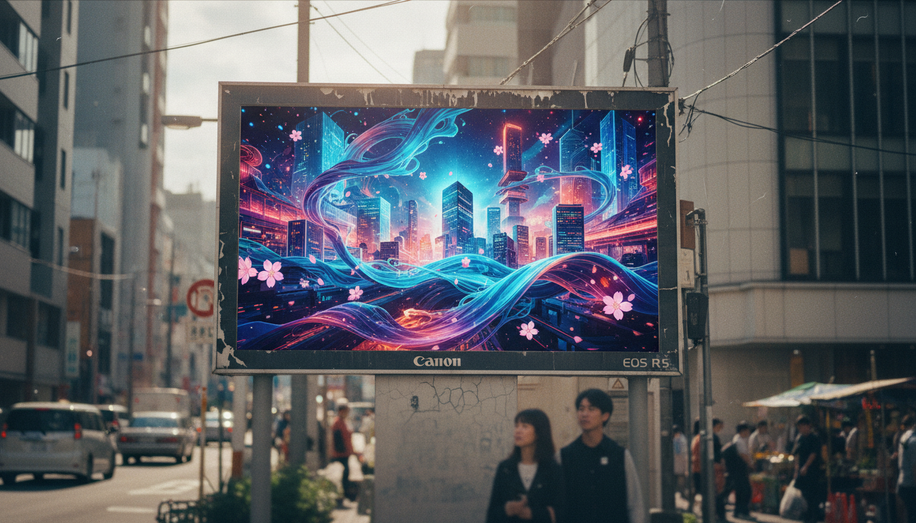

In the heart of Toronto’s Yonge-Dundas Square, a bustling urban crossroads once dominated by flashing advertisements, digital screens have been repurposed into vibrant canvases for public art, drawing crowds not for sales pitches but for cultural immersion. This transformation exemplifies a growing movement where out-of-home (OOH) digital billboards shed their commercial skin to become platforms for non-commercial artistic expression, turning city streets into dynamic galleries accessible to all.
Digital OOH technology, with its high-resolution LEDs and programmable displays, lends itself perfectly to this evolution. Screens spanning blocks, like the Viva Vision Canopy in Las Vegas’s Fremont Street—boasting nearly 50 million LEDs across five blocks—offer unprecedented scale for immersive visuals, complete with a 600,000-watt sound system that amplifies the experience. While often used for spectacles, such infrastructure has inspired cultural initiatives that prioritize art over commerce. In Denver, the Downtown Denver Partnership’s Night Lights Denver project projects light art onto digital billboards and buildings, creating ongoing outdoor installations that celebrate local creativity during evening hours.
Museums have pioneered this shift indoors, extending it to public-facing digital walls. At the Cleveland Museum of Art, a Christie MicroTiles video wall—two screens each 15 units wide by five tall—integrates interactivity via RFID-enabled iPads, allowing up to 16 visitors to engage with exhibits in real time. Similarly, the San Francisco Museum of Modern Art deploys Planar video walls, Clarity Matrix systems, and touch screens to showcase art information and events, blending education with visual excitement. These installations demonstrate how digital signage transcends messaging to foster interactive art encounters, a model now spilling into urban exteriors.
Public squares provide fertile ground for such experiments. Toronto’s Yonge-Dundas Square repurposed its ad-dominated screens for animated artworks, as noted by designer Marcos Terenzio of Shikatani Lacroix Design. “The art gave a cultural outlet and engaged people at a more significant emotional level,” he observed, proving that non-commercial content can captivate as effectively as ads while enriching the public realm. In Seoul’s Gangnam district, d’strict’s anamorphic media art at D’strict Shinsegae Duty Free Shop features a 3.5m x 6m x 1.5m LED screen displaying Korean-inspired illusions—floating three-dimensional objects that expand the display’s volume, evoking a sense of real-world emergence. Though housed in a commercial space, the content emphasizes cultural motifs over promotion, blurring lines between retail and public art.
Even billboards once synonymous with brands have hosted pure artistic interludes. Tokyo’s Shinjuku Station features a 155-square-foot curved 3D LED billboard that cycles through anime characters from Dragon Ball, One Piece, and Pokémon, alongside promotions for local festivals—offering glasses-free 3D effects visible in daylight and drawing tourists as a de facto art attraction. Nexen Tire’s Infinity LED Wall in Seoul, a 30-meter-wide by 7-meter-high display at the company’s headquarters, showcases dynamic visuals like cascading waterfalls and morphing tornadoes, commissioned as visual art rather than straightforward advertising.
Immersive exhibits further illustrate the potential. The Arte Museum by d’strict employs digital signage for “WAVE,” a public media art piece that uses large-scale projections to create undulating, sensory experiences. Van Gogh and Klimt immersive shows leverage OOH-scale screens for projected masterpieces, enveloping viewers in painterly worlds without commercial overlays. NASA’s 3D billboard outside the Kennedy Space Center, a 30-foot-high display with 6.1 million pixels per frame, delivers a six-minute anamorphic journey through space exploration—artistic storytelling funded by public interest rather than sales.
These examples signal a broader cultural pivot. Organizations like teravarna explore billboards as “creative public art,” integrating them into cityscapes to provoke curiosity and dialogue. Kitcast highlights how digital signage in public spaces, from Arte Museum’s illusions to WAVE’s fluidity, democratizes art by making it kinetic and communal. Challenges remain—scheduling amid ad revenue demands, technical glitches in weather-exposed setups like Coca-Cola’s robotic Times Square display—but successes abound.
As urban populations swell, digital OOH billboards stand poised to redefine public space. By prioritizing non-commercial content—cultural narratives, interactive exhibits, illusionary spectacles—they unleash artistic expression on a monumental scale, inviting passersby to pause, reflect, and connect. In cities worldwide, these glowing canvases prove that billboards need not sell; they can inspire.