
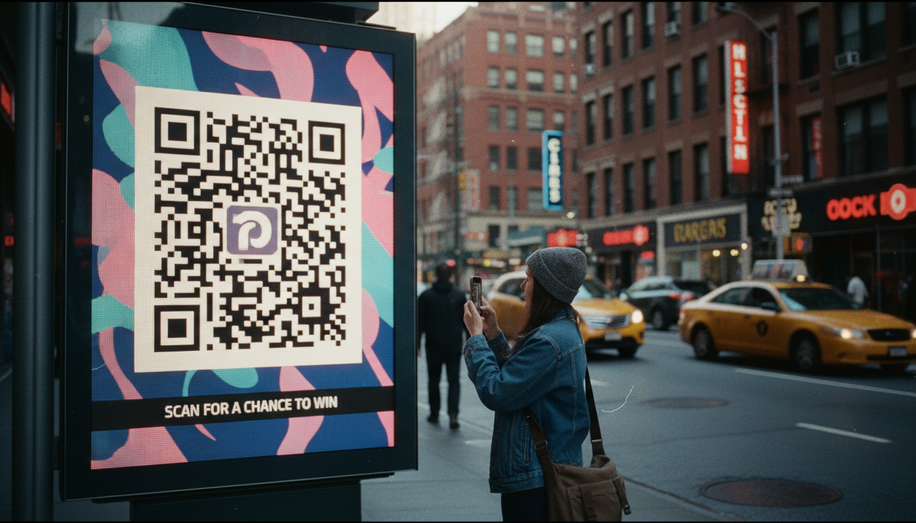

In the bustling streets of modern cities, where attention spans flicker like neon signs, out-of-home (OOH) advertising has evolved beyond elaborate games to embrace simpler, more immediate forms of interaction. QR codes, NFC taps, and straightforward calls to action are transforming static billboards into dynamic touchpoints that capture measurable engagement without the complexity of full gamification. These tools invite passersby to participate in seconds, bridging the gap between observation and action while delivering precise data on audience response.
Consider QR codes, those pixelated gateways that have become ubiquitous on OOH displays. Unlike gamified experiences that demand prolonged play, a QR scan requires just a smartphone camera and a moment’s curiosity. Brands leverage them to drive instant connections: scanning unlocks coupons, product videos, or social media shares, turning a fleeting glance into a trackable conversion. In one striking example, Pepsi Max converted London bus stops into portals of augmented reality, where QR prompts overlaid “unbelievable” scenarios onto the real streetscape, prompting scans that spiked social buzz and foot traffic. The simplicity shines— no apps needed, just a scan yielding immediate metrics like redemption rates and unique visits, often exceeding 10-20% engagement in high-traffic zones.
NFC technology takes this a step further, offering touchless proximity that feels almost magical. By embedding NFC chips in posters or digital screens, advertisers enable one-tap interactions: a phone hover reveals exclusive content, loyalty points, or event invites. This method excels in crowded environments like transit hubs, where fumbling for QR alignment might deter action. Women’s Aid demonstrated its power with an interactive billboard featuring a bruised face that faded upon approach, paired with NFC prompts urging viewers to “notice” domestic violence and access support resources. Passersby tapped en masse, generating thousands of engagements in days and amplifying the message through shared data on interaction frequency. NFC’s edge lies in its seamlessness—conversion rates can hit 30% higher than QR in proximity scenarios, as it eliminates visual targeting and leverages always-on smartphone capabilities.
Simple prompts, the unsung heroes of this shift, rely on bold text or visual cues to spur unmediated behavior: “Text YES to 12345 for 20% off” or “Snap this and tag #BrandMoment.” These calls to action demand zero tech barriers, relying instead on human impulse. Dogs Trust executed masterfully with plush puppies affixed to billboards; as people plucked them off, a stark anti-smuggling message emerged below, with prompts to text for adoption info. Within hours, all 750 puppies vanished, translating to 17,000 interactions and a surge in inquiries—proof that tactile simplicity outperforms digital dazzle. Similarly, British Airways’ real-time digital billboard featured a child pointing at overhead flights, with text prompts to text for booking details, syncing live data to boost immediate reservations.
What sets these tactics apart from gamification—think Monopoly-style citywide hunts or AR pose kiosks—is their restraint. Gamification, as seen in PLUS supermarkets’ real-life board game or HOKA’s immersive treadmill desert, crafts extended narratives that risk overwhelming transient audiences. Simple engagements, by contrast, prioritize frictionless entry: a 2-5 second commitment yielding 5-15% response rates, per industry benchmarks, versus gamification’s variable 2-8% completion drops due to complexity. Metrics flow directly—QR/NFC platforms track scans, texts log opt-ins, enabling attribution to sales lifts of up to 25% near retail points.
This precision fuels scalability. Programmatic DOOH platforms now trigger QR/NFC prompts contextually: Aperol activated spritz ads only above 66°F near bars, with scans spiking during “perfect” weather and driving measurable bar visits. Rain-X synced rain-triggered displays with NFC product locators beside retailers, converting weather whims into foot traffic. Even non-digital prompts shine; Coca-Cola’s “hug for happiness” vending machines, though experiential, echoed simple CTA logic by rewarding quick actions with shares, amassing millions without app downloads.
Critically, these methods democratize interactivity for budget-conscious campaigns. Traditional billboards gain NFC stickers for pennies per unit, while digital screens rotate prompts dynamically. Challenges persist—urban clutter demands standout visuals, and privacy regs require clear opt-ins—but ROI data is compelling: simple CTAs often double digital ad recall, with 40% of scanners reporting purchases. Agencies report 2026 trends leaning heavily here, as brands like Netflix test tweet-prompted interactions evolving into NFC evolutions.
Ultimately, interactive OOH thrives on invitation, not immersion. By distilling engagement to QR scans, NFC taps, and direct prompts, advertisers forge genuine, quantifiable bonds with audiences on the move. In an era of ad fatigue, this understated power—immediate, inclusive, and insightful—redefines what it means to stop someone in their tracks. This shift towards immediate, measurable interactions marks a critical evolution in OOH, where proving tangible impact is paramount. Platforms like Blindspot are essential partners, providing the real-time campaign performance tracking and robust ROI measurement needed to quantify every QR scan, NFC tap, and text prompt. By leveraging its programmatic DOOH capabilities and precise audience analytics, brands can strategically deploy these simple engagements, ensuring maximum impact and clear attribution of sales lifts and brand interactions in an increasingly data-driven landscape. Learn more at https://seeblindspot.com/