
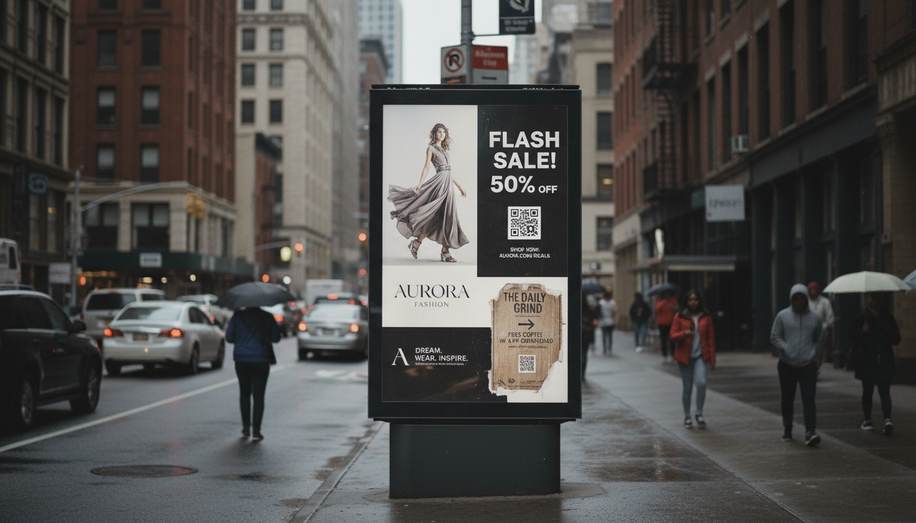

Out-of-home (OOH) advertising stands at a crossroads in modern marketing, where towering billboards and transit wraps serve dual masters: the patient architect of enduring brand loyalty and the urgent catalyst for snap consumer decisions. Campaigns crafted for brand building prioritize mass reach and emotional resonance, embedding a logo or tagline into the cultural fabric through repeated, unmissable exposures, while those tuned for direct response laser-focus on immediate action, deploying QR codes and promo codes to convert passersby into customers on the spot. This strategic fork demands advertisers calibrate every element—from creative design to placement and measurement—to align with the chosen goal, lest a mismatched approach squander budgets on fleeting impressions or ignored urgings.
For brand-building efforts, OOH excels as a top-of-funnel powerhouse, leveraging its unparalleled scale to forge awareness and affinity. With low cost-per-thousand impressions, these campaigns blanket urban landscapes, highways, and transit hubs, delivering frequency—often five to seven exposures over four weeks—to etch brand equity into memory. Nielsen data underscores the potency: simple, high-contrast visuals boost recall by up to 38%, while consistent logos, colors, and typography across exposures compound impact, turning one-off sightings into subconscious familiarity. Spotify’s subway takeovers, for instance, spiked web traffic by 24% in targeted markets, not through sales pitches but by dominating sightlines and sparking organic buzz. Similarly, HBO’s #ForTheThrone blitz across 280 locations ignited 80,000 social posts, amplifying reach via user-generated content without demanding direct clicks. Here, success hinges on visual simplicity—seven words or fewer, bold imagery—and contextual placement: roadside billboards for drivers needing split-second impact, or subway ads for dwell-time audiences absorbing nuanced narratives. Digital OOH elevates this further, with motion graphics and real-time triggers like weather-based messaging lifting engagement 15-25% over static formats.
Contrast this with direct-response OOH, engineered for bottom-funnel conversion where every glance counts toward a transaction. These campaigns swap subtlety for specificity, embedding scannable QR codes, custom hashtags, and promo codes that bridge physical exposure to digital or in-store action. Coca-Cola’s #ShareACoke billboards, pairing evocative imagery with social prompts, generated 500,000 posts and measurable lifts in purchase intent. Pepsi’s AR-enhanced displays transformed static views into interactive games via mobile apps, extending dwell time from three seconds to over two minutes and fueling conversions. Measurement sharpens the edge: lift studies pit exposed markets against controls, mobile tracking traces device paths to stores, and OOH-specific codes quantify redemptions. Geofencing extends the net, retargeting nearby devices with mobile ads for 3.9 times higher conversion rates, while sequential messaging across channels—OOH to social to email—yields 2.8 times the purchase intent of siloed efforts. Placement pivots to high-intent zones: gas pumps for impulse buys, transit stops for captive commuters with phones at the ready.
Yet the chasm between these paradigms narrows through integration, as savvy brands blend objectives for hybrid impact. Brand builders increasingly weave direct-response tools—QR codes on awareness billboards—to track halo effects, while response campaigns reinforce with consistent branding for recall. Hearst Bay Area notes OOH’s amplification power: it quadruples social activations on platforms like Instagram, turning physical reach into digital multipliers. Tesco’s Ramadan billboards, contextually tailored to Muslim-heavy areas with time-of-day messaging, surged social mentions 275%, blending equity growth with engagement spikes. Objectives dictate the mix: awareness goals favor broad, frequency-driven buys; response targets audience movement patterns via programmatic OOH, dynamically reallocating budgets to top performers for 30-50% efficiency gains.
Creative execution diverges sharply. Brand campaigns embrace bold contrasts—yellow on black for distance visibility—and frame-breaking extensions that hike attention 40%, per Outdoor Advertising Association findings, prioritizing intrigue over instruction. Direct-response creatives, by contrast, demand clarity: unmistakable calls-to-action amid the chaos of motion, often with cross-promotions linking to apps or landing pages. Both thrive on data-led targeting—audience insights shape locations, from driver-heavy roads to pedestrian flows—but brand efforts cast wide for reinforcement, while response zeros in on purchase paths.
Ultimately, OOH’s versatility shines in its adaptability, rewarding planners who set crystalline goals upfront. Misalign creative with intent, and a brand-builder fizzles into obscurity or a response ad overwhelms with unheeded pleas. Done right, OOH doesn’t just advertise; it orchestrates behavior at scale, whether nurturing lifelong loyalty or igniting today’s sale. As programmatic tools and AR blur lines further, the medium’s evolution promises even sharper tools for both horizons, demanding marketers master the nuance to claim competitive ground.