
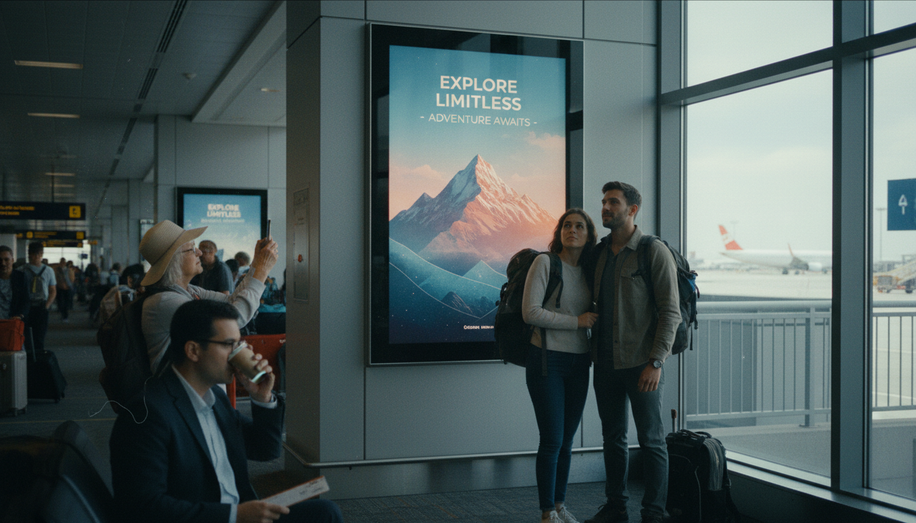

In the bustling corridors of major airports, where hurried travelers navigate gates, lounges, baggage claim, and security checkpoints, out-of-home (OOH) advertising has emerged as a precision tool for brands targeting high-value passenger segments. Recent Nielsen studies commissioned by Clear Channel Outdoor reveal that 83% of frequent flyers notice airport ads, with three-quarters associating them with premium brands, underscoring the medium’s ability to cut through the chaos and influence affluent, mobile audiences. As air travel surges toward record volumes in 2025 and beyond, advertisers are increasingly leveraging these strategic touchpoints to drive awareness, engagement, and action among business elites, luxury seekers, and impulse buyers.
Gates represent a prime opportunity to capture passengers in a state of anticipation, often with 30 to 60 minutes of dwell time before boarding. Here, frequent flyers—87% of whom plan three or more business trips annually—are highly receptive, with 56% recalling ads and nearly half taking subsequent actions like visiting websites or downloading apps. For business decision-makers, who are twice as likely to influence AI investments, digital OOH displays featuring QR codes or interactive elements can prompt immediate scans—45% of those acting post-exposure did so in the latest study, up 6% from 2022. A luxury watch brand, for instance, might deploy dynamic screens at international gates targeting high-income executives, syncing messaging with flight delays to extend visibility and boost 61% website visits among responders.
Airport lounges offer an even more intimate setting for premium segmentation, where affluent travelers—whose household incomes exceed national averages—linger for comfort and exclusivity. These spaces attract loyalty program members and C-suite professionals open to upscale experiences; 79% of frequent flyers express interest in trying new products on-site, and 63% in joining travel rewards programs. OOH here thrives on subtlety: elegant digital walls or branded activations, like selfie stations appealing to 47% of patrons, foster memorability without intrusion. A high-end spirits advertiser could position immersive projections in lounges frequented by international business class passengers, capitalizing on the relaxed mindset to elevate brand prestige—82% of exposed flyers actively read such ads, per recent data.
At baggage claim, the post-flight decompression zone transforms waiting passengers into opportunistic consumers, with dwell times averaging 15-20 minutes amid high foot traffic. This touchpoint excels for targeting arrivals—leisure tourists planning vacations or weary business travelers eyeing conveniences—with 57% overall taking action after ad exposure, including 61% visiting promoted locations. Nielsen findings show airport media influences future travel decisions, making it ideal for tourism boards or retail chains to place vivid reclamations urging hotel bookings or store visits via scannable codes. For segments like families or mid-tier professionals, bold visuals amid the carousel spin can trigger impulse responses, as 85% of flyers report non-food purchases influenced by airport stimuli in broader surveys.
Security checkpoints, though fleeting, pack outsized impact during the tense pre-screening queue, where passengers fixate on distractions. With average dwell exceeding an hour airport-wide, this high-attention bottleneck suits quick-hit messaging for broad segments, from economy leisure flyers to premium rushers. Digital OOH here drives 36% social media visits and 53% website traffic among actors, amplified by proximity to mobile devices—frequent flyers are primed for tech-forward calls-to-action. Airlines or fintech brands targeting millennials and Gen Z might flash personalized offers via data-informed displays, exploiting the 61% recall rate to convert stress into engagement.
Strategically placing OOH across these touchpoints allows advertisers to layer campaigns for maximum ROI, blending impressions (tracked via digital analytics) with engagement metrics like QR scans and brand lift surveys. Airport environments yield superior results over traditional media; Arbitron data even shows increased purchase likelihood among hesitant consumers. For business frequent flyers, gates and lounges prioritize decision-driving narratives, while baggage and security snag leisure spenders—57% action rates affirm the funnel-spanning power.
Yet success demands nuance: contextual relevance trumps volume, as lounges favor aspirational storytelling and checkpoints demand brevity. With 65% of flyers linking airport ads to quality buys, brands must integrate AR filters or geo-fenced digital extensions to extend reach beyond terminals. As airports evolve into commercial ecosystems amid 2025’s travel boom, OOH at these junctures not only boosts recall—61% in the Nielsen update—but converts captive audiences into loyalists, proving its worth in an era of fragmented attention. For advertisers eyeing jet-setters, the airport isn’t just a transit hub; it’s a high-intent arena where placement precision turns passersby into patrons.