
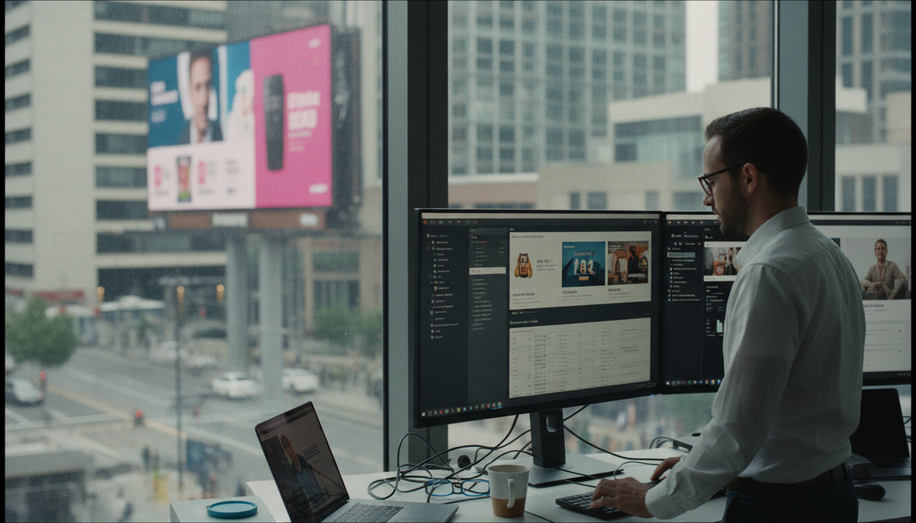

In the fast-paced world of digital out-of-home (DOOH) advertising, where screens beam dynamic messages to millions across urban landscapes, mastering content delivery hinges on robust content management systems (CMS). These platforms enable advertisers to schedule, deploy, and orchestrate content across vast networks of displays, from Times Square billboards to transit hubs worldwide. As DOOH networks expand, selecting the right CMS becomes critical for ensuring messages resonate in real time while navigating scalability hurdles.
Core dna stands out as an enterprise-grade CMS tailored for stretched marketing teams managing complex DOOH deployments. Its consolidated architecture unifies content management, eCommerce, and custom workflows within a single system, supporting flexible entities and a vast API database ideal for integrating live data feeds like weather or traffic into screen content. This hybrid platform blends headless capabilities with templating, allowing DOOH operators to push personalized ads dynamically across thousands of screens. Benefits include GDPR compliance and enterprise security protocols, which safeguard sensitive campaign data amid regulatory scrutiny. However, its high customization demands skilled setup, posing challenges for smaller networks lacking dedicated developers.
For DOOH’s multi-channel demands, headless CMS like Contentful excel by decoupling content from presentation, enabling seamless delivery to diverse screens via APIs and SDKs. Developers prize its flexibility for building front-end agnostic solutions, perfect for syncing content across mobile apps, web dashboards, and physical displays. Key benefits encompass API security, custom roles, and permissions, ensuring controlled access in large teams coordinating global campaigns. In practice, this means real-time updates—such as swapping ad creatives based on audience demographics—without downtime. Challenges arise in frontend development; teams must pair it with robust delivery networks, and security customizations require ongoing tweaks to meet evolving DOOH standards.
Kontent.ai prioritizes scaling content operations, a boon for expansive DOOH networks juggling localized messaging. Its platform governs workflows securely, enabling tailored content models that adapt to regional languages or time zones. Advertisers benefit from advanced governance tools that streamline approvals, reducing errors in high-stakes environments like retail DOOH. Customization shines for global brands, but the learning curve can slow initial rollout, particularly when integrating with legacy screen hardware.
Sitecore, a veteran in enterprise CMS, powers sophisticated DOOH with digital experience prowess, including advanced access controls and modular integrations. It facilitates comprehensive personalization, such as audience-triggered content on smart city screens, backed by regular security updates. Benefits include playing well with external systems for data-driven campaigns, yet its steep learning curve often necessitates certified developers, inflating costs and timelines for mid-sized operators.
Sanity.io brings real-time collaboration to the fore, treating content as structured data for effortless DOOH management. Granular access controls and audit logs ensure accountability across distributed teams, while dynamic APIs support live edits visible instantly on networks. This proves invaluable for time-sensitive promotions, like event tie-ins. Drawbacks include dependency on developer expertise for custom schemas, potentially complicating non-technical content teams.
HubSpot CMS integrates content with marketing automation, offering 24/7 monitoring, firewall protection, and a global CDN suited for DOOH’s edge computing needs. Built-in tools simplify landing pages and emails that complement screen campaigns, with drag-and-drop interfaces empowering marketers. Benefits extend to performance tracking, optimizing ad rotations for engagement. Challenges lie in its focus on web-centric experiences, requiring extensions for pure DOOH scalability.
Emerging players like Hygraph leverage GraphQL for content federation, granting independence in hosting and global access via 190 Edge CDN nodes—crucial for low-latency DOOH delivery. Brands such as Samsung use it for robust integrations with AI and eCommerce, enabling hyper-localized ads. Magnolia, favored by enterprises like American Express, manages multiple sites effortlessly, supporting self-hosting or cloud options with integrations like Salesforce. Its prowess in multi-site oversight aids DOOH portfolios spanning venues. Yet, pricing—starting at $3,000 monthly for full features—challenges budgets, and self-hosting demands IT overhead.
Optimizely, a digital experience platform, embeds CMS with personalization tools, powering over a million sites including Alaska Airlines. It excels in A/B testing for DOOH creatives, but enterprise pricing requires sales demos. Acquia, built on Drupal, offers scalability and REST APIs for quick integrations, ideal for open-source enthusiasts seeking headless flexibility.
Across these platforms, common benefits include API-driven dynamism for real-time DOOH updates and security features mitigating cyber risks in public networks. Customization empowers tailored workflows, from geo-fencing to programmatic ad buys. Yet challenges persist: steep learning curves in Sitecore and Core dna demand developer investment; headless models like Contentful require frontend pairings; and costs escalate for enterprise scales, with open-source alternatives like Drupal offering control but high maintenance.
For DOOH networks, hybrid or headless CMS prevail, balancing marketer agility with developer power. Core dna leads for security-focused customization, while Contentful and Sitecore dominate digital versatility. Success demands assessing network size, team expertise, and integration needs—piloting platforms to match the unyielding rhythm of out-of-home screens. As DOOH evolves toward AI-orchestrated experiences, CMS that federate content across edges will define mastery of the message. However, true mastery extends beyond content orchestration; it demands tangible proof of impact and continuous optimization. This is where platforms like Blindspot become indispensable, offering real-time campaign performance tracking, audience measurement, and ROI attribution to ensure AI-driven content not only resonates but delivers measurable business outcomes across every screen. Discover more at https://seeblindspot.com/