
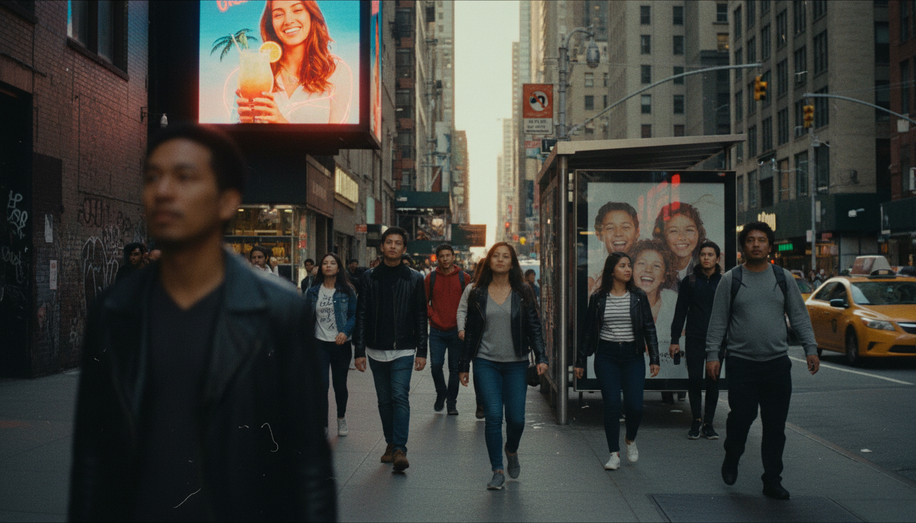

In the fleeting world of out-of-home (OOH) advertising, where a billboard or digital screen has mere seconds to seize a driver’s glance or a pedestrian’s gaze, color emerges as a silent powerhouse. Far beyond mere aesthetics, the psychology of color in OOH creative wields profound influence, shaping emotions, amplifying brand recognition, and commanding attention amid urban chaos. Strategic palettes don’t just decorate; they infiltrate the subconscious, triggering responses that linger long after the ad fades into the rearview mirror.
At its core, color psychology examines how hues interact with the human brain to evoke moods and drive behavior, a principle amplified in OOH’s high-stakes environment. Red, for instance, pulses with urgency and excitement, its bold wavelength making it the first hue the eye detects from afar—ideal for promotions or calls to action. Coca-Cola’s iconic campaigns harness this fire, draping digital out-of-home (DOOH) screens in vibrant crimson to stir passion and celebration, boosting immediate engagement as viewers feel an instinctive pull toward action. Studies underscore this potency: colors can elevate brand recognition by up to 80%, turning a split-second sighting into lasting recall.
Contrast blue, the anchor of trust and serenity. In OOH designs, it conveys reliability and calm professionalism, perfect for financial services or healthcare brands seeking to reassure hurried audiences. Banks and tech firms favor its cool tones, which stand resilient against glaring sunlight, ensuring readability without overwhelming the senses. Pairing blue with white—symbolizing purity and clarity—creates a palette of openness, as seen in minimalist transit ads that cut through visual noise, fostering subconscious loyalty. Yet cultural nuances matter: while Western viewers link white to simplicity, some Eastern contexts associate it with mourning, demanding tailored adaptations for global OOH rollouts.
Yellow bursts onto the scene as an optimism engine, its high-visibility cheer grabbing attention and evoking friendliness. This sunny hue excels in family-oriented or seasonal campaigns, like summer billboards promoting festivals, where it combats glare and infuses energy without red’s aggression. Research highlights its edge: vibrant yellows can spike engagement by 80%, making brands feel approachable and fun amid monotonous commutes. Green, meanwhile, whispers growth, health, and harmony, aligning seamlessly with eco-brands or wellness products. Its natural associations refresh outdoor retail signage, drawing eyes to organic foods or sustainable initiatives, while high contrast ensures it pops against verdant backdrops or hazy skies.
The magic intensifies through combinations, where palettes harmonize to maximize impact. High-contrast duos like red-on-white scream urgency for clearance sales, enhancing readability at highway speeds. Cool blue-green mixes soothe luxury apparel ads, evoking elegance and balance, while yellow accents inject playfulness into foodservice promotions. In DOOH, dynamic shifts—red fading to green for a “sale to sustainability” narrative—leverage video wall tech for layered emotional journeys, strengthening brand ties. Summer conditions sharpen these choices: intense sunlight demands saturated, bold hues to pierce glare, while neutrals like gray or black add sophistication without fading into the heat haze.
Brand recognition thrives on consistency, where signature colors forge neural shortcuts. Viewers spotting Tiffany’s robin-egg blue or Starbucks’ verdant siren don’t just see an ad—they feel the brand’s essence, a phenomenon rooted in repeated exposure. This subconscious imprint boosts recall by 85% in some studies, as colors encode memories faster than text or imagery alone. Yet pitfalls lurk: overuse risks fatigue, and poor contrast—say, yellow on white—renders messages invisible, squandering prime real estate.
OOH creators must also navigate environmental interplay. Billboards battling sun-drenched horizons favor warm primaries for pop, while urban nightscapes embrace neons for glow. Digital advancements like programmable DOOH allow real-time tweaks, swapping palettes for weather or events to sustain relevance. Precision in selection, informed by audience demographics and cultural lenses, transforms static visuals into emotional magnets.
Ultimately, mastering color psychology elevates OOH from backdrop clutter to memory-makers. By evoking joy with yellow-green blends, urgency via red thrusts, or trust through blue anchors, designers craft campaigns that not only capture eyes but hearts—and wallets. In this vivid arena, the right palette doesn’t whisper; it commands the street.