
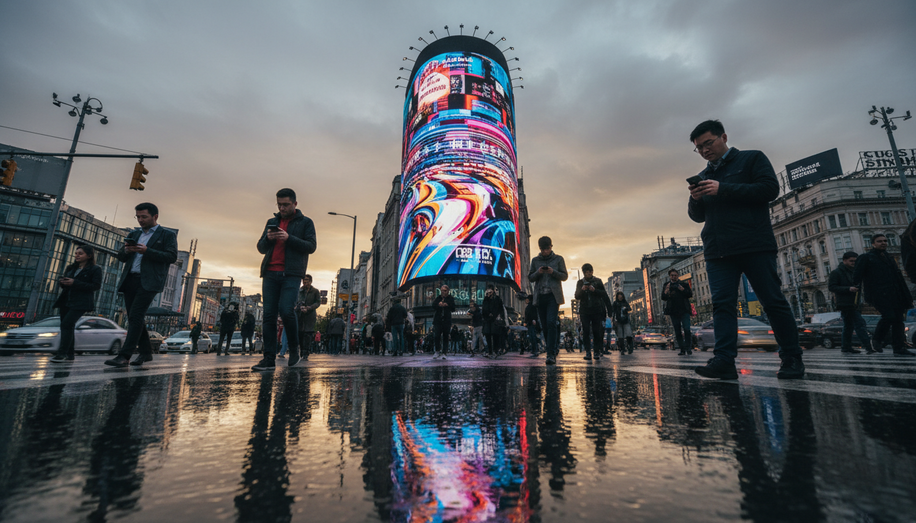

Out-of-home advertising has emerged as a critical anchor in modern multi-channel marketing strategies, delivering measurable impact that extends far beyond traditional brand awareness metrics. Recent research demonstrates that OOH doesn’t simply complement digital and broadcast channels—it fundamentally amplifies their effectiveness while addressing gaps that other media cannot fill.
The integration of OOH with a broader media mix has become increasingly important as marketers navigate a fragmented landscape. A five-year collaboration between Clear Channel Outdoor and Kantar revealed compelling evidence of OOH’s additive nature in balanced marketing strategies. The research analyzed thousands of measurement studies across diverse advertising categories and found that OOH consistently outperforms digital media in critical brand metrics. Most notably, OOH delivers a significant 13.3% increase in ad awareness compared to digital media, television, and connected TV, demonstrating its unique ability to capture and retain consumer attention.
The cost-effectiveness of OOH adds another layer of appeal for budget-conscious marketers. Out-of-home advertising offers some of the lowest cost-per-thousand-impressions rates among traditional media channels, making it an efficient way to extend campaigns beyond expensive broadcast television buys. For brands leveraging cable or linear TV, OOH serves as an ideal complement that maintains message consistency while reducing overall media spending. Nielsen research supports this efficiency advantage, showing that OOH delivers four times more online activity per dollar spent compared to television, radio, and print.
What truly distinguishes OOH in multichannel strategies is its ability to bridge physical and digital consumer touchpoints. When combined with digital advertising, brands can elevate overall campaign effectiveness by 31 percent while increasing reach by 68 percent. This synergy proves particularly powerful when social media integration enters the equation. Out-of-home and social media form a natural pairing that boosts consumer engagement and generates shareable moments extending campaign impact across platforms. The combination allows brands to follow consumers along their daily journeys, creating consistent messaging that travels from physical spaces into digital conversations.
The mechanics of this effectiveness lie in OOH’s unique positioning in the consumer decision-making funnel. Unlike digital ads that often deliver fleeting impressions, out-of-home builds brand consciousness through repeated exposure and frequency. Consumers may encounter the same OOH creative multiple times during their daily commutes or travels, creating a cumulative effect that builds subconscious brand affinity. This extended engagement window means conversions may occur days or weeks after the initial impression, reflecting genuine influence on purchasing behavior rather than immediate impulse reactions. Research indicates that 68 percent of consumers report making purchases after seeing a billboard, particularly when clear digital calls-to-action bridge OOH and online channels.
Digital out-of-home (DOOH) further enhances these capabilities by delivering up to 60 percent more impressions than static ads through dynamic content rotation. DOOH advertising generates 54 percent higher gains in ad recall compared to benchmarks across all media types, making it an increasingly attractive option for forward-thinking marketers.
The research also reveals that OOH matches linear television in driving brand favorability and purchase intent while delivering TV-like impact at more efficient price points. This is particularly valuable given that 75 percent of linear TV impressions reach only 25 percent of U.S. households. Out-of-home fills this critical gap by capturing the attention of consumers who have cut the cord or shifted toward streaming services, ensuring brands maintain visibility across audiences that traditional TV can no longer efficiently reach.
For marketers facing economic uncertainty and continued media fragmentation, the evidence increasingly points toward OOH as an essential rather than optional component of integrated campaigns. Modern marketing success emerges not from selecting a single dominant channel but from strategically blending multiple touchpoints into a unified brand experience. Out-of-home advertising provides the physical anchor that grounds digital strategies in real-world consumer behavior while extending the reach and efficiency of expensive broadcast buys. In an environment where audience attention remains fragmented and measurement remains challenging, OOH delivers both immediate conversion lift and long-term brand building—making it an indispensable element of any contemporary marketing strategy.
To truly harness OOH’s potential as a strategic anchor in today’s fragmented landscape, marketers require sophisticated tools for precise execution and measurable impact. Platforms like Blindspot empower brands to leverage audience measurement and location intelligence for optimal site selection, even managing dynamic programmatic DOOH campaigns for maximum reach. This enables real-time performance tracking and robust ROI measurement, transforming OOH into a data-driven powerhouse within any integrated marketing strategy.
https://seeblindspot.com/