
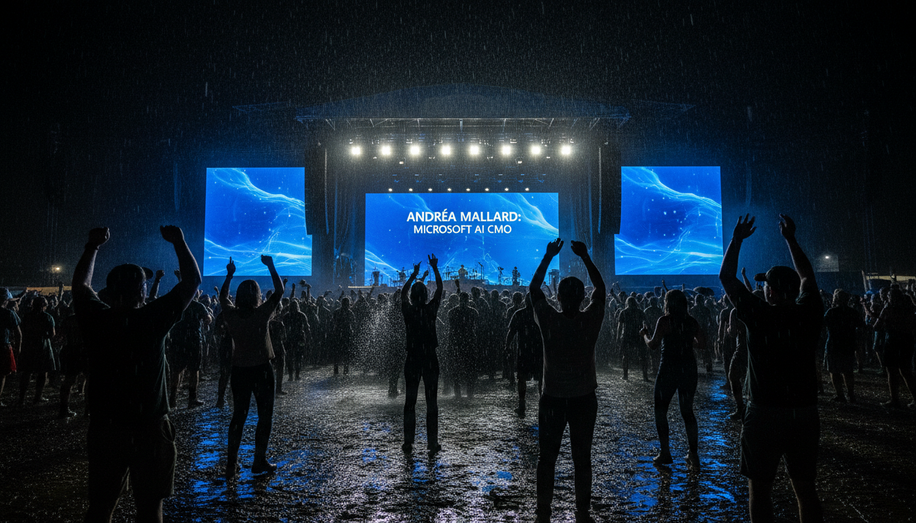

Microsoft AI has appointed Andréa Mallard, the former global chief marketing officer at Pinterest, as its new CMO, signaling the tech giant’s aggressive push to humanize and market its sprawling artificial intelligence portfolio. Mallard, who departed Pinterest in January after seven years, announced the move in a LinkedIn post just under two weeks ago, framing AI as “the most consequential technological shift of my lifetime” that will profoundly influence future generations.
In her post, Mallard expressed enthusiasm for joining a team of “profoundly thoughtful leaders” including CEO Mustafa Suleyman—DeepMind co-founder and head of the Microsoft AI division established in 2024—Yusuf Mehdi, Jacob Andreou, and others. She quoted Suleyman’s recent remarks at a global team meeting: “AI must work in service of people. Not the other way around. Ever.” This philosophy, she noted, echoes throughout the organization and underscores her mission to build technology that “earns the trust needed to serve human potential.” Mallard also hinted at upcoming expansions to the Microsoft AI marketing team, inviting professionals passionate about human-centered AI to connect.
The hire comes at a pivotal moment for Microsoft AI, known internally as MAI, which unveiled refreshed branding and a dedicated website in late 2025 to spotlight its consumer-facing products. These include the LLM companion Copilot, AI-enhanced search engine Bing, Edge browser, and communication platform GroupMe, all integrated with generative AI capabilities. Microsoft’s broader AI strategy has involved billions in investments in OpenAI, embedding its models across Co-Pilot, Bing, Azure cloud computing, and more, as the company races to dominate a fiercely competitive landscape.
For out-of-home (OOH) advertisers, Mallard’s appointment holds particular intrigue. Microsoft AI is advancing AI-driven tools tailored for the advertising sector, including Performance Max campaigns with customer-acquisition features, expanded automation for responsive search ads, and share-of-voice metrics that aggregate impression data from search and shopping. Early testers have reported 5% improvements in click-through rates from automated asset creation, alongside greater transparency in impression share lost to budget or rank—metrics that stretch back to November 2024. These innovations could extend to OOH by powering dynamic, real-time optimizations for digital billboards and transit displays, where AI analyzes foot traffic, weather, and audience data to swap creatives instantly. As Mallard steps in, her track record in scaling brands for mass appeal positions her to bridge these technical advancements with compelling narratives that resonate in high-impact outdoor environments.
Mallard’s Pinterest tenure offers a blueprint for such transformation. As global CMO, she built the company’s marketing function from the ground up, guiding it through its 2019 IPO and the COVID-19 disruptions. She repositioned Pinterest as an inspiration-driven haven amid doom-scrolling social feeds, launching initiatives like the annual Pinterest Predicts trends report and the advertiser-focused Pinterest Presents showcase. These moves boosted cultural relevance with Gen Z, expanded advertiser interest, and grew monthly active users to 600 million. Her role later expanded to external communications, earning her ADWEEK Brand Genius recognition. Prior stops include CMO at Athleta (a Gap brand) and Omada Health, plus leadership at IDEO and Rodale, alongside current board seats at Kajabi, TwentyFirstCenturyBrand, and Hydrow.
Pinterest moved swiftly to fill the void, naming Claudine Cheever—formerly Amazon’s VP of global brand and marketing—as its new CMO. Mallard’s exit reflects a broader talent scramble in AI, where firms are poaching senior marketers to demystify complex tech for consumers. Nvidia, for instance, recently tapped Google veteran Alison Wagonfeld as its first CMO. Microsoft AI’s emphasis on “Humanistic Superintelligence (HSI),” a 2025 concept championed by Suleyman, further aligns with this trend—positioning AI as a human-augmenting tool rather than a replacement.
For OOH specialists, Mallard’s arrival amplifies opportunities in Microsoft’s ecosystem. Her Pinterest success in visual, discovery-based marketing mirrors the medium’s strength in capturing attention during movement—think commuters glancing at bus wraps or drivers eyeing highway spectaculars. With AI tools now automating ad personalization at scale, OOH campaigns could leverage Copilot-like intelligence for hyper-localized content, predicting trends via Pinterest Predicts-style insights fused with real-time Bing data. Mallard’s focus on trust and responsibility could inspire ethical guidelines for AI in outdoor advertising, ensuring transparency in data usage and algorithmic decisions that power DOOH networks.
As Microsoft AI intensifies its consumer outreach, Mallard’s mandate will likely emphasize storytelling that makes AI accessible and aspirational. Her LinkedIn call to action for marketing talent suggests rapid scaling ahead, potentially unlocking new partnerships for OOH players to integrate AI-optimized creatives into Microsoft’s advertising fabric. In an era where AI reshapes media buying, her leadership could redefine how outdoor inventory commands premium value through intelligent, trust-building campaigns.
In this evolving landscape, platforms like Blindspot become critical enablers for Microsoft’s AI-driven OOH vision. By providing programmatic DOOH campaign management, real-time performance tracking, and granular ROI measurement, Blindspot empowers advertisers to leverage AI for dynamic content optimization while ensuring transparency and building the trust essential for human-centered campaigns that truly resonate. Learn more at https://seeblindspot.com/