
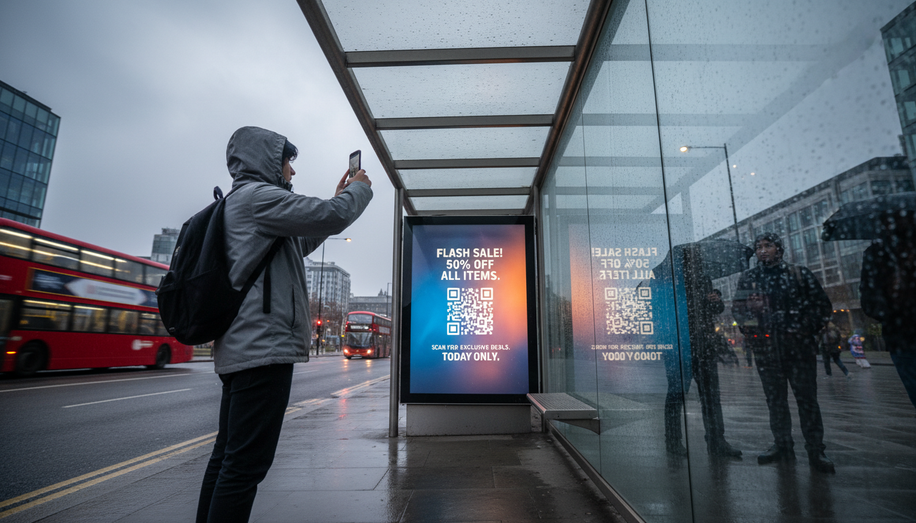

The retail landscape has fundamentally shifted. Shoppers no longer follow linear purchase paths, instead navigating a complex web of digital and physical touchpoints. In response, retail media and out-of-home advertising have begun forming a powerful symbiosis, creating opportunities for brands to intercept consumers at critical moments across their journey to purchase.
Retail media networks have traditionally dominated online spaces, placing ads directly on retailer websites and apps to capture shoppers already in a buying mindset. However, the industry has reached a saturation point. As spending on omnichannel retail media approaches $61.2 billion in 2025, with off-site retail media alone accounting for $41.82 billion, the conversation has shifted from whether to expand beyond owned digital properties to how quickly brands can execute that expansion. This expansion naturally extends into physical retail environments, where digital out-of-home advertising serves as a critical bridge between online campaigns and in-store conversions.
The integration of DOOH into retail media strategies addresses a fundamental marketing challenge: reaching consumers when they are most receptive. Unlike traditional billboard advertising, which requires lengthy negotiations and long-term commitments, programmatic DOOH enables real-time ad placement with the flexibility of digital buying. Brands can now purchase ad space dynamically, adjusting targeting and creative assets in minutes rather than months. This agility proves invaluable for retail media campaigns, where inventory turns quickly and promotional windows remain narrow.
The strategic value becomes apparent when examining how DOOH influences purchasing behavior within or near retail environments. A study conducted by Catalina and GSTV demonstrated this impact tangibly: a major ice cream brand’s DOOH campaign at gas station pumps drove a 17% sales lift in nearby grocery stores, generating a return on ad spend of $5.37, with nearly half of purchasers being new to the brand. This case exemplifies how DOOH functions not as an isolated tactic but as an amplifier for retail media investments, extending reach beyond the retailer’s digital properties into the physical world where conversion ultimately occurs.
The mechanics of this symbiosis rely on shared data infrastructure. Modern retail media networks leverage first-party retailer data—purchase history, loyalty program participation, and browsing behavior—to create precise audience targeting. This same data foundation powers DOOH campaigns, enabling location-based, behavior-driven messaging at strategic points along the customer journey. When a consumer sees a personalized offer on a transit shelter near their favorite grocery store, or encounters a dynamic in-store display reinforcing a digital campaign they viewed moments earlier, the retail media investment extends its influence into physical space.
Integration also enhances measurement capabilities across channels. Unified reporting frameworks now allow marketers to track customer movement from online ad exposure through in-store purchase, creating a complete full-funnel narrative. Footfall attribution technology connects digital touchpoints to physical store visits, demonstrating DOOH’s measurable contribution to retail objectives. This closed-loop measurement transforms out-of-home from a brand awareness channel into an accountable, performance-driven component of retail media strategies.
For retailers themselves, this integration opens substantial revenue opportunities. By combining in-store digital signage with their broader media networks, retailers can offer advertisers tiered omnichannel packages that bundle DOOH placements with email, social, and display advertising. This bundled approach simplifies media buying for brands while maximizing inventory monetization for retailers, creating more efficient market dynamics.
The convergence of retail media and DOOH reflects broader shifts in consumer behavior and marketing technology. Shoppers increasingly use ad-blockers and skip digital advertisements, yet they cannot avoid DOOH messages in transit hubs, retail environments, and public spaces. This unavoidable visibility, combined with precise targeting capabilities and real-time flexibility, positions DOOH as an essential counterbalance to the saturation of digital advertising channels.
As retail media continues its explosive growth trajectory, success will increasingly depend on seamless omnichannel execution. Brands that treat DOOH as integral to retail strategy rather than peripheral will capture shoppers across their complete journey—from initial awareness triggered by a dynamic billboard to final conversion at the shelf. In this evolved landscape, retail media and out-of-home advertising are no longer separate disciplines but complementary forces amplifying each other’s impact on consumer behavior and business results.